
A complete optical component RFQ helps the manufacturer understand the application, evaluate manufacturability and provide accurate pricing. Missing information may lead to repeated questions, unsuitable material or coating recommendations and delays during quotation.
Whether you are requesting optical windows, lenses, mirrors, prisms or filters, the RFQ should describe both the component and its intended operating conditions. However, specifications should not be tighter than the system actually requires, because unnecessary tolerances can increase cost and lead time.
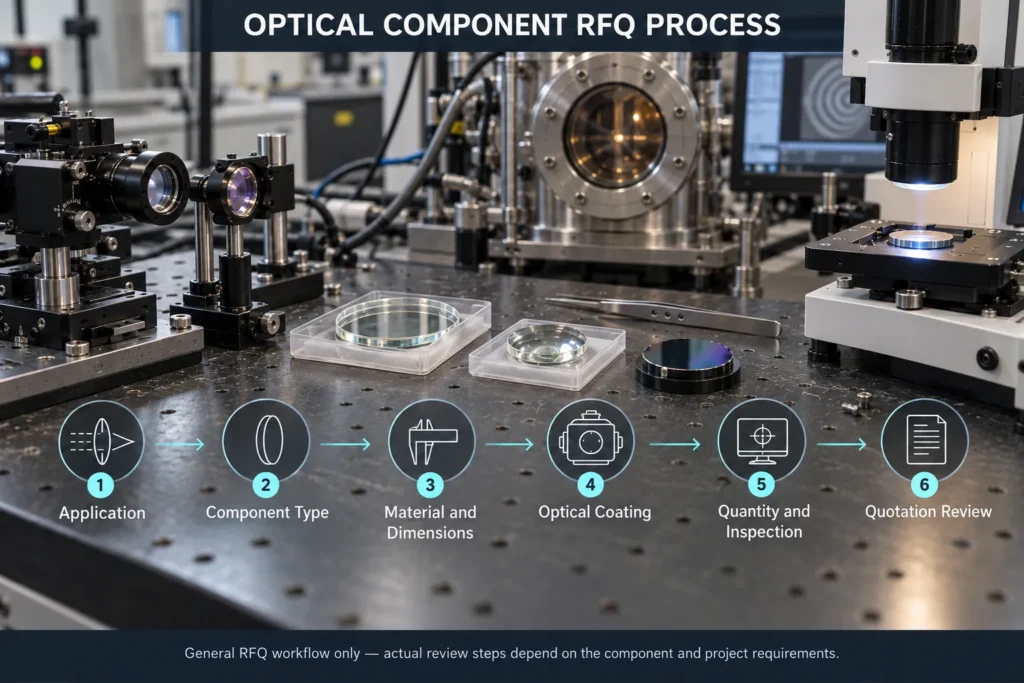
In This Guide
Quick Answer
An optical component RFQ should normally include:
- Component type and intended application
- Operating wavelength or wavelength range
- Drawing or dimensional sketch
- Optical material and grade
- Dimensions and mechanical tolerances
- Surface quality
- Surface flatness or figure
- Transmitted or reflected wavefront requirements
- Parallelism, wedge or centration
- Clear aperture
- Optical coating specification
- Operating environment
- Prototype and production quantities
- Required delivery date
- Inspection and documentation requirements
If you do not know the correct manufacturing tolerance, provide the optical or mechanical performance required by the system. The manufacturer can then recommend a practical specification.
1. Describe the Application
Begin the RFQ by explaining how the optical component will be used.
For example, identify whether the component is intended for:
- Imaging
- Laser beam delivery
- Sensor protection
- Thermal imaging
- Spectroscopy
- Beam steering
- Wavelength selection
- Industrial inspection
Application information helps the manufacturer understand which characteristics are most important. A protective window may prioritize transmission, strength and environmental durability. An imaging lens may require tighter control of surface figure, centration and transmitted wavefront.
It is also useful to describe where the optic will be installed, such as in a laboratory instrument, outdoor sensor, medical device, industrial laser or vacuum system.
2. Identify the Component Type and Optical Function
Clearly state whether you need an optical window, spherical lens, aspheric lens, mirror, prism, filter or another component.
The RFQ should also explain its optical function. For example:
- A window protects a sensor without changing optical power.
- A lens focuses or collimates light.
- A mirror redirects or focuses a beam.
- A prism changes beam direction or orientation.
- A filter transmits selected wavelengths and blocks others.
For lenses, state whether the optic will focus a collimated beam, collimate a point source or operate between finite conjugates. This information can affect lens shape, orientation and performance evaluation.
3. Provide the Operating Wavelength
The operating wavelength is essential for material and coating selection.
Use a specific value or measurable range, such as:
- 532 nm
- 1064 nm
- 400–700 nm
- 3–5 μm
- 8–12 μm
- 10.6 μm
Avoid descriptions such as “visible,” “infrared” or “laser coating” without a defined wavelength.
For laser applications, also provide the available information about:
- Continuous-wave or pulsed operation
- Average power
- Pulse energy
- Pulse duration
- Repetition rate
- Beam diameter
- Beam profile
- For CW lasers: optical power and irradiance at the optic
- For pulsed lasers: pulse energy, fluence and peak intensity
These parameters help determine whether material absorption, coating absorption or laser-induced damage may be important. State how the beam diameter is defined—such as 1/e² diameter for a Gaussian beam—because the calculated irradiance or fluence depends on the spot-size convention.
4. Attach a Drawing or Dimensional Sketch
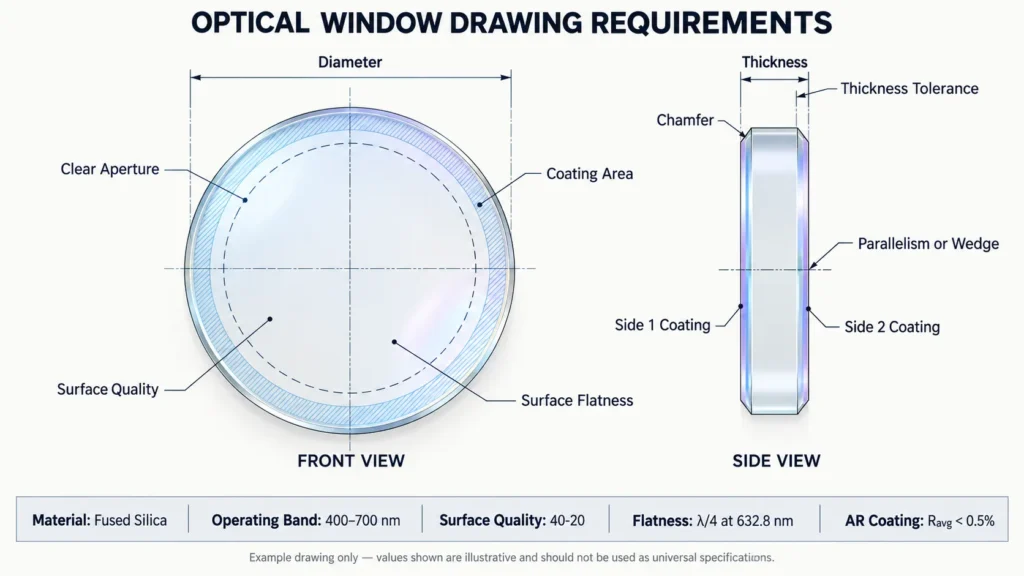
A dimensioned drawing is preferred because it reduces ambiguity. Include the drawing number and revision, units, applicable drawing standard, datum surfaces and general tolerances.
For circular windows and filters, the drawing may include:
- Diameter
- Center thickness
- Diameter tolerance
- Thickness tolerance
- Clear aperture
- Chamfer or bevel
- Edge finish
For rectangular components, specify the length, width, thickness, corner condition and relevant datum surfaces.
Lens drawings may also require:
- Radius of curvature
- Center thickness
- Edge thickness
- Effective focal length
- Back focal length
- Centration
- Orientation
Effective focal length and back focal length are different specifications. The drawing should state which value is required and the wavelength at which it applies.
If a finished drawing is not available, submit a clear sketch together with the functional requirements. A controlled drawing can be created or confirmed before production.
5. Specify the Optical Material
State the required material and grade whenever they have already been determined.
Common materials include:
- Optical glass
- Fused silica
- Sapphire
- Calcium fluoride
- Silicon
- Germanium
- Zinc selenide
- Zinc sulfide
Material grade can influence homogeneity, transmission, inclusions, absorption and cost. Do not assume that every grade of the same material provides identical optical performance.
When material selection is still open, provide the wavelength range, temperature, environmental exposure and required transmission. The manufacturer can then evaluate suitable options.
Optical Component RFQ Checklist
| RFQ Section | Information to Provide | Why It Matters |
|---|---|---|
| Application | Optical function and operating system | Identifies the most important performance requirements |
| Wavelength | Single wavelength or spectral band | Guides material and coating selection |
| Drawing | Dimensions, tolerances, shape and datums | Defines the part to be manufactured |
| Material | Material name and grade | Affects transmission, durability and processing |
| Optical quality | Surface quality, figure, wavefront and clear aperture | Controls imaging and beam performance |
| Coating | Band, AOI, polarization and R or T target | Defines finished spectral performance |
| Environment | Temperature, humidity, pressure and abrasion | Influences material and coating suitability |
| Commercial details | Quantity, delivery and repeat demand | Supports pricing and production planning |
| Documentation | Reports, certificates and test data | Defines the required quality records |
This checklist is intended for preliminary RFQ preparation. Final requirements should be confirmed using the applicable drawing and inspection method.
6. Define the Optical Specifications
Select optical requirements according to the component’s function.
Surface Quality
Surface quality describes defects such as scratches and digs. Common drawing values include 80-50, 60-40, 40-20 and 20-10.
Surface quality is not the same as surface roughness, flatness or transmitted wavefront. These specifications control different characteristics.
The RFQ should identify the surface-imperfection method and applicable standard. MIL-PRF-13830B uses visual scratch-dig comparison, while the ISO 10110-7 dimensional method controls defect area. ISO drawings may also use a visibility method—for example, 5/60-40 has the same meaning as a MIL-style 60-40 callout—so the method and standard should be stated explicitly.
Flatness or Surface Figure
Flatness is commonly specified for optical windows, mirrors and flats. Curved lenses usually require surface power and irregularity or another surface-figure specification.
When using values such as λ/2 or λ/4, state the test wavelength, clear aperture, measurement condition and whether the value is peak-to-valley or RMS. Clarify whether power is included or specified separately from irregularity.
Wavefront Performance
Transmitted wavefront error may be important for imaging windows, lenses and beam-delivery components. Mirrors may require reflected wavefront performance.
State whether the requirement is peak-to-valley or RMS and define the wavelength, measurement aperture, single-pass or double-pass configuration, and whether the optic is tested mounted or unmounted.
Parallelism, Wedge and Centration
Parallelism or wedge controls beam deviation through windows and filters. Lens centration controls the alignment between the optical and mechanical axes.
Use tolerances that match the actual system need. Extremely tight values can significantly increase manufacturing and inspection costs.
Clear Aperture
The clear aperture defines the area over which the stated optical specifications must be met. Specify it as a diameter, dimension or percentage of the full surface, and distinguish it from the coating aperture if they are different.
7. Describe the Optical Coating
“AR coated” is not a complete coating specification.
Include the following information where applicable:
- Wavelength or wavelength band
- Angle of incidence
- Polarization
- Required transmission or reflectance
- Average or minimum performance
- Number of coated surfaces
- Environmental durability
- Laser damage requirement
A measurable specification might state:
Ravg < 0.5% per surface from 450–650 nm at 0° AOI under the specified polarization condition
Here, Ravg means average reflectance across the stated band. If the requirement must be met at every wavelength, specify a maximum value such as Rmax instead. Average, minimum and absolute spectral requirements are not interchangeable.
Filters and mirrors used at an angle should always include the angle of incidence. If the two surfaces need different coatings, identify Side 1 and Side 2 clearly on the drawing.
8. Explain the Operating Environment
Environmental information helps the manufacturer evaluate material and coating durability.
Relevant conditions may include:
- Minimum and maximum temperature
- Thermal cycling
- Humidity
- Vacuum or pressure
- Outdoor exposure
- Abrasion
- Chemical exposure
- Cleaning method
- Shock and vibration
- Mounting or sealing method
A component with acceptable laboratory performance may not be suitable for an exposed outdoor or industrial environment.
9. Include Quantity, Delivery and Packaging
State the prototype quantity and expected production quantity separately.
For example:
- Prototype quantity: 5 pieces
- Initial production quantity: 100 pieces
- Estimated annual demand: 1,000 pieces
This information helps the manufacturer select an appropriate process and pricing structure.
Also include the desired delivery date and packaging requirements. Optics may require individual wrapping, protective containers, clean packaging or identification labels.
10. Define Inspection and Documentation
Do not assume that every quotation includes the same inspection documents.
State whether you require:
- Standard inspection
- Dimensional inspection report
- Material certificate
- Coating measurement report
- Interferometric report
- First article inspection
- Certificate of conformance
- Individual serial numbers
- Special traceability
Additional testing and reports may affect price and lead time, so they should be included during the RFQ stage.
Common RFQ Mistakes
Sending Only a Part Number
A part number without a drawing or revision can create uncertainty. Include the current controlled drawing.
Requesting Unnecessarily Tight Tolerances
Tighter tolerances do not always improve system performance. They may increase manufacturing cost and inspection time.
Omitting the Wavelength
Material transmission, focal length and coating performance all depend on wavelength.
Using an Incomplete Coating Description
Specify the wavelength band, AOI and required transmission or reflection rather than only writing “AR coated.”
Forgetting Quantity or Documentation
Quantity, inspection reports and certificates influence the quotation and should be stated from the beginning.
Frequently Asked Questions
Can I Request a Quote Without a Finished Drawing?
Yes. A preliminary quotation may be based on a sketch and performance requirements. A final drawing should be approved before production.
What If I Do Not Know the Material?
Provide the wavelength, environment and required optical performance. Chenyu Optics can review suitable material options.
Should I Include My Target Price?
It is optional, but a target price and expected quantity can help the manufacturer evaluate practical materials, tolerances and production methods.
Do I Need to Specify Every Optical Tolerance?
No. Include the requirements that affect system performance. If a value is unknown, describe the functional requirement and request a manufacturing recommendation.
Why Are Inspection Reports Quoted Separately?
Special reports require measurement time, calibrated equipment and documentation. Identifying them during the RFQ prevents unexpected costs later.
Custom Optical Components from Chenyu Optics
Chenyu Optics supports drawing-based production of custom optical windows, lenses, mirrors, prisms, filters and coated substrates.
RFQs can be reviewed according to:
- Application and operating wavelength
- Material and grade
- Component dimensions
- Surface quality and optical tolerances
- Clear aperture
- Coating performance
- Prototype and production quantities
- Inspection and packaging requirements
Final specifications should be agreed upon according to the customer drawing, application requirements, manufacturing capability and available inspection method.
Request an Optical Component Quotation
Send Chenyu Optics your drawing, application, wavelength, material, coating requirements, quantity and inspection requirements. If some specifications are not yet determined, include the required system performance so they can be reviewed before quotation.