
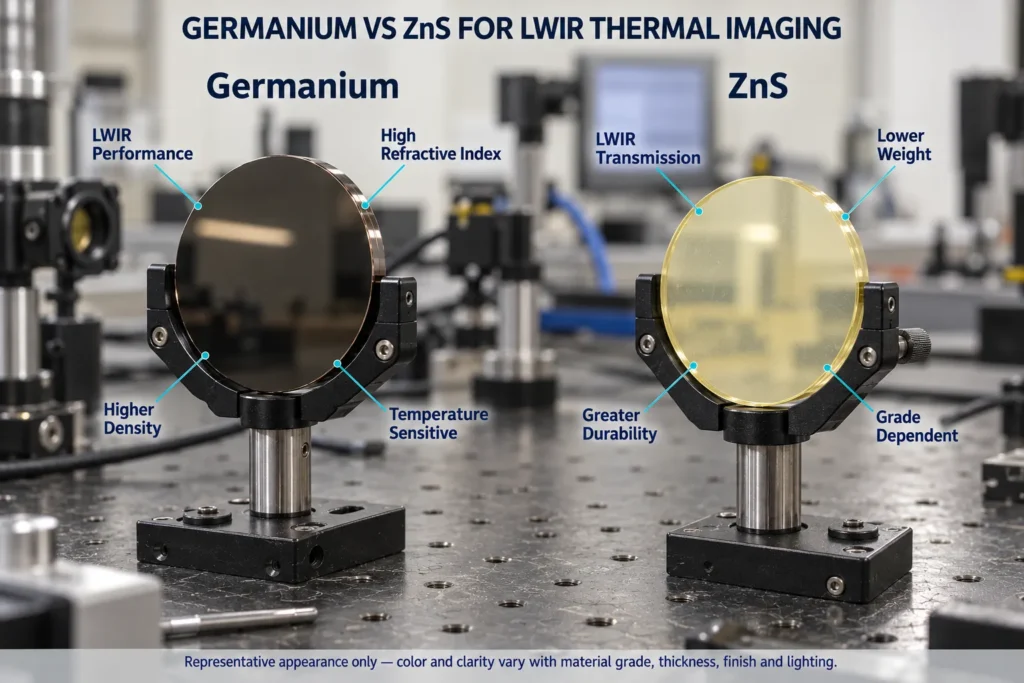
Germanium and zinc sulfide are widely used for long-wave infrared thermal-imaging windows and lenses. Both can transmit within the common 8–12 μm LWIR band, but they differ in refractive index, weight, temperature behavior, visible appearance and environmental durability.
Germanium is a familiar choice for protected thermal-imaging systems and precision infrared lenses. ZnS is often considered when lower weight, multispectral transmission or grade-specific environmental performance is required. The correct choice depends on the exact material grade, operating temperature, coating and mechanical environment.
 Germanium vs ZnS for LWIR Thermal Imaging
In This Guide
Quick Answer
Choose germanium when:
- Strong performance in the 8–12 μm band is required
- The operating temperature is controlled
- A well-established LWIR lens material is preferred
- Compact lens designs benefit from its high refractive index
- Visible transmission is not required
Choose ZnS FLIR grade when:
- Lower density is beneficial for a large external window
- Environmental performance will be validated for the exact grade, coating and required tests
- Lower component weight is beneficial
- The system operates primarily in the thermal infrared
- Visible clarity is not required
Choose multispectral ZnS when:
- Visible and infrared sensors share the same aperture
- Reduced visible scatter is required
- The additional cost of multispectral processing is justified
Germanium, ZnS FLIR grade and multispectral ZnS are not interchangeable. The exact material grade and supplier data should be confirmed before finalizing the drawing.
What Is Germanium?
Germanium is a crystalline infrared material commonly used for LWIR windows, lenses and protective covers. It is opaque in the visible spectrum and normally appears dark gray or black.
Germanium has a high refractive index, which can support compact infrared lens designs. However, the high index also creates substantial Fresnel reflection from uncoated surfaces. An antireflection coating is normally required to achieve useful finished-component transmission.
Germanium is relatively dense, so large windows or multi-element lens systems can become heavy. Its infrared properties are also sensitive to temperature, making thermal conditions important during material selection.
Common applications include:
- Thermal-imaging lenses
- Protected LWIR windows
- Infrared detector windows and covers
- Industrial thermography
- Security and surveillance systems
- Scientific infrared instruments
What Is Zinc Sulfide?
Zinc sulfide is a polycrystalline infrared material normally produced by chemical vapor deposition. It is available in different grades with different visible and infrared properties.
ZnS FLIR Grade
FLIR-grade ZnS is mainly intended for thermal-imaging applications. It commonly appears pale yellow and translucent rather than water-clear in the visible region.
It is often considered for exposed infrared windows, but it should not be described as universally more durable than germanium. Germanium is substantially harder, while rain erosion, impact resistance, coating durability and thermal cycling performance depend on the exact substrate grade, component design and qualification tests.
Multispectral ZnS
Multispectral ZnS undergoes additional processing to reduce scatter and improve visible transmission.
It can be used in systems that combine visible, near-infrared and thermal-infrared sensors through a common aperture. Its additional processing generally makes it more expensive than standard FLIR-grade material.
An RFQ should therefore state the exact ZnS grade rather than simply specifying “ZnS.”
Germanium vs ZnS: Key Differences
| Property | Germanium | ZnS FLIR Grade | Multispectral ZnS |
|---|---|---|---|
| Main spectral use | Primarily infrared | Primarily thermal infrared | Visible through infrared depending on grade |
| Visible appearance | Dark and opaque | Pale yellow and translucent | Clearer visible appearance |
| LWIR suitability | Commonly used | Commonly used | Can be used depending on system requirements |
| Refractive index | About 4.0 in the LWIR | About 2.2 in the LWIR; verify supplier data | About 2.2 in the LWIR; verify supplier data |
| Density | About 5.32 g/cm³ | About 4.09 g/cm³ | About 4.09 g/cm³ |
| Environmental durability | High hardness; exposed use depends on coating and qualification | Grade-, coating- and test-specific | Grade-, coating- and test-specific |
| Temperature sensitivity | Infrared performance changes significantly with temperature | Generally considered for broader environmental use | Grade-specific evaluation required |
| Typical use | LWIR lenses and protected windows | Rugged thermal-imaging windows | Common-aperture visible and thermal systems |
| Coating | Normally required | Normally required | Multispectral coating may be required |
| Cost consideration | Size and coating dependent | Grade and size dependent | Usually higher due to additional processing |
This table provides a general comparison. Actual performance depends on material grade, thickness, wavelength, temperature, surface finish and coating.
1. LWIR Transmission
Both germanium and appropriate ZnS grades can be used in the 8–12 μm LWIR band.
Germanium is widely used for thermal-imaging lenses because of its established infrared performance and high refractive index. It can provide good material-level transmission in the LWIR, but reflection losses are high without a suitable coating.
ZnS FLIR grade is optimized for thermal-infrared applications. Its useful transmission depends on grade, thickness, processing and coating.
Published material transmission ranges should not be confused with guaranteed finished-window transmission. The finished result also depends on:
- Material absorption
- Component thickness
- Surface reflection
- Surface quality
- Coating performance
- Operating temperature
- Angle of incidence
The RFQ should specify transmission over the actual operating band rather than relying only on a broad material range.
2. Refractive Index and Reflection
Germanium has a particularly high refractive index in the infrared. This can be useful for lens design because strong optical power can be achieved with suitable surface curvatures.
The disadvantage is high surface reflection. An uncoated germanium component can lose a substantial portion of the incident energy through Fresnel reflection.
ZnS also has a relatively high refractive index, although lower than germanium. It normally requires an AR coating when high finished-window transmission is needed.
Coating specifications should include:
- Wavelength band
- Angle of incidence
- Polarization when relevant
- Average or minimum transmission
- Number of coated surfaces
- Environmental durability
Writing only “AR coated” is not sufficient for a measurable specification.
3. Temperature Performance
Temperature is one of the most important differences between germanium and ZnS.
Germanium’s refractive index changes strongly with temperature. Representative supplier data gives a dn/dT near 408 × 10−6/°C at 10.6 μm, compared with about 54 × 10−6/°C for multispectral ZnS. Germanium absorption can also increase at elevated temperatures, reducing useful transmission and affecting image quality. Use the selected supplier grade and design temperature for final modelling.
For temperature-varying systems, evaluate:
- Minimum operating temperature
- Maximum operating temperature
- Temperature gradient
- Heating and cooling rate
- Focus shift
- Material absorption
- Coating temperature capability
ZnS may be preferred for some environmentally demanding thermal-imaging windows, but its performance must still be checked using the exact material grade.
Neither material should be selected using room-temperature transmission data alone when the window will operate at elevated or rapidly changing temperatures.
 LWIR Window Material Selection Guide
4. Mechanical Strength and Environmental Durability
ZnS is often evaluated alongside germanium for external thermal-imaging windows, especially when lower density or multispectral operation is important. It is not automatically more scratch resistant: representative supplier data shows germanium has substantially higher Knoop hardness than ZnS.
Potential exposures include:
- Rain erosion
- Windblown dust
- Sand
- Repeated cleaning
- Mechanical handling
- Shock and vibration
- Outdoor temperature cycling
Germanium can perform well in protected systems, but an exposed surface may require a durable coating or additional protection.
Material durability alone does not guarantee component survival. Window thickness, unsupported aperture, edge quality, mounting stress and pressure must also be considered.
For severe environments, define the required environmental tests rather than using general terms such as “rugged” or “outdoor grade.”
5. Weight and Component Size
Germanium has a higher density than ZnS. The weight difference becomes more important as window diameter and thickness increase.
Lower material weight can benefit:
- Airborne thermal cameras
- Gimbal systems
- Handheld imagers
- Mobile surveillance equipment
- Large protective windows
However, thickness cannot be selected from density alone. Mechanical strength, pressure, mounting design and allowed deflection must be evaluated together.
A thinner germanium window is not automatically equivalent to a thicker ZnS window. Each design requires material-specific analysis.
6. Visible and Multispectral Use
Standard germanium is opaque in the visible spectrum. It cannot serve as a common window for both a visible camera and an LWIR detector.
ZnS performance depends strongly on grade.
FLIR-grade ZnS is mainly used for thermal imaging and should not be described as a clear visible window. Multispectral ZnS provides improved visible transmission and reduced scatter, making it more relevant to common-aperture systems.
If visible transmission is required, specify:
- Multispectral ZnS grade
- Visible wavelength range
- LWIR wavelength range
- Required transmission in each band
- Allowed visible scatter
- Coating performance
- Angle of incidence
A broadband multispectral coating may be more complex than a coating designed only for 8–12 μm.
7. Surface Quality and Optical Performance
Surface quality describes scratches and digs, while surface flatness or figure controls the overall shape of the polished surface.
For LWIR components, suitable tolerances depend on:
- Imaging resolution
- Detector pixel size
- Window position
- Beam diameter
- Clear aperture
- Stray-light sensitivity
- Coating requirements
A tighter visible scratch-dig specification does not automatically guarantee better LWIR image quality.
For precision systems, transmitted wavefront may be more useful than individual-surface flatness because it evaluates the finished window’s effect on the transmitted beam.
8. Coating and Surface Protection
Both germanium and ZnS normally require application-specific coatings.
Possible coating requirements include:
- Broadband AR coating for 8–12 μm
- Dual-band or multispectral coating
- Durable protective coating
- One-side AR and one-side environmental protection
- Specified transmission at an angle
- Coating adhesion and durability testing
The coating must be matched to the substrate. A coating designed for germanium should not be assumed to provide the same result on ZnS.
The drawing should identify Side 1 and Side 2 when the two surfaces have different coating requirements.
Which Material Is Better for Different Applications?
Protected Thermal-Imaging Lenses
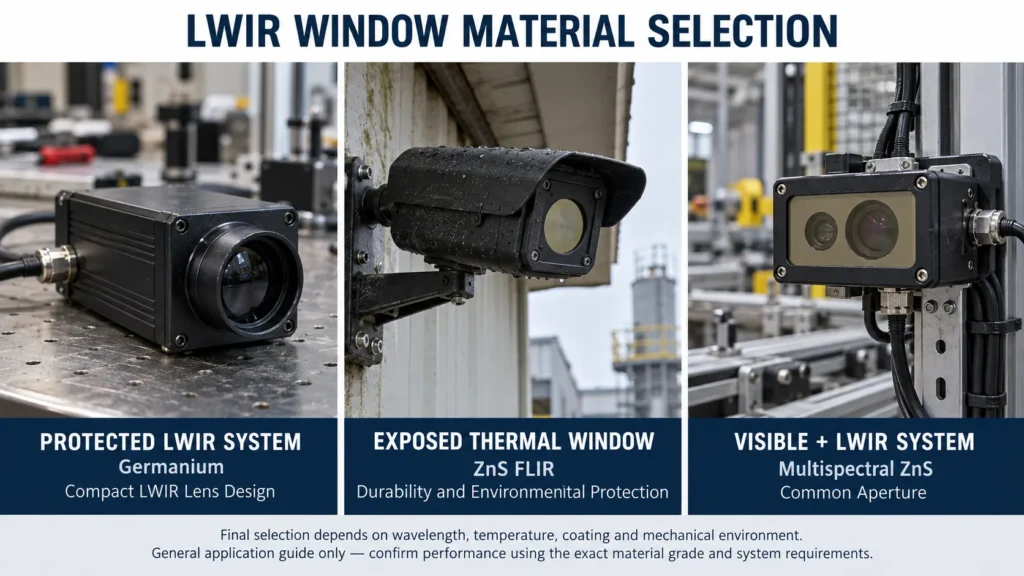
Germanium is a common starting point for LWIR lens elements in controlled or protected environments.
Exposed Outdoor Windows
ZnS FLIR grade may be considered when lower density or a particular environmental qualification is important. Final selection should be based on the required erosion, impact, abrasion, coating and thermal-cycle tests.
Common-Aperture Visible and LWIR Systems
Multispectral ZnS is generally more relevant because germanium does not transmit visible light.
Elevated-Temperature Systems
ZnS may offer advantages in some temperature-varying applications. Final selection must use grade-specific optical and thermal data.
Weight-Sensitive Systems
ZnS may be considered when reducing window mass is important, especially for larger apertures.
Common Selection Mistakes
Treating Every ZnS Grade as the Same
FLIR-grade and multispectral ZnS have different visible performance and cost.
Ignoring Germanium’s Temperature Dependence
Room-temperature data may not represent performance at elevated temperature.
Comparing Only Published Transmission Ranges
Finished-window transmission also depends on thickness, coating and surface reflection.
Assuming ZnS Is Automatically Suitable for Visible Imaging
Visible applications normally require an appropriate multispectral grade.
Specifying Only “AR Coated”
Include the wavelength band, angle of incidence and measurable reflection or transmission target.
Frequently Asked Questions
Is Germanium Better Than ZnS for LWIR?
Neither material is universally better. Germanium is widely used for LWIR lenses, while ZnS may be preferred for exposed and mechanically demanding windows.
Can ZnS Transmit Visible Light?
Multispectral ZnS can provide useful visible transmission. Standard or FLIR-grade ZnS is normally translucent rather than optically clear in the visible region.
Why Does Germanium Need an AR Coating?
Its high refractive index produces substantial surface reflection. An AR coating improves finished-component transmission.
Which Material Is Lighter?
ZnS has a lower density than germanium, which can reduce weight in large components.
Can Germanium Be Used at High Temperature?
Its optical properties change significantly with temperature. The actual maximum operating condition should be evaluated using material, coating and system-level thermal data.
Custom Germanium and ZnS Optics from Chenyu Optics
Chenyu Optics supports drawing-based custom germanium and ZnS windows, lenses and coated infrared substrates for thermal imaging, sensing and industrial systems.
Requirements can be reviewed according to:
- Germanium, ZnS FLIR or multispectral ZnS
- Operating wavelength
- Diameter or custom shape
- Thickness and dimensional tolerance
- Surface quality
- Flatness or surface figure
- Parallelism or wedge
- Clear aperture
- AR or protective coating
- Operating temperature
- Prototype and production quantities
- Inspection and packaging requirements
Final specifications should be confirmed according to the material grade, application, coating design and available inspection method.
Need Help Choosing Germanium or ZnS?
Send Chenyu Optics your wavelength band, dimensions, operating temperature, environmental requirements, coating and quantity. We can review the manufacturing requirements and provide a quotation based on the approved drawing.