
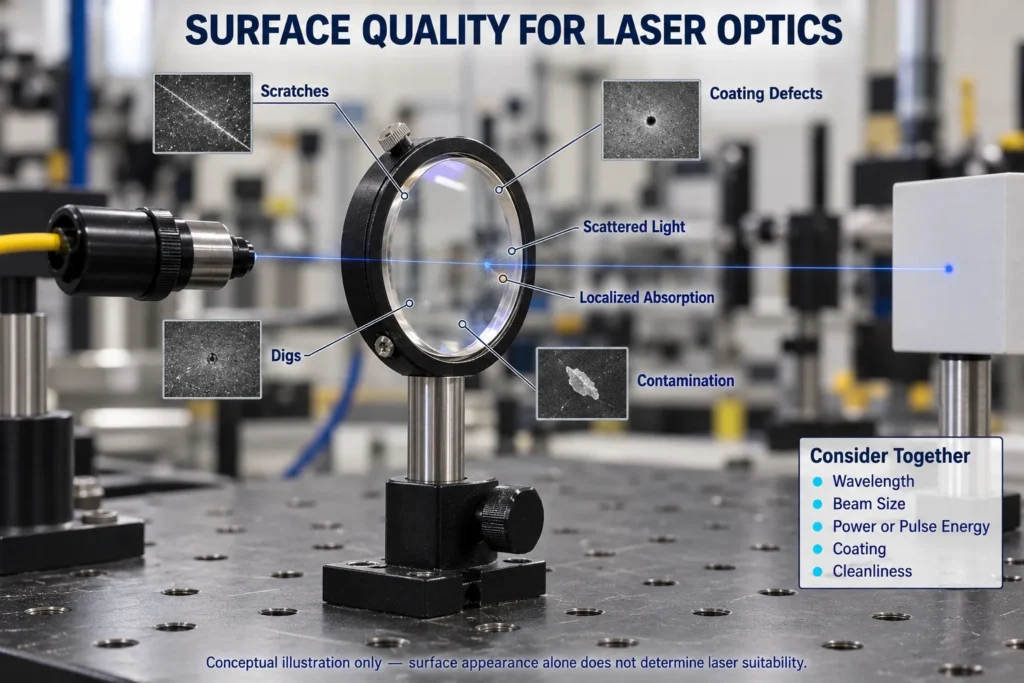
Surface quality is an important specification for laser windows, lenses, mirrors and beam splitters. Scratches, digs, coating defects and contamination can scatter light, reduce beam quality and create localized absorption.
However, selecting the lowest possible scratch-dig value does not automatically make an optic suitable for a laser. Wavelength, beam diameter, power density, pulse characteristics, coating quality and cleanliness must also be considered.
In This Guide
Quick Answer
To specify surface quality for a laser optic, provide:
- Optical component type
- Laser wavelength
- Continuous-wave or pulsed operation
- For CW lasers: irradiance at the optic (W/cm²), or power and beam area
- For pulsed lasers: pulse energy, pulse duration and on-optic fluence (J/cm²)
- Repetition rate and expected exposure duration
- Beam diameter at the optic, measurement definition (such as 1/e²), and beam profile
- Angle of incidence and polarization
- Scratch-dig or ISO imperfection requirement
- Clear aperture
- Coating specification
- Laser-induced damage threshold requirement
- Cleaning and packaging requirements
- Applicable inspection standard
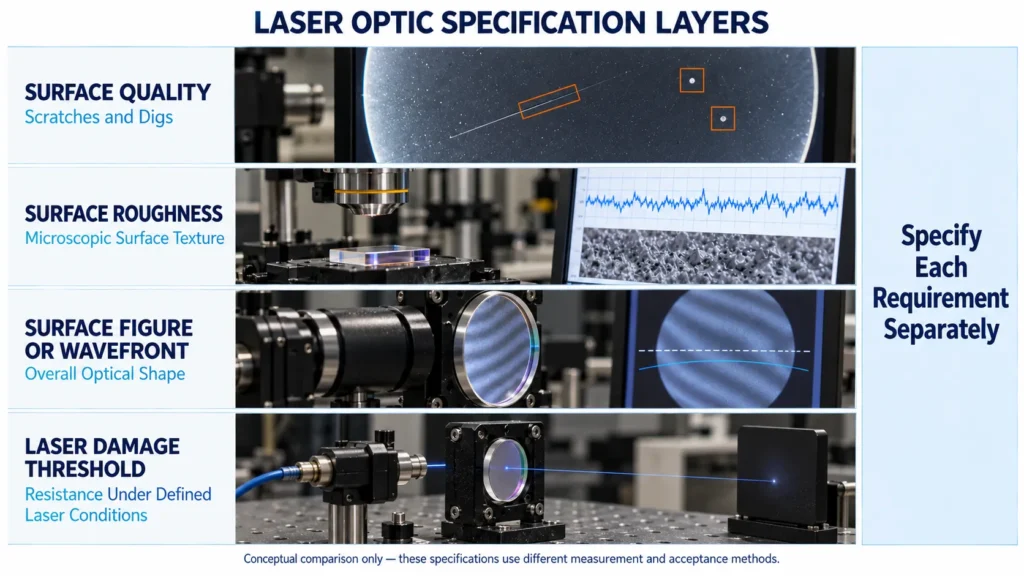
Surface quality controls scratches and digs, but it does not directly specify surface roughness, surface figure, transmitted wavefront or laser-induced damage threshold. These requirements should be listed separately when they are important.
What Is Surface Quality?
Surface quality describes localized imperfections on a polished optical surface.
Common imperfections or related surface-acceptance items include:
- Scratches
- Digs
- Pits
- Sleeks
- Edge chips
- Coating defects
- Stains and contamination
Traditional scratch-dig specifications use two numbers, such as 60-40, 40-20 or 20-10. Under MIL-style visual inspection, the first number is primarily a scratch visibility designation established by comparison with a calibrated standard; it is not a direct scratch-width measurement. The second number is the dig designation, whose acceptance depends on defect size, count and distribution rules in the stated standard.
A lower pair of numbers generally represents tighter cosmetic control. However, these numbers do not directly indicate surface flatness, surface roughness or coating durability.
The drawing should identify the governing inspection standard and revision. MIL-style scratch-dig specifications and ISO 10110-7 surface-imperfection specifications use different classification methods and should not be treated as directly interchangeable. Coating defects, contamination and edge chips may also require separate acceptance criteria rather than being assumed to be fully covered by the scratch-dig pair.
Why Does Surface Quality Matter for Laser Optics?
A defect can scatter part of the incident laser beam. Scattered light may reduce delivered power, create stray light or affect nearby detectors.
Defects and contamination can also create localized regions of increased absorption. In demanding laser systems, local heating may contribute to coating or substrate damage.
The practical effect depends on:
- Wavelength
- Beam diameter
- Beam intensity distribution
- Continuous-wave or pulsed operation
- Pulse duration, repetition rate and exposure duration
- On-optic irradiance or fluence
- Defect size and location
- Substrate absorption
- Coating absorption
- Environmental cleanliness
A scratch crossing a small focused beam may be more significant than the same scratch located outside the used aperture. The surface requirement should therefore be connected to the actual clear aperture and beam footprint.
Common Surface-Quality Levels
The following values are frequently seen on optical drawings:
80-50
Often used for general commercial components where cosmetic appearance and low scatter are not critical.
60-40
Common for standard optical windows and many general-purpose optical systems.
40-20
Frequently considered for more demanding imaging or laser applications where improved cosmetic control is required.
20-10
Used when tighter control of visible surface defects and scatter is important.
10-5 or Tighter
May be requested for specialized precision or low-scatter applications, but manufacturing and inspection costs can increase substantially.
These descriptions are general references only. A scratch-dig value should not be selected solely from the laser power. Beam conditions, coating, cleaning and damage-threshold requirements must also be evaluated.
Laser Optic Surface Specification Checklist
| Specification Area | Information to Provide | Why It Matters |
|---|---|---|
| Laser source | Wavelength and laser type | Affects absorption, coating and inspection relevance |
| Beam parameters | On-optic diameter, diameter definition, profile and beam location | Determines which surface area is optically active |
| Power parameters | CW irradiance or pulsed fluence at the optic, plus source power or pulse energy | Relates delivered energy to the illuminated area |
| Pulse parameters | Duration and repetition rate | Required for pulsed-laser evaluation |
| Surface quality | Scratch-dig or ISO requirement | Controls localized surface imperfections |
| Clear aperture | Defined usable optical area | Identifies where the requirement applies |
| Coating | Band, AOI and reflectance or transmission | Affects finished optical performance |
| LIDT | Test wavelength, pulse conditions, exposure protocol, damage criterion and standard | Defines comparable laser-damage testing requirements |
| Other optical tolerances | Roughness, figure or wavefront | Controls characteristics not covered by scratch-dig |
| Handling | Cleaning, packaging and cleanliness | Reduces contamination-related risks |
This checklist provides general specification guidance. Laser suitability must be evaluated for the complete optic and actual operating conditions.
How to Choose a Scratch-Dig Requirement
Start with the function of the optic and the position of the beam.
Ask the following questions:
- Does the laser beam use most of the clear aperture?
- Is the optic close to a focus?
- Is the system sensitive to scattered light?
- Is the optic used in an imaging path?
- Is the laser continuous-wave or pulsed?
- Is the component replaceable?
- Is cosmetic appearance important to the customer?
For a general alignment or enclosure window, a commercial specification may be adequate. A precision beam-delivery optic or component near a sensitive image plane may require tighter control.
The best value is the least restrictive specification that still protects system performance. This reduces unnecessary polishing, inspection and rejection costs.
Define the Clear Aperture
The surface-quality requirement should apply over a stated clear aperture rather than automatically covering every part of the physical surface.
The clear aperture may be specified as:
- A diameter
- A rectangular area
- A percentage of the outside dimension
- A defined beam footprint
For example:
Surface Quality: 20-10 over the central 90% clear aperture
The bevel and a narrow edge zone are normally outside the usable optical area. If edge defects require separate limits, they should be defined on the drawing.
Surface Quality Is Not Surface Roughness
Surface quality controls visible localized defects. Surface roughness describes much smaller variations in the polished surface texture.
Roughness can contribute to wide-angle scatter and may be specified in nanometers or angstroms RMS. A component with a tight scratch-dig value can still have unsuitable roughness, and a low-roughness surface can still contain an isolated scratch.
When low scatter is critical, consider specifying both:
- Scratch-dig or ISO surface imperfections
- Surface roughness over a defined spatial-frequency range
The measurement method and sampling area should also be agreed upon.
Surface Quality Is Not Laser Damage Threshold
Laser-induced damage threshold, commonly abbreviated as LIDT, describes the conditions under which damage is observed during a specified test.
Scratch-dig values do not guarantee a particular LIDT. Damage performance may also depend on:
- Substrate absorption
- Polishing residue
- Subsurface damage
- Coating materials
- Coating process
- Surface contamination
- Cleaning method
- Test protocol
- Beam profile
If LIDT is important, specify it independently. Include the test wavelength, pulse duration, repetition rate, on-optic beam size and definition, spatial profile, polarization, angle of incidence, number of exposures, damage criterion and applicable test method. For pulsed lasers, report fluence in J/cm²; for continuous-wave lasers, report irradiance in W/cm² under the stated exposure conditions.
The current general-principles reference is ISO 21254-1:2025. Threshold-determination protocols such as 1-on-1 and S-on-1 are described in ISO 21254-2. A damage-threshold value measured under one set of conditions should not be applied directly to a substantially different laser, and a single-pulse result should not be treated as proof of multi-pulse lifetime.
Include the Optical Coating
The coating is part of the final laser optic and should not be specified only as “AR coated” or “laser coating.”
Include:
- Operating wavelength
- Angle of incidence
- Polarization
- Required reflectance or transmission
- Number of coated surfaces
- Laser parameters
- LIDT requirement when applicable
- Environmental durability
Coating imperfections may require separate acceptance criteria because a substrate can meet its scratch-dig requirement before coating but develop coating-related defects afterward.
Clarify whether final surface inspection is required before coating, after coating or at both stages.
Control Cleanliness and Handling
Contamination can be as important as permanent surface defects. Dust, fingerprints, cleaning residue and packaging debris may scatter or absorb laser energy.
The RFQ can define:
- Final cleaning requirement
- Cleanroom handling when necessary
- Protective wrapping
- Individual containers
- Noncontact optical packaging
- Inspection before shipment
- Approved cleaning method
Users should inspect and clean optics only with methods suitable for the material and coating. Incorrect wiping can create new scratches or coating damage.
Define the Inspection Method
Surface acceptance depends on the standard and inspection conditions.
The drawing or purchase specification should identify:
- Applicable standard
- Scratch-dig or imperfection value
- Clear aperture
- Inspection lighting
- Magnification when applicable
- Coated or uncoated inspection stage
- Permitted number and distribution of defects
- Required inspection documentation
Do not create a custom visual-inspection method unless the criteria can be applied consistently by both customer and supplier.
Common Specification Mistakes
Choosing Surface Quality Only From Laser Power
Laser power alone does not determine the correct scratch-dig value. Beam size, pulse conditions, coating and defect location also matter.
Treating Scratch-Dig as an LIDT Guarantee
Scratch-dig controls visual imperfections. It does not certify laser-damage performance or predict a damage threshold without a defined laser-damage test.
Mixing MIL and ISO Requirements
State one applicable inspection system clearly. Do not assume direct equivalence between different standards.
Ignoring the Clear Aperture
Define the area where the surface requirement applies. Otherwise, harmless edge-zone defects may cause unnecessary rejection.
Forgetting Cleanliness and Packaging
A clean optic can become unsuitable if it is contaminated during handling or shipment.
How to Write the Requirement
A practical laser-window specification might include:
- Substrate surface quality: 20-10 scratch-dig according to the stated standard
- Clear aperture: Central 90% of the diameter
- Surface roughness: Specified separately when required
- Coating: AR at the operating wavelength and stated AOI
- LIDT: Wavelength, CW irradiance or pulsed fluence, beam definition, exposure protocol and applicable ISO 21254 test conditions
- Inspection: Final inspection after coating
- Packaging: Individually cleaned and protected
The exact values must be selected according to the system rather than copied from a general example.
Frequently Asked Questions
Is 20-10 Always Better Than 40-20 for a Laser Optic?
It is a tighter cosmetic requirement, but it may not provide a practical performance benefit in every system.
Does a Scratch Automatically Cause Laser Damage?
No. Damage risk depends on defect characteristics, contamination, coating, wavelength and laser conditions. A visible scratch should still be evaluated according to the application.
Does Surface Quality Include Surface Roughness?
No. Surface roughness is a separate specification and normally requires a different measurement method.
Can an AR Coating Improve Surface Quality?
A coating can reduce reflection but does not repair substrate scratches or digs. Coating may also introduce its own defects.
What Information Is Needed for a Laser Optics Quote?
Provide the component drawing, substrate, wavelength, beam parameters, surface quality, coating, LIDT requirement, quantity and inspection requirements.
Custom Laser Optics from Chenyu Optics
Chenyu Optics supports drawing-based custom laser windows, lenses, mirrors, beam splitters and coated optical substrates.
Requirements can be reviewed according to:
- Optical material and grade
- Operating wavelength
- Component dimensions
- Surface quality
- Surface roughness
- Surface figure or wavefront
- Clear aperture
- Optical coating
- Available laser-damage requirements
- Prototype and production quantities
- Cleaning and packaging requirements
Final specifications should be confirmed according to the application, approved drawing, coating design and available inspection method.
Need Help Specifying a Laser Optic?
Send Chenyu Optics your wavelength, laser type, on-optic beam diameter and definition, CW irradiance or pulse parameters and fluence, angle of incidence, polarization, component drawing, material, coating and quantity. We can review manufacturing requirements and prepare a quotation based on the agreed specification.