
An antireflection (AR) coating reduces Fresnel reflection from an optical surface, improving transmission and reducing ghost images, stray light and unwanted optical feedback. AR coatings are widely used on windows, lenses, prisms, filters, laser crystals and infrared components.
The correct coating cannot be selected by wavelength alone. Substrate material, angle of incidence (AOI), polarization, required reflectance, laser conditions and environmental durability must all be considered.
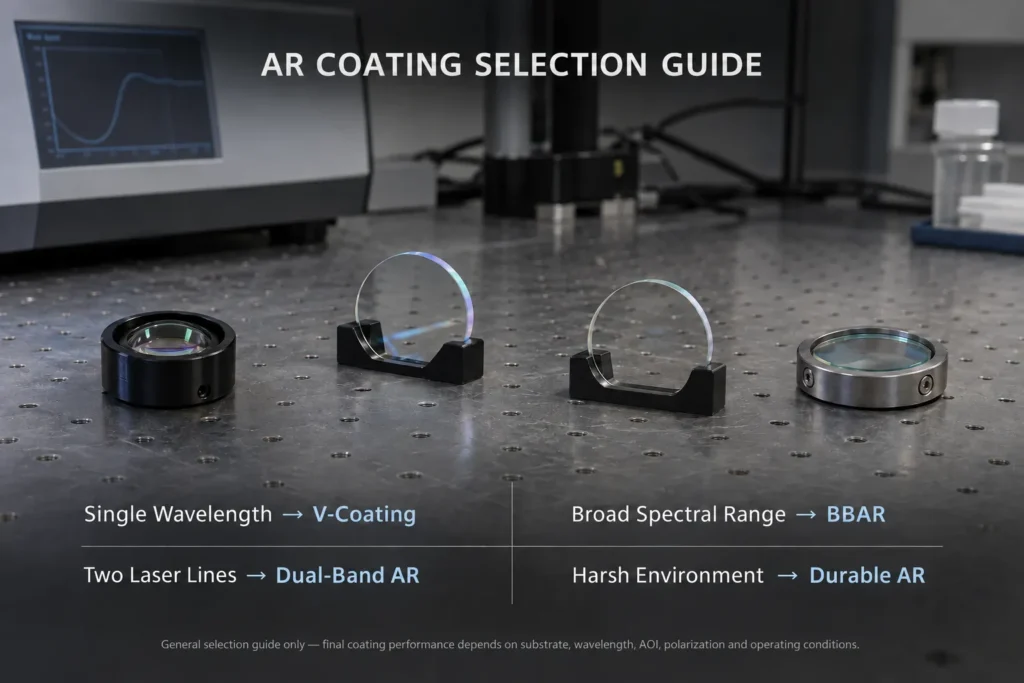
A V-coating is normally selected for one laser wavelength and a limited angular range, while a broadband AR (BBAR) coating is more suitable for imaging or instruments operating across a continuous spectral band.
In This Guide
Quick Answer: Which AR Coating Should You Choose?
Choose a single-layer coating when cost, simplicity and moderate reflection reduction over a limited band are more important than the lowest residual reflectance.
Choose a V-coating for very low reflection at one laser wavelength and a defined AOI.
Choose a BBAR coating for imaging, spectroscopy or instruments operating across a continuous wavelength band.
Choose a dual-band coating when two separated laser wavelengths must transmit efficiently through the same component.
Specify an angle-specific or wide-angle design when the optic operates at 45°, rotates in use or receives a wide cone of rays.
Add durability and LIDT requirements separately when the optic is exposed to cleaning, humidity, abrasion, outdoor conditions or high-power laser radiation.
Important: “AR coated” is not a complete specification. At minimum, state the substrate, wavelength or band, AOI, polarization and allowable reflectance or required transmission.
How Does an AR Coating Work?
At normal incidence between two nonabsorbing media, the power reflectance of an uncoated interface can be approximated by:
R = |(n2 − n1) ÷ (n2 + n1)|²
Here, n1 and n2 are the refractive indices of the incident and substrate media at the operating wavelength. For air-to-glass with an index near 1.5, reflection is about 4% per uncoated surface.
This simple expression is not sufficient for absorbing materials, oblique incidence or polarization-dependent analysis. Infrared materials such as silicon and germanium should be evaluated with their wavelength-dependent optical constants and the actual operating geometry.
An AR coating uses one or more thin-film layers to make reflected waves interfere destructively within a designed wavelength and angular range. Benefits can include higher transmission, improved image contrast, lower stray light, fewer ghost images and reduced optical feedback.
Common Types of AR Coatings
| Coating type | Best suited for | Main advantage | Main limitation |
|---|---|---|---|
| Single-layer AR | Moderate reflection reduction | Simple and economical | Limited minimum reflectance and bandwidth |
| V-coating | One laser wavelength | Very low reflection at the design wavelength | Narrow wavelength and AOI range |
| Broadband AR | Continuous spectral range | Versatile across a band | Usually higher minimum reflection than a V-coat |
| Dual-band AR | Two separated wavelengths | Efficient at two selected bands | Performance between bands may be limited |
| Angle-specific or wide-angle AR | Oblique incidence or wide beam cones | Controls angular and polarization effects | More complex design and verification |
Selection note: Durability is a separate coating requirement, not a spectral coating category. Any design should be reviewed for adhesion, abrasion, humidity, temperature and cleaning resistance appropriate to its use.
1. Define the Wavelength Requirement
Identify whether the system uses one laser wavelength, two discrete wavelengths, a narrow band, a broad continuous range, a tunable source or multiple detector bands. A V-coating can provide very low reflectance close to its design wavelength but may perform poorly away from it. A BBAR coating supports a wider spectrum, usually with a higher residual reflectance than a narrowband design.
Avoid specifying more bandwidth than the system needs. Extra bandwidth can add layers, cost and process sensitivity while reducing the best achievable performance at the most important wavelength.
2. Specify Reflectance or Transmission
State a measurable requirement rather than only a coating name. Useful quantities include average reflectance across a band, maximum reflectance at any wavelength, reflectance at a laser line, average component transmission and minimum transmission at a critical wavelength.
Ravg < 0.5% per coated surface from 450–650 nm at 0–10° AOI, unpolarized
Rmax < 1.0% per coated surface over the same conditions
Average and maximum limits are different. A maximum requirement is normally harder because no measured point in the band may exceed it. Also state whether the result applies per coated surface or to the complete component; component transmission includes substrate absorption and all interfaces.
3. Define the Angle of Incidence and Polarization
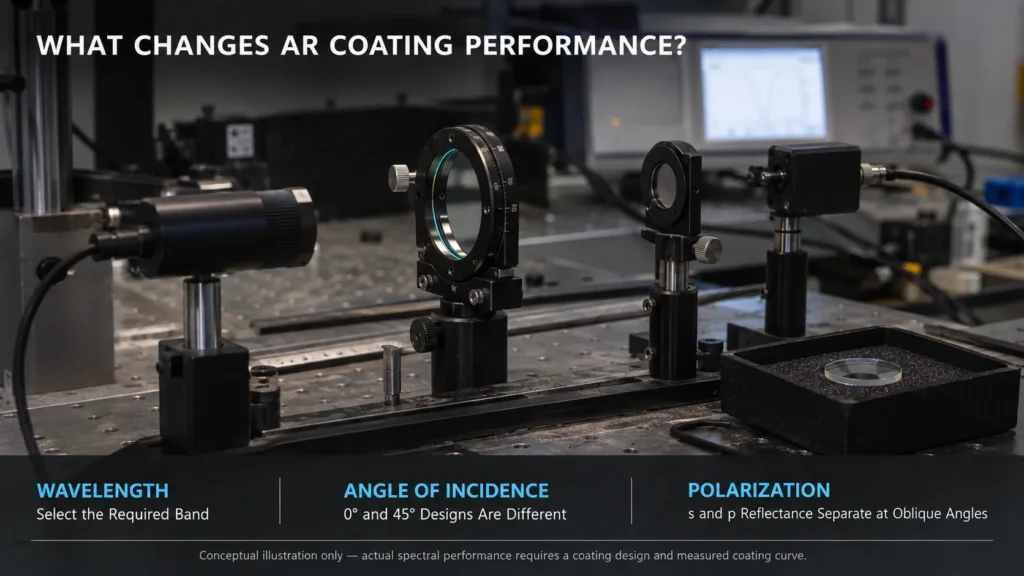
Thin-film performance is angle-sensitive. As AOI increases, the spectral response generally shifts and the s- and p-polarized curves separate. Specify the nominal AOI, permitted angular range, beam cone or numerical aperture, and whether the component rotates during operation.
At normal incidence, s and p behavior is identical for isotropic media. At oblique incidence, state whether the light is unpolarized, s-polarized, p-polarized, circular/elliptical or variable. Circular and elliptical states contain s and p components relative to the plane of incidence and must be evaluated accordingly.
A 45° optic should normally use a coating designed and verified at 45°, rather than assuming a standard 0° coating will meet the requirement.
4. Match the Coating to the Substrate
An AR design is matched to the substrate’s refractive index, absorption, thermal behavior and surface properties. A design for N-BK7 will not provide identical performance on fused silica, sapphire, CaF2, silicon, germanium or ZnSe.
The RFQ should state the exact material and grade. Substrate selection affects uncoated reflection, available coating materials, deposition temperature, adhesion, stress, spectral transmission and laser absorption. Crystalline materials may also require orientation or thermal-expansion information.
5. Consider Laser Power and LIDT
For laser systems, provide wavelength, CW or pulsed operation, beam diameter and profile, AOI and polarization. For pulsed lasers, also give pulse energy, duration and repetition rate; for CW lasers, give optical power or irradiance and exposure conditions.
Pulsed LIDT is commonly reported as energy density (J/cm²), while CW performance is often evaluated using irradiance (W/cm²) together with beam size and exposure time. An LIDT value is only comparable when wavelength, pulse duration, repetition rate, beam profile, test method and damage criterion are sufficiently similar. Cleanliness, surface preparation and handling also affect performance.
6. Consider Environmental Durability
Review humidity, temperature range, thermal cycling, salt fog, abrasion, cleaning frequency, chemical exposure, vacuum and outdoor operation. If a formal durability standard is required, identify the exact revision, test method and acceptance criteria. Optical performance and durability should both be specified rather than assuming one guarantees the other.
How to Write an AR Coating Specification
A complete coating request should include:
- Substrate material and grade
- Wavelength or wavelength band
- Average and maximum reflectance, or component transmission
- Per-surface or complete-component reporting
- AOI, angular range and beam cone
- Polarization state
- Number and designation of coated surfaces
- Clear aperture
- Laser parameters and LIDT test conditions
- Environmental durability and cleaning requirements
- Witness-sample, spectral-report and acceptance requirements
- Prototype and production quantity
Example: BBAR coating on both surfaces, Ravg < 0.5% per surface from 450–650 nm at 0–10° AOI for unpolarized light; Rmax < 1.0% per surface over the same band and angular range.
Common Selection Mistakes
Specifying Only “AR Coated”
This does not define wavelength, reflectance, AOI, polarization or durability.
Using a 0° Coating at 45°
The spectral response shifts with angle and s/p performance can separate.
Ignoring the Substrate
The same layer design will not perform identically on materials with different optical constants.
Requesting Unnecessary Bandwidth
A wider band can increase complexity and cost while reducing the lowest achievable reflection.
Comparing LIDT Values with Different Test Conditions
Damage thresholds are not directly comparable without matching wavelength, temporal regime, beam characteristics and test method.
Frequently Asked Questions
What Is the Difference Between a V-Coating and BBAR?
A V-coating targets very low reflection near one design wavelength. A BBAR coating reduces reflection across a wider continuous range.
Does an AR Coating Increase Transmission?
Usually yes, if the substrate transmits the wavelength and coating absorption is low. Finished transmission also depends on substrate absorption, thickness and every optical surface.
Can One AR Coating Work at 0° and 45°?
A specially designed wide-angle coating may meet defined limits at both, but a coating optimized at 0° normally shifts at 45°. Both angles and polarization conditions must be specified and verified.
Should Both Surfaces Be AR Coated?
Often yes for windows and lenses, but some systems require only one coated surface or different coatings on each side. Identify surfaces on the drawing.
Does AR Coating Improve Laser Damage Resistance?
Not automatically. Reduced back reflection can help the optical system, but the coating introduces additional layers and defects that may limit damage resistance. Specify and test LIDT separately.
Custom AR-Coated Optical Components from Chenyu Optics
Chenyu Optics provides custom AR-coated windows, lenses, prisms, filters and infrared optical components. Final specifications should be confirmed from the customer drawing, substrate, operating conditions and available measurement method.
Need Help Selecting an AR Coating?
Send us your substrate, wavelength range, AOI, polarization, transmission target, laser parameters and environmental requirements.
Chenyu Optics can help evaluate a practical AR coating specification for your optical component.