
A custom optical mirror must be specified according to its wavelength, beam geometry, required reflectance and operating environment. Choosing only a mirror coating is not enough because substrate properties, surface flatness, surface quality and mounting can also affect performance.
A complete RFQ helps the manufacturer select an appropriate substrate, polishing process, coating design and inspection method. Tolerances should match the optical system without adding unnecessary manufacturing cost.
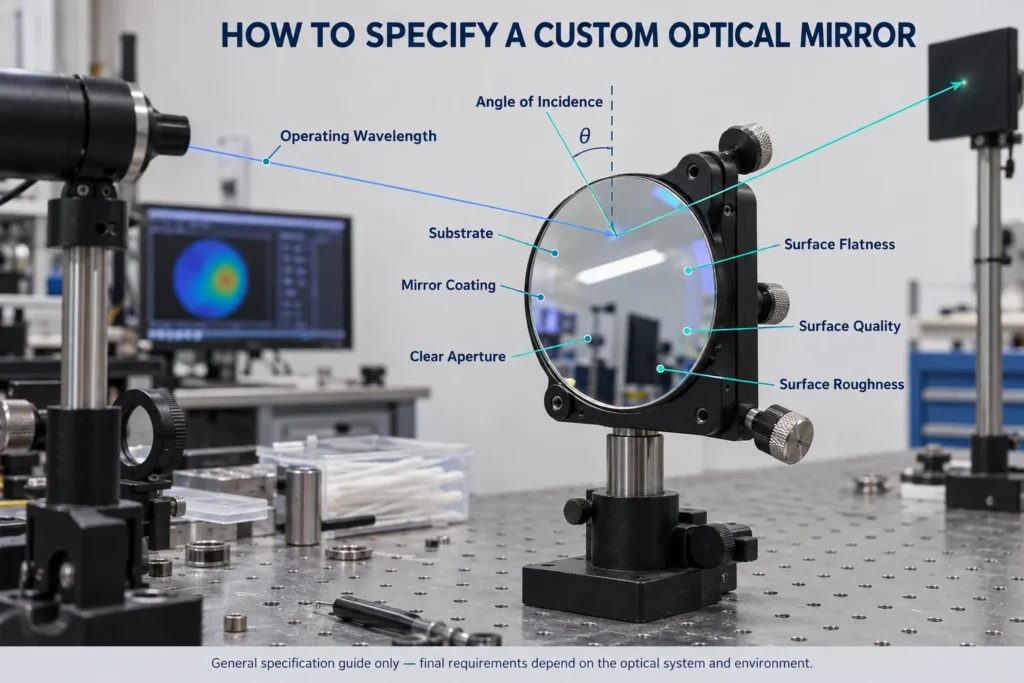 Custom Optical Mirror Specification Guide
In This Guide
Quick Answer
A custom optical mirror RFQ should normally include:
- Mirror type and optical function
- Operating wavelength or wavelength band
- Angle of incidence
- Polarization when relevant
- Substrate material
- Outside dimensions and thickness
- Surface flatness or surface figure
- Reflected wavefront when required
- Surface quality
- Surface roughness when required
- Clear aperture
- Reflective coating
- Required reflectance
- Coating durability
- Back-surface and edge requirements
- Quantity and inspection documentation
Flat mirrors require a flatness specification. Curved mirrors require radius and surface-figure specifications. If the correct tolerance is unknown, provide the allowable system wavefront error or beam deviation.
1. Define the Mirror’s Function
Begin by identifying how the mirror will be used.
Common applications include:
- Laser beam steering
- Imaging systems
- Spectroscopy
- Interferometry
- Illumination
- Beam folding
- Detector systems
- UV or infrared instruments
State whether the mirror is flat, concave, convex, spherical, parabolic or another shape.
A beam-steering flat requires different specifications from a focusing mirror. Precision imaging and interferometry may require tighter reflected-wavefront control, while an illumination mirror may accept more economical tolerances.
Also identify whether the mirror is a front-surface or second-surface design. Precision optical systems normally use front-surface mirrors to avoid ghost reflections and refraction through a cover substrate.
2. Specify the Operating Wavelength
Always provide a measurable wavelength or band, such as:
- 355 nm
- 532 nm
- 1064 nm
- 400–700 nm
- 3–5 μm
- 8–12 μm
- 10.6 μm
The wavelength affects substrate selection, coating materials, surface roughness and inspection.
For laser systems, include:
- Continuous-wave or pulsed operation
- Average power
- Pulse energy
- Pulse duration
- Repetition rate
- Beam diameter
- Beam profile
These values help evaluate coating absorption and available laser-damage performance.
3. Select the Mirror Substrate
The substrate provides the mechanical and optical foundation for the reflective coating.
Fused Silica
Fused silica offers low thermal expansion, good thermal stability and suitability for many UV, visible and near-infrared applications.
Optical Glass
Optical glass such as BK7 or an approved equivalent is often economical for visible and near-infrared mirrors used under moderate temperature conditions.
Low-Expansion Glass-Ceramic
Low-expansion glass-ceramics are commonly considered for precision mirrors requiring dimensional stability across temperature changes.
Silicon
Silicon offers good thermal conductivity and low density relative to some infrared materials. It may be used for infrared or lightweight mirror applications.
Metal Substrates
Aluminum and other metals may be used where low weight, fast thermal response or integrated mechanical features are important. Their polishing, plating and thermal behavior require application-specific review.
Substrate selection should consider wavelength, temperature, stiffness, weight, diameter, thickness and mounting method.
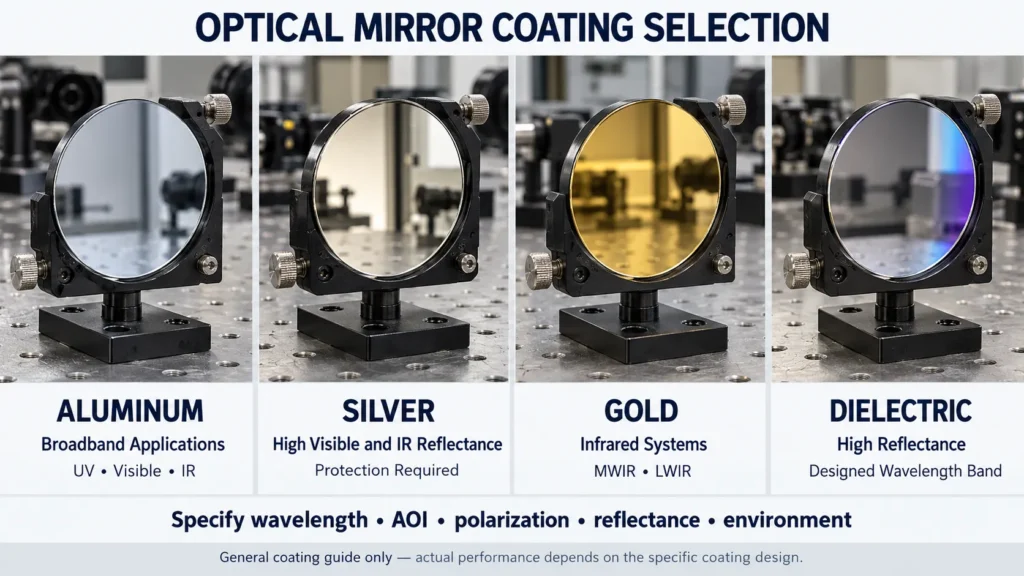
4. Choose the Reflective Coating
Mirror coatings are selected according to wavelength, reflectance and environment.
Protected Aluminum
Protected aluminum provides broad reflectance from the ultraviolet or visible into the infrared, depending on the coating design. A protective overcoat improves durability.
Enhanced Aluminum
Enhanced aluminum uses additional dielectric layers to improve reflectance over a selected band.
Protected Silver
Protected silver provides high reflectance across much of the visible and infrared spectrum. Its durability depends on the protective coating and environment.
Protected Gold
Protected gold is commonly used in infrared systems. It provides strong infrared reflectance but is not normally selected for broad visible applications.
Dielectric Mirror Coating
Dielectric mirrors can provide very high reflectance over a designed wavelength band. Their performance can be sensitive to angle of incidence and polarization.
Do not specify only “silver mirror” or “dielectric mirror.” Include the band, AOI, polarization and required reflectance.
Custom Optical Mirror Specification Checklist
| Specification | Information to Provide | Why It Matters |
|---|---|---|
| Mirror type | Flat, spherical, parabolic or custom | Defines optical function |
| Wavelength | Single wavelength or spectral band | Determines coating and inspection |
| Angle of incidence | Nominal angle and allowed range | Affects reflectance and spectral position |
| Substrate | Exact material and grade | Controls stability, weight and processing |
| Dimensions | Diameter or shape and thickness | Defines mounting and manufacturing |
| Flatness or figure | Value, wavelength and aperture | Controls reflected wavefront |
| Surface quality | Scratch-dig or applicable standard | Limits visible surface defects |
| Surface roughness | RMS value and measurement method | Controls scatter in sensitive systems |
| Clear aperture | Defined usable reflective area | Identifies where specifications apply |
| Coating | Type, reflectance and durability | Defines spectral performance |
| Environment | Temperature, humidity and cleaning | Affects substrate and coating selection |
| Inspection | Spectral or interferometric reports | Defines required documentation |
This checklist provides general RFQ guidance. Not every mirror requires every tolerance listed.
5. Specify Surface Flatness or Figure
A flat mirror should include a surface-flatness requirement, commonly expressed as:
- λ
- λ/2
- λ/4
- λ/10
A complete requirement should state:
- Test wavelength
- Clear aperture
- Peak-to-valley or RMS
- Support condition
- Whether coating is included in final inspection
For a reflective surface near normal incidence, reflected wavefront error is approximately twice the surface-form error. At oblique incidence, the relationship also depends on angle of incidence. Coating stress and mounting deformation can further affect the finished result.
Curved mirrors should use surface-figure and radius requirements instead of a flatness specification.
6. Reflected Wavefront
Reflected wavefront describes the finished mirror’s effect on the reflected beam. It may be more useful than substrate flatness alone for precision systems.
Specify:
- Reflected wavefront value
- Test wavelength
- Clear aperture
- Angle of incidence
- PV or RMS
- Measurement condition
- Mounted or unmounted state
A mirror can meet its uncoated substrate flatness but change after coating or installation. Large, thin mirrors are particularly sensitive to coating stress and mounting force.
7. Surface Quality
Surface quality controls localized defects such as scratches and digs.
Typical values may include:
- 80-50 for noncritical commercial applications
- 60-40 for many general optical mirrors
- 40-20 for more demanding imaging or laser applications
- 20-10 for tighter cosmetic and scatter control
These are general examples rather than universal recommendations.
Surface quality does not define surface flatness, roughness or laser-damage performance. The applicable inspection standard and clear aperture should be stated.
8. Surface Roughness
Surface roughness describes microscopic variations in the polished surface.
Low roughness can be important for:
- Short-wavelength systems
- High-power lasers
- Low-scatter imaging
- Interferometry
- Precision spectroscopy
If roughness is critical, specify:
- Maximum RMS roughness
- Measurement area
- Spatial-frequency range when relevant
- Measurement method
A tight scratch-dig value does not automatically guarantee low surface roughness.
 Optical Mirror Coating Selection Guide
9. Dimensions and Clear Aperture
Provide a controlled drawing containing:
- Diameter, length and width
- Thickness and tolerance
- Chamfer or bevel
- Edge finish
- Mounting features
- Datum surfaces
- Clear aperture
The clear aperture defines the usable coated area over which optical requirements apply.
Avoid requiring full performance to the physical edge unless the system uses that region. A practical edge exclusion improves coating and inspection feasibility.
10. Angle of Incidence and Polarization
Mirror performance can change with angle of incidence.
Dielectric coatings are particularly dependent on AOI and polarization. At oblique angles, s- and p-polarized light may have different reflectance and phase behavior.
State:
- Nominal AOI
- AOI tolerance
- Polarization
- Beam cone angle
- Required reflectance at operating conditions
A coating designed for 0° should not be assumed to provide the same performance at 45°.
11. Environmental and Cleaning Requirements
The coating and substrate must survive the intended environment.
Relevant conditions include:
- Operating and storage temperature
- Humidity
- Outdoor exposure
- Vacuum
- Chemical exposure
- Dust and abrasion
- Cleaning frequency
- Shock and vibration
Protected metal coatings are more durable than bare metal layers, but they are not scratch-proof. Define the cleaning method and handling requirements when the mirror will be serviced regularly.
Common Specification Mistakes
Specifying Only the Coating Material
“Aluminum mirror” does not define wavelength, reflectance, protection or durability.
Confusing Flatness With Reflected Wavefront
Flatness describes the surface. Reflected wavefront describes the effect on the reflected beam.
Ignoring AOI and Polarization
Coating performance can change when the mirror is tilted.
Treating Surface Quality as Roughness
Scratch-dig and microscopic surface texture are separate specifications.
Ignoring Coating and Mounting Stress
A thin mirror may change shape after coating or installation.
Frequently Asked Questions
Which Substrate Is Best for an Optical Mirror?
There is no universal best material. Selection depends on wavelength, temperature, weight, size, stability and cost.
Is λ/4 Flatness Equal to λ/4 Reflected Wavefront?
No. Near normal incidence, reflected wavefront error is generally about twice the surface-form error, before other effects are included.
Which Mirror Coating Has the Highest Reflectance?
It depends on wavelength and AOI. A dielectric coating can provide very high reflectance over a designed band, while metal coatings are useful for broader wavelength coverage.
Does a Mirror Need a Clear Aperture?
Yes. It identifies the usable coated area where optical specifications must be met.
What Information Is Needed for a Custom Mirror Quote?
Provide the drawing, substrate, wavelength, AOI, polarization, flatness or figure, surface quality, coating, reflectance and quantity.
Custom Optical Mirrors from Chenyu Optics
Chenyu Optics supports drawing-based custom flat and curved mirrors for imaging, laser, sensing, industrial and scientific systems.
Requirements can be reviewed according to:
- Substrate material
- Mirror dimensions
- Surface flatness or figure
- Reflected wavefront
- Surface quality
- Surface roughness
- Clear aperture
- Reflective coating
- Wavelength and AOI
- Prototype and production quantities
- Inspection and packaging
Final specifications should be confirmed according to the application, approved drawing, coating design and available inspection method.
Request a Custom Optical Mirror Quote
Send Chenyu Optics your drawing, substrate, wavelength, angle of incidence, polarization, surface tolerances, coating requirements and quantity. If some values have not been finalized, provide the required system performance for review.