
Hard-coated and soft-coated optical filters can both provide wavelength selection for imaging, sensing, spectroscopy and laser systems. The main difference is not simply spectral performance—it is how the thin-film coating is deposited, protected and expected to respond to environmental exposure.
Hard coatings are generally dense and durable, while soft coatings often require additional protection or lamination. However, terminology and manufacturing processes vary between suppliers, so buyers should confirm the coating construction, environmental requirements and guaranteed spectral performance before ordering.
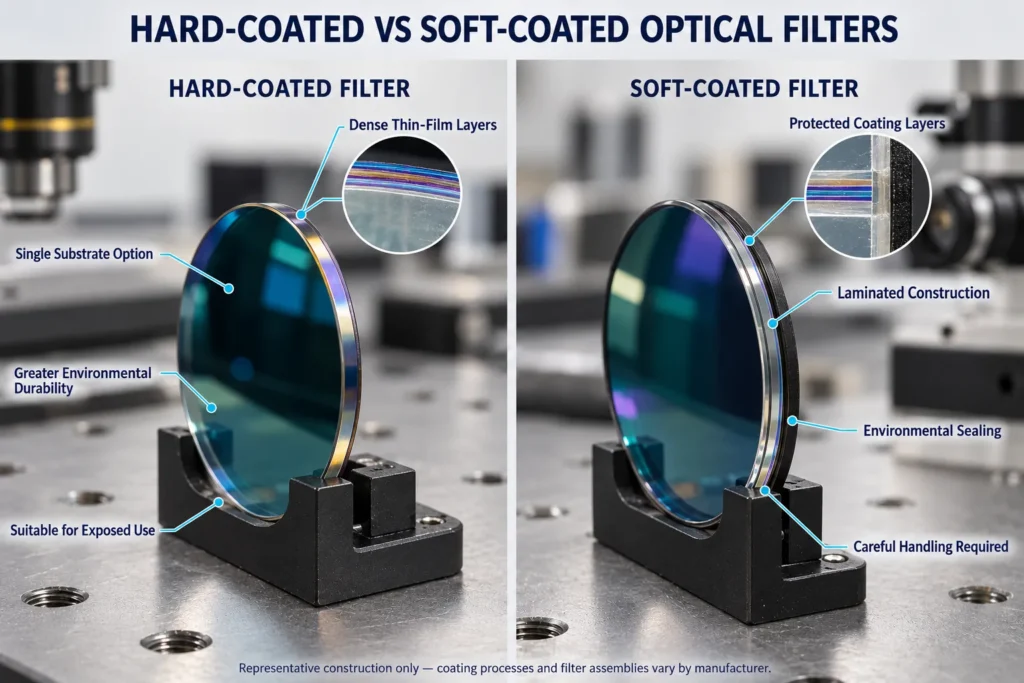 Hard-Coated vs Soft-Coated Optical Filters
In This Guide
Quick Answer
Choose a hard-coated optical filter when:
- Environmental durability is important
- The filter may be exposed to humidity or temperature cycling
- Frequent cleaning is expected
- Long-term spectral stability is required
- A thin single-substrate construction is beneficial
- The filter is used in industrial or outdoor equipment
Consider a soft-coated optical filter when:
- The coating can remain protected inside an assembly
- A laminated or sealed construction is acceptable
- The operating environment is controlled
- The required spectral design is available using a soft-coating process
- Cost and project requirements support this construction
“Hard-coated” does not automatically mean optically superior, and “soft-coated” does not automatically mean unsuitable. The correct choice depends on spectral performance, durability, dimensions, environment and budget.
What Is a Hard-Coated Optical Filter?
A hard-coated filter typically uses dense dielectric thin-film layers deposited on an optical substrate.
Modern hard coatings are commonly produced using dense-film processes such as ion-beam sputtering or advanced magnetron/plasma sputtering. Ion-assisted deposition can also improve film density and durability in some designs. However, the process name alone does not guarantee a hard-coated filter; coating structure and verified environmental performance are the more useful criteria.
The coating is generally more resistant to humidity, moderate cleaning and environmental exposure than traditional soft coatings.
Hard-coated filters may be manufactured on a single substrate without requiring another glass plate to cover the coating. This can reduce thickness and eliminate some problems associated with lamination.
Typical hard-coated products include:
- Bandpass filters
- Longpass filters
- Shortpass filters
- Notch filters
- Dichroic filters
- Fluorescence filters
- Laser-line filters
- Machine-vision filters
The exact durability still depends on the coating materials, deposition process, substrate and environmental qualification.
What Is a Soft-Coated Optical Filter?
A soft-coated filter generally uses coating materials or deposition methods that produce layers more sensitive to moisture, abrasion or cleaning.
The coated surface may therefore be protected by:
- A second glass substrate
- Optical cement
- Edge sealing
- A mounted filter assembly
- A protective cover
Traditional soft-coated filters are often supplied as laminated assemblies. The coating layers are located between two substrates rather than being directly exposed. Some traditional designs use materials such as zinc sulfide and cryolite, and may include metallic layers, absorbing glass, optical cement or edge sealing. Construction varies by supplier, so these materials should not be assumed from the term “soft coated” alone.
Soft coatings can provide useful spectral performance, but their construction may introduce additional considerations:
- Greater total thickness
- Adhesive or cement stability
- Edge-seal durability
- Temperature limitations
- Humidity sensitivity
- Delamination risk
- More restricted cleaning procedures
Not every supplier uses the term “soft coating” in exactly the same way. Buyers should ask whether the coating is exposed, laminated, sealed or protected by another method.
Hard-Coated vs Soft-Coated Optical Filters
| Comparison | Hard-Coated Filter | Soft-Coated Filter |
|---|---|---|
| Typical coating structure | Dense dielectric layers | More environmentally sensitive layers |
| Common construction | Single substrate or assembled component | Often laminated between substrates |
| Environmental durability | Generally higher | Usually requires greater protection |
| Humidity resistance | Commonly better | Depends strongly on sealing |
| Cleaning | Often supports careful surface cleaning | Exposed coating may be easily damaged |
| Thickness | Can be relatively thin | Laminated design may be thicker |
| Temperature stability | Often suitable for wider conditions | May be limited by coating or cement |
| Spectral performance | Design dependent | Design dependent |
| Long-term stability | Generally strong when properly specified | Depends on protection and environment |
| Typical use | Industrial, outdoor and demanding systems | Protected or controlled environments |
| Cost | Process and specification dependent | May be economical for some designs |
| Custom availability | Depends on coating capability | Depends on supplier and spectral design |
This table provides a general comparison. Actual performance must be confirmed using the supplier’s coating construction, test method and environmental specification. Where durability matters, request measurable acceptance criteria for adhesion, abrasion or cleaning, humidity exposure, temperature cycling and spectral shift.
Coating Construction
Hard coatings are normally formed from dense inorganic layers. The high packing density can reduce moisture penetration and improve environmental stability.
A soft-coated filter may contain layers that are more porous or mechanically delicate. Lamination protects these layers, but the finished component then depends on more than the coating alone.
A laminated filter may include:
- Front cover glass
- Optical coating
- Optical cement
- Rear substrate
- Edge seal
- Mechanical housing
Each interface can affect transmission, reflection, wavefront and long-term reliability.
For either filter type, the RFQ should state whether the customer requires a bare filter, a laminated assembly or a mounted component.
Spectral Performance
Spectral performance should be evaluated from measurable requirements rather than the general coating category.
Important specifications include:
- Center wavelength
- FWHM
- Cut-on wavelength
- Cut-off wavelength
- Peak or average transmission
- Optical density, stated as average or absolute minimum
- Blocking range
- Edge steepness
- Passband ripple
- Angle of incidence
- Polarization
A hard-coated filter can provide steep edges and strong blocking, but performance still depends on the coating design and available manufacturing process.
A soft-coated filter can also meet demanding spectral requirements in suitable applications. It should not be rejected only because of its coating category.
Compare the actual transmission curves, tolerance limits and environmental tests supplied for the finished filter.
Temperature and Humidity
Temperature and humidity can affect coating layers, substrates, optical cement and edge seals.
Qualified hard coatings generally offer better resistance to environmental variation because their dense layers are less likely to absorb moisture. However, the label “hard coated” is not a substitute for environmental test data, and coating stress, adhesion and substrate expansion must still be considered.
For soft-coated filters, humidity may enter through damaged or incomplete edge seals. Temperature cycling can also affect cemented interfaces and create stress between different materials.
Specify:
- Minimum operating temperature
- Maximum operating temperature
- Storage temperature
- Humidity exposure
- Thermal cycling
- Condensation conditions
- Required environmental standard
Avoid using only the phrase “outdoor use.” A measurable test requirement provides a clearer basis for filter selection.
Cleaning and Handling
Hard-coated filters are generally more tolerant of careful cleaning, but they are not scratch-proof.
Suitable cleaning depends on:
- Coating materials
- Substrate
- Surface quality
- Type of contamination
- Approved solvent
- Cleaning tool
- Applied pressure
A soft coating should not be touched or wiped unless the manufacturer has approved the cleaning method. If the coating is laminated, only the exterior glass surfaces should normally be cleaned.
For either type:
- Wear clean gloves
- Avoid touching the clear aperture
- Remove loose dust before wiping
- Use coating-compatible materials
- Store the filter in protective packaging
- Do not use unapproved solvents
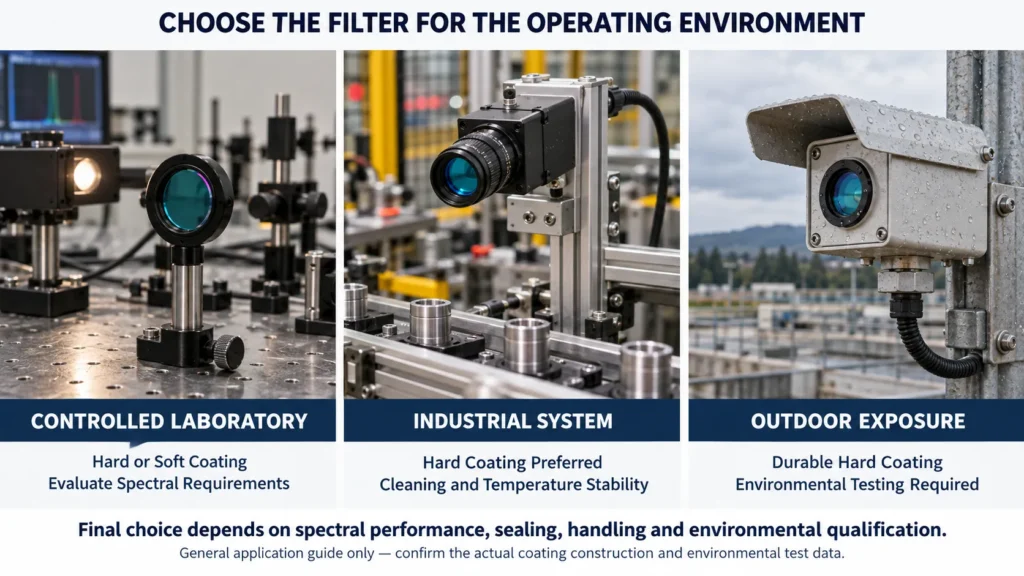 Optical Filter Selection by Operating Environment
Optical Thickness and Wavefront
A laminated soft-coated filter may be thicker than a single-substrate hard-coated filter.
In a converging or imaging beam, additional thickness can affect:
- Focus position
- Optical path length
- Spherical aberration
- Transmitted wavefront
- Mechanical clearance
Cement layers and multiple substrates may also contribute to wedge or transmitted-wavefront variation.
If the filter is used in a precision imaging system, specify the total thickness, thickness tolerance, parallelism and transmitted-wavefront requirement.
Angle of Incidence
Interference filters change spectral position when tilted. The passband normally shifts toward shorter wavelengths as the angle of incidence increases.
At larger angles, s- and p-polarized light can produce different spectral responses.
For both hard- and soft-coated filters, provide:
- Nominal angle of incidence
- Allowed angular range
- Illumination cone angle
- System f-number
- Polarization state
Coating durability does not prevent angle-dependent spectral shift. This is an optical property of the interference design.
Which Filter Type Is Better for Different Applications?
Industrial Machine Vision
Hard-coated filters are often preferred because they can provide good durability, stable spectral performance and practical cleaning.
Fluorescence Imaging
High-performance hard coatings are widely used, particularly when steep edges and strong blocking are required. The actual spectral curves remain the primary selection criteria.
Protected Laboratory Instruments
Either type may be suitable when the environment is controlled and the filter is protected inside the instrument.
Outdoor Sensors
A hard-coated filter with appropriate environmental qualification is normally the stronger starting point.
High-Temperature or Thermal-Cycling Systems
Evaluate the coating, substrate, cement, mount and sealing method. Laminated construction may introduce additional temperature limitations.
Cost-Sensitive Equipment
Compare complete filter specifications rather than assuming one technology is always cheaper. Quantity, size, coating complexity and inspection requirements all affect price.
Common Selection Mistakes
Assuming Hard Coating Always Has Better Spectral Performance
Coating durability and spectral performance are different characteristics. Compare the actual filter curves and tolerances.
Treating Every Soft-Coated Filter as the Same
Some are exposed, some are laminated and others use sealed assemblies. Construction should be confirmed.
Ignoring the Edge Seal
A damaged edge seal can expose sensitive coating layers to humidity.
Cleaning a Filter Without Checking the Coating
An unsuitable cleaning method can scratch the surface, damage the coating or weaken the seal.
Specifying Only a Coating Type
“Hard coated” or “soft coated” does not define CWL, bandwidth, transmission, OD or blocking range.
How to Specify a Custom Optical Filter
A complete RFQ should include:
- Filter type
- Operating wavelength
- CWL or edge wavelengths
- FWHM when applicable
- Required transmission
- Optical density
- Blocking range
- Angle of incidence
- Polarization
- Filter dimensions
- Clear aperture
- Surface quality
- Transmitted wavefront when required
- Total thickness, parallelism or wedge when relevant
- Operating environment and measurable environmental test conditions
- Whether lamination, edge sealing or multiple substrates are permitted
- Coating orientation and approved cleaning method
- Cleaning requirements
- Quantity and documentation
If coating construction is important, state whether a single-substrate, laminated, sealed or mounted filter is required.
Frequently Asked Questions
Are Hard-Coated Filters Scratch-Proof?
No. They are generally more durable than soft coatings, but improper handling or cleaning can still damage them.
Do Soft-Coated Filters Always Need Lamination?
Not always, but sensitive coatings often require protection through lamination, sealing or installation inside a protected assembly.
Do Hard-Coated Filters Have Better Transmission?
Not automatically. Transmission depends on the coating design, substrate and spectral requirements.
Can a Soft-Coated Filter Be Used Outdoors?
Possibly, if it has suitable sealing and verified environmental performance. A durable hard coating is usually the safer starting point.
What Information Is Needed for a Custom Filter Quote?
Provide the spectral requirements, dimensions, AOI, polarization, environment, coating construction, quantity and inspection requirements.
Custom Optical Filters from Chenyu Optics
Chenyu Optics supports drawing-based custom bandpass, longpass, shortpass, notch and other optical filters for imaging, sensing, laser and industrial systems.
Requirements can be reviewed according to:
- Filter type
- Center or edge wavelength
- FWHM
- Peak or average transmission
- Optical density
- Blocking wavelength range
- Angle of incidence
- Polarization
- Filter dimensions
- Clear aperture
- Surface quality
- Operating environment
- Prototype and production quantities
- Inspection and packaging requirements
Final specifications should be confirmed according to the approved drawing, coating design, environmental requirements and available measurement method.
Need Help Selecting an Optical Filter?
Send Chenyu Optics your wavelength range, transmission, OD, blocking range, AOI, dimensions, operating environment and quantity. We can review the filter construction and prepare a quotation based on the agreed specification.