
Spherical and aspheric lenses can both focus, collimate and image light, but their surface shapes and optical performance are different.
A spherical lens has a constant radius of curvature and is generally easier and less expensive to manufacture. An aspheric lens has a curvature that changes from the center to the edge, allowing it to reduce spherical aberration and produce a smaller focused spot.
Choose a spherical lens for cost-sensitive systems with moderate performance requirements. Choose an aspheric lens for high-NA focusing, laser-diode collimation, fiber coupling or compact optical systems requiring better aberration control.
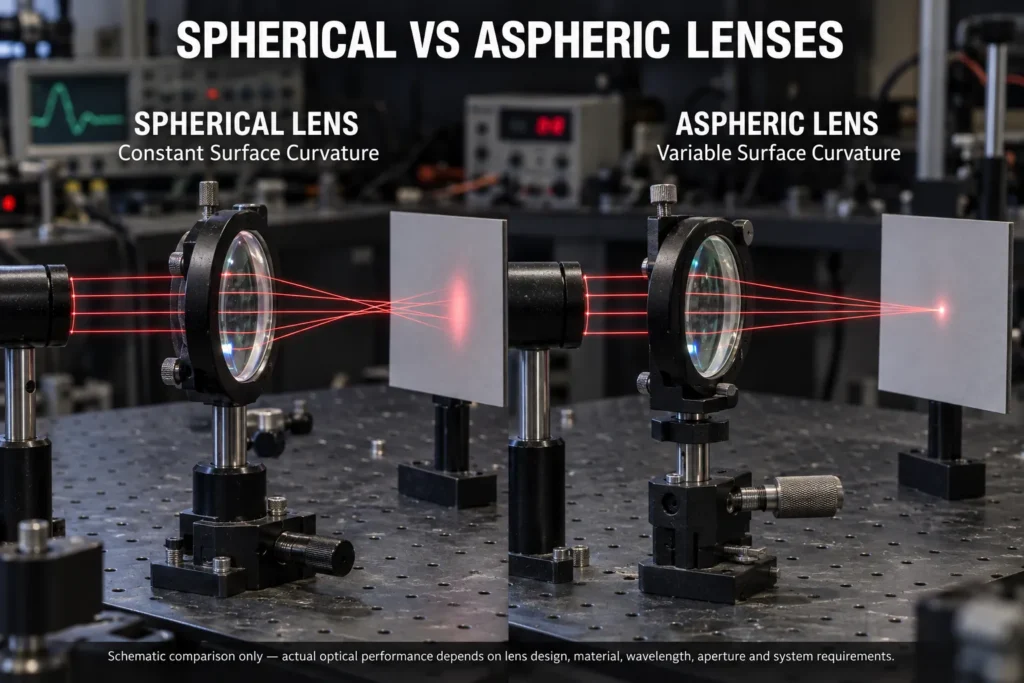 Spherical vs Aspheric Lens Comparison
In This Guide
Quick Answer: Spherical or Aspheric Lens?
Choose a spherical lens when lower cost, standard geometry and shorter lead time are priorities.
Choose an aspheric lens when spherical aberration must be reduced or a smaller focused spot is required.
Choose an aspheric lens for high-numerical-aperture systems, laser-diode collimation, fiber coupling and efficient light collection.
Choose spherical lenses when standard components or several economical elements can provide the required performance.
Consider an achromatic lens when broadband chromatic correction is more important than monochromatic spherical-aberration correction.
Important: An aspheric lens is not automatically better for every system. Final performance depends on wavelength, aperture, conjugates, alignment, manufacturing accuracy and the complete optical design.
What Is a Spherical Lens?
A conventional spherical lens uses one or two spherical powered surfaces with a constant radius of curvature; one surface may also be plano.
Common forms include:
- Plano-convex lenses
- Double-convex lenses
- Plano-concave lenses
- Double-concave lenses
- Meniscus lenses
Spherical lenses are widely used because they are relatively straightforward to manufacture, polish, inspect and coat. Many standard focal lengths, diameters and materials are readily available.
Their main limitation is spherical aberration. Rays passing near the edge of a spherical lens may focus at a different position from rays passing near the optical axis.
What Is an Aspheric Lens?
An aspheric lens has at least one surface whose curvature changes from the center toward the edge.
Its surface may be defined using a vertex radius, conic constant and additional aspheric coefficients. These parameters allow the designer to control how rays at different heights are refracted.
A properly designed aspheric surface can significantly reduce spherical aberration. It may produce a smaller focused spot, improve light collection and help reduce the number of elements in an optical assembly.
Aspheric lenses are commonly used in:
- Laser-diode collimation
- Fiber coupling
- Compact imaging systems
- Medical instruments
- Illumination optics
- Barcode scanners
- High-NA focusing systems
Spherical vs Aspheric Lenses: Key Differences
| Feature | Spherical lens | Aspheric lens |
|---|---|---|
| Surface curvature | Constant radius | Changes from center to edge |
| Spherical aberration | Inherent in a spherical singlet | Can be significantly reduced |
| Focused spot | Generally larger at low f-number under comparable focal-length, aperture and conjugate conditions | Can be smaller with the correct design |
| Numerical aperture | Better suited to moderate NA | Suitable for high-NA applications |
| Number of elements | May require several elements | May replace multiple spherical elements |
| Manufacturing | Established and relatively simple | More complex fabrication and inspection |
| Availability | Many standard options | Standard and custom options, but more design-specific |
| Typical cost | Usually lower | Usually higher per element |
| Main applications | General imaging, focusing and beam control | Laser collimation, fiber coupling and compact imaging |
Disclaimer: This table provides general guidance for preliminary lens selection. Actual performance and cost depend on material, focal length, aperture, aspheric departure, tolerances, quantity and inspection requirements.
What Is Spherical Aberration?
Spherical aberration occurs when rays passing through different parts of a spherical lens focus at different axial positions.
Central rays and edge rays therefore do not form one common focal point. The result may be a larger blur, reduced image contrast or lower fiber-coupling efficiency.
Spherical aberration becomes more noticeable when:
- The lens operates at a low f-number
- A large portion of the aperture is used
- The numerical aperture is high
- A small focused spot is required
- The lens has strong optical power
An aspheric surface changes its curvature across the aperture so that central and marginal rays can be directed closer to a common focus.
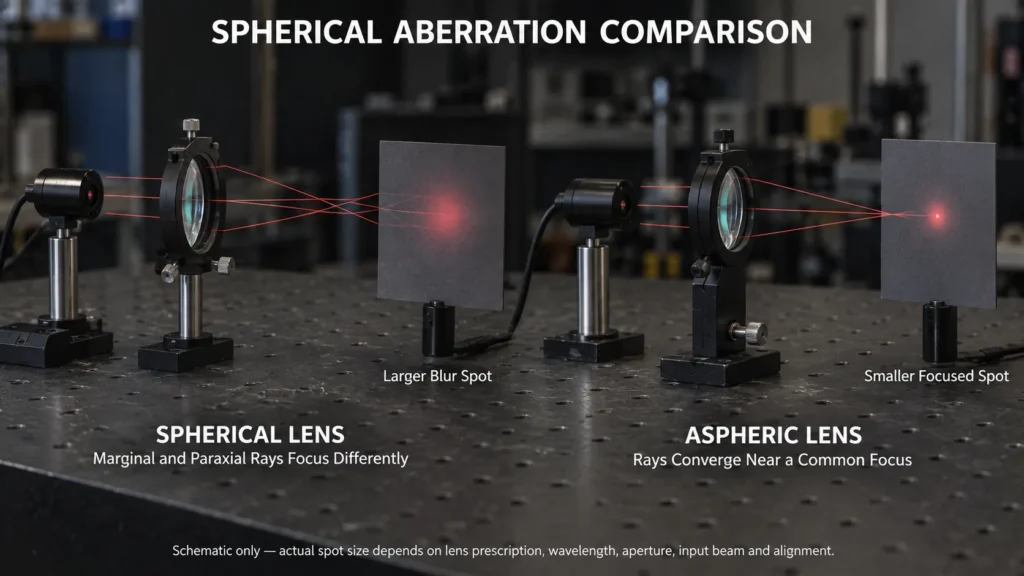 Spherical Aberration in Spherical and Aspheric Lenses
When Should You Choose a Spherical Lens?
A spherical lens is usually appropriate when:
- The optical requirements are moderate
- The system operates at a relatively high f-number
- Only part of the clear aperture is used
- Cost and lead time are important
- Standard focal lengths and diameters are acceptable
- Multiple spherical elements can balance the aberrations
Spherical lenses are practical for general illumination, laboratory systems, moderate-resolution imaging and many beam-control applications.
When Should You Choose an Aspheric Lens?
An aspheric lens should be considered when:
- A smaller focused spot is required
- The numerical aperture is high
- Efficient light collection is important
- A laser diode must be collimated
- Light must be coupled into a fiber
- The system must be compact
- One asphere may replace several spherical elements
An aspheric lens may cost more individually but reduce the number of lenses, mounts and alignment steps in the complete system.
Do Aspheric Lenses Correct Chromatic Aberration?
Not automatically.
An aspheric surface controls geometric aberrations through its shape. Chromatic aberration is caused by material dispersion, which means different wavelengths experience different refractive indices.
A single-material aspheric lens can therefore still focus different wavelengths at different positions.
For broadband applications, consider:
- Achromatic doublets
- Aspherized achromats
- Multiple optical materials
- Multi-element lens systems
- Reflective optics
A single-material aspheric singlet can reduce geometric aberrations, but it does not independently correct axial chromatic aberration.
Manufacturing and Cost
Spherical lenses are commonly produced by grinding, polishing, centering, edging and coating. Their geometry can be inspected using established interferometric methods.
Aspheric lenses may be manufactured by:
- Precision grinding and polishing
- CNC polishing
- Precision glass molding
- Diamond turning
- Polymer molding
The most suitable process depends on the material, diameter, surface departure, tolerance and production quantity.
Precision glass molding can reduce the unit cost of suitable aspheric lenses at higher volumes. Custom polished aspheres generally require more complex manufacturing and inspection.
Material, Coating and Specifications
Common lens materials include:
- N-BK7 for economical visible and NIR systems
- Fused silica for UV, laser and thermal applications
- Calcium fluoride for UV-to-mid-IR systems
- Silicon for wavelengths above approximately 1.2 µm through the MWIR region
- Germanium for thermal imaging
- ZnSe for broadband IR and CO2 lasers
An AR coating should be defined by wavelength, angle of incidence, reflectance or transmission and environmental durability.
For a custom lens, provide:
- Material and grade
- Operating wavelength
- Diameter and focal length
- Center and edge thickness
- Surface quality
- Surface figure
- Centration
- Clear aperture
- AR coating
- Quantity and inspection requirements
For an aspheric lens, also provide the vertex radius, conic constant, aspheric coefficients, surface-equation and coefficient sign convention, datum definition, decenter and tilt tolerances, aspheric figure error, slope error, valid clear aperture and approved inspection method.
Common Selection Mistakes
Assuming an Aspheric Lens Is Always Better
A spherical lens may meet moderate requirements at a lower cost.
Assuming an Asphere Corrects Every Aberration
An asphere can reduce spherical and other geometric aberrations but does not automatically eliminate chromatic or off-axis errors.
Comparing Only the Individual Lens Price
An aspheric lens may reduce the total number of elements and simplify assembly.
Ignoring Alignment Sensitivity
High-performance aspheres can be sensitive to decentration, tilt and spacing errors.
Omitting the Aspheric Surface Equation
The drawing should state the radius, conic constant, coefficients, coordinate convention and valid aperture.
Frequently Asked Questions
What Is the Main Difference Between Spherical and Aspheric Lenses?
A spherical surface has a constant radius. An aspheric surface changes curvature from the center toward the edge.
Do Aspheric Lenses Eliminate Spherical Aberration?
A correctly designed asphere can significantly reduce spherical aberration under its specified operating conditions. It does not guarantee aberration-free performance in every system.
Are Aspheric Lenses Better for Lasers?
They are often preferred for laser-diode collimation, fiber coupling and high-NA focusing. Spherical lenses remain suitable for many moderate-aperture laser systems.
Are Aspheric Lenses More Expensive?
They usually have higher manufacturing and inspection costs. Molding can make suitable aspheric designs economical at higher production quantities.
Can One Aspheric Lens Replace Several Spherical Lenses?
Sometimes. An aspheric element may provide enough aberration correction to reduce the number of lenses, but this must be verified against field of view, wavelength range, tolerances and the complete optical design.
Custom Spherical and Aspheric Lenses from Chenyu Optics
Chenyu Optics manufactures custom spherical and aspheric lenses for laser, imaging, illumination, sensing and industrial optical systems.
Custom components can be evaluated according to:
- Optical material
- Operating wavelength
- Spherical or aspheric surface design
- Diameter and focal length
- Surface quality and figure
- Aspheric form and slope error
- Centration and clear aperture
- AR coating
- Prototype or production quantity
- Inspection requirements
Final specifications should be confirmed according to the customer drawing, optical model, surface equation, material, coating design and available inspection method.
Need Help Choosing a Spherical or Aspheric Lens?
Send us your operating wavelength, focal length, dimensions, aperture, coating and performance requirements.
Chenyu Optics can help evaluate whether a spherical or aspheric lens is the more practical manufacturing solution for your optical system.