
Fused silica and BK7 are two common materials for optical windows. Both provide good transmission in the visible spectrum, but they differ in ultraviolet performance, thermal expansion, refractive index, temperature resistance and cost.
BK7 is often selected for economical visible and near-infrared applications. Fused silica is generally preferred for ultraviolet transmission, demanding temperature conditions and selected laser systems. The correct choice depends on wavelength, environment, coating and required optical performance.
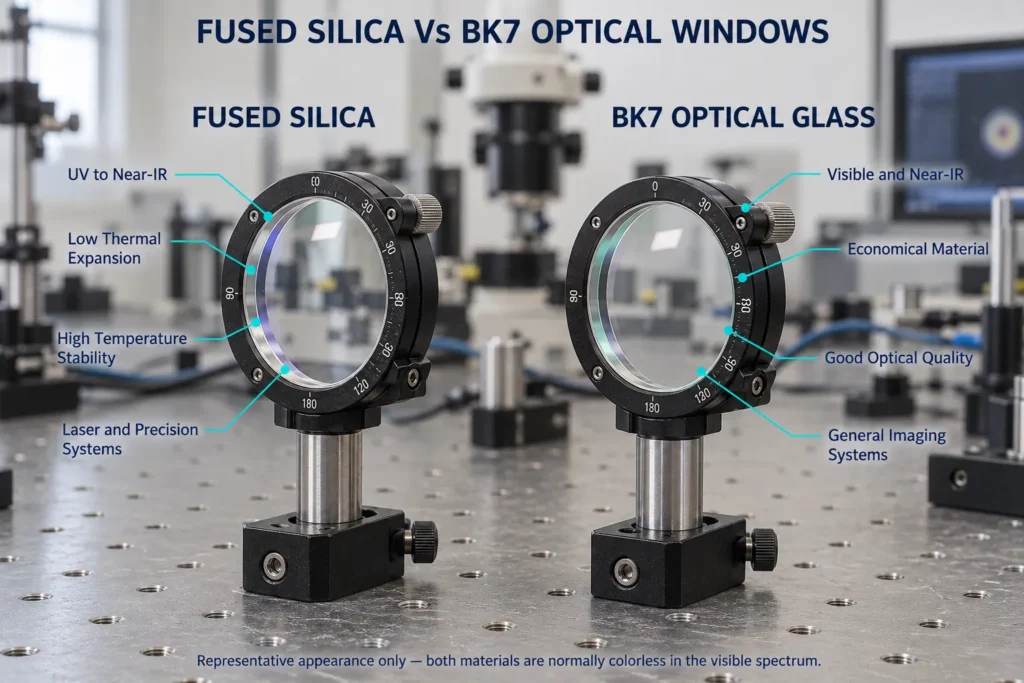 Fused Silica vs BK7 Optical Windows
In This Guide
Quick Answer
Choose fused silica when:
- Ultraviolet transmission is required
- The window experiences temperature changes
- Low thermal expansion is important
- High material purity is required
- The component is used in a demanding laser system
- Thermal shock resistance is important
Choose BK7 when:
- The system operates primarily in the visible spectrum
- Near-infrared transmission is required within a suitable range
- Operating temperatures are moderate
- Cost is an important consideration
- A standard imaging or protective window is needed
For new designs, “BK7” often refers to the general glass type, while current material specifications may use a particular supplier grade such as N-BK7. The exact glass designation should be stated on the drawing.
What Is Fused Silica?
Fused silica is a noncrystalline form of silicon dioxide. Unlike optical glass, it does not contain a conventional mixture of multiple glass-forming oxides.
It is valued for:
- Good ultraviolet transmission
- Low thermal expansion
- High thermal stability
- Good chemical resistance
- Low fluorescence in suitable grades
- High purity
- Good optical homogeneity
Different fused-silica grades are available for ultraviolet, visible, near-infrared and laser applications. Manufacturing method and impurity content can affect UV transmission, infrared absorption and fluorescence.
Common applications include:
- UV imaging windows
- Laser windows
- Semiconductor equipment
- Spectroscopy
- Scientific instruments
- Thermally stable viewports within the limits of the selected grade and assembly
- Precision optical systems
The term “fused quartz” is sometimes used in a related context, but fused silica and fused quartz may be produced from different raw materials. The exact grade should be confirmed rather than relying on the general name alone.
What Is BK7 Optical Glass?
BK7 is a borosilicate crown optical glass widely used for lenses, prisms, windows and other optical components.
Modern drawings frequently specify a current equivalent grade such as N-BK7. Supplier-specific equivalents may have similar optical properties, but they should not be assumed to be identical without reviewing the relevant datasheet.
BK7 is popular because it provides:
- Good visible transmission
- Good optical homogeneity
- Consistent refractive-index data
- Good polishing characteristics
- Broad commercial availability
- Lower cost than fused silica in many applications
Typical applications include:
- Protective optical windows
- Machine-vision systems
- Camera and sensor covers
- Laboratory instruments
- Visible-light optics
- General laser alignment systems
- Prisms and lenses
BK7 is normally a practical choice when UV performance and extreme thermal stability are not required.
Fused Silica vs BK7: Key Differences
| Comparison | Fused Silica | BK7 Optical Glass |
|---|---|---|
| Material structure | Amorphous silicon dioxide | Multicomponent optical glass |
| Visible appearance | Colorless | Colorless |
| UV transmission | Generally better | More limited in the UV |
| Visible transmission | Good | Good |
| Near-IR use | Suitable within grade-dependent range | Suitable within glass-dependent range |
| Typical thermal expansion | Approximately 0.5 × 10⁻⁶/K for representative HPFS grades | 7.1 × 10⁻⁶/K for N-BK7 from −30 to +70°C |
| Thermal stability | Generally better | Suitable for moderate conditions |
| Thermal shock resistance | Generally stronger | More sensitive to rapid temperature change |
| Typical visible refractive index | Approximately 1.46, depending on grade and wavelength | nd = 1.5168 for N-BK7 |
| Laser use | Common for demanding UV and laser systems | Suitable for many lower-demand systems |
| Material cost | Usually higher | Usually more economical |
| Typical use | UV, laser and thermal applications | General visible imaging and protection |
This table provides a general comparison. The numerical values are representative reference values, not universal guarantees. Actual performance depends on the exact material grade, wavelength, temperature, thickness, surface quality and coating.
1. Transmission Range
Fused silica generally provides better transmission into the ultraviolet than BK7. UV-grade fused silica is commonly selected for applications below the useful UV range of standard optical glass. BK7 still has useful near-UV transmission in some thicknesses and applications; it should not be described as completely opaque to ultraviolet light.
Both materials provide good visible transmission when properly polished and coated.
In the near-infrared, useful transmission depends on:
- Material grade
- Window thickness
- Hydroxyl content
- Internal absorption
- Surface reflection
- Coating
- Required minimum transmission
A broad supplier transmission range is not the same as guaranteed finished-window performance. Transmission can decrease near the limits of the material range even if the material is technically described as transmitting there. Fused-silica UV and near-infrared performance also varies with grade and hydroxyl content. Published internal transmittance excludes surface-reflection losses and is therefore not the same as the transmission of an uncoated finished window.
Request a finished-component transmission specification over the actual wavelength band.
2. Refractive Index and Reflection
BK7 has a higher refractive index than fused silica in the visible spectrum.
This affects:
- Surface reflection
- Optical path length
- Beam displacement
- Lens power
- Focus shift when replacing a window
- Coating design
At normal incidence in visible light, a representative uncoated fused-silica surface reflects approximately 3.5%, while an N-BK7 surface reflects approximately 4.2%. These are refractive-index-based estimates; the exact value depends on wavelength and grade. Both materials may require an antireflection coating when high transmission or low ghost reflection is important.
A fused-silica window should not replace a BK7 window in a precision system without checking optical path length, thickness and focus position.
3. Thermal Expansion
Fused silica has substantially lower thermal expansion than BK7.
This makes it useful when a window experiences:
- Wide temperature changes
- Rapid heating or cooling
- Temperature gradients
- Precision dimensional requirements
- Heat from nearby equipment
- Thermal cycling
Low expansion can reduce dimensional change and thermally induced stress, but the complete assembly must still be evaluated.
The mount, seal and window can have different thermal-expansion rates. A rigid mount may stress either material as temperature changes.
BK7 remains suitable for many laboratory, imaging and industrial applications where the temperature range is moderate and well controlled.
4. Temperature and Thermal Shock
Fused silica generally provides better resistance to rapid temperature change than BK7 because of its low thermal expansion.
However, the allowable operating temperature of a finished window also depends on:
- Window dimensions
- Edge quality
- Mounting method
- Temperature gradient
- Coating
- Adhesive or seal
- Heating rate
- Mechanical load
A high-temperature fused-silica substrate can still fail if it is clamped incorrectly or combined with an unsuitable coating or adhesive.
The RFQ should therefore specify both the operating temperature and the expected temperature-change conditions.
5. Laser Performance
Fused silica is widely used for UV, visible and near-infrared laser windows. Suitable grades can offer low absorption, good homogeneity and high material purity.
BK7 can also be used in many laser systems, particularly where power density is moderate and UV transmission is not required.
Laser suitability depends on more than the material name. Review:
- Wavelength
- Average power
- Pulse energy
- Pulse duration
- Repetition rate
- Beam diameter
- Surface quality
- Subsurface damage
- Coating absorption
- Surface cleanliness
- Laser-induced damage threshold
A fused-silica window does not automatically guarantee a particular damage threshold. Material grade, polishing and coating must be specified together.
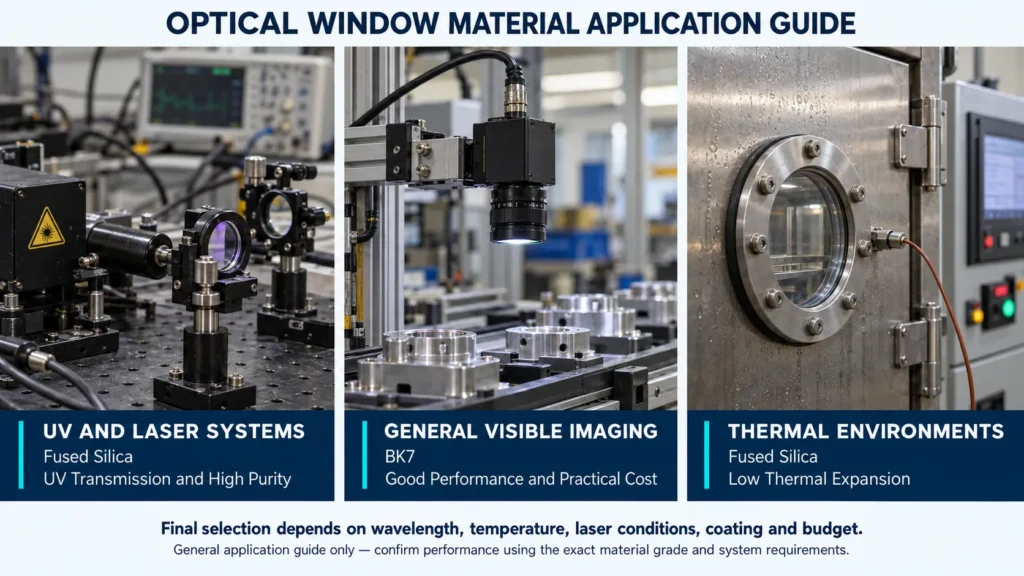 Fused Silica and BK7 Application Guide
6. Mechanical and Chemical Durability
Both materials can be manufactured into durable optical windows when they are correctly polished, mounted and protected.
Fused silica offers good chemical resistance and environmental stability. BK7 also performs well in many indoor and controlled industrial environments but may be less suitable for severe thermal or chemical exposure.
Mechanical performance depends on:
- Window diameter
- Thickness
- Unsupported aperture
- Edge chips
- Surface damage
- Mounting stress
- Pressure difference
- Shock and vibration
Fused silica should not automatically be considered stronger in every mechanical design. Pressure and safety-critical windows require application-specific structural evaluation.
7. Surface Quality and Flatness
Both fused silica and BK7 can be polished to demanding optical specifications.
Common drawing requirements include:
- Surface quality
- Surface flatness
- Parallelism or wedge
- Clear aperture
- Transmitted wavefront
- Surface roughness
- Chamfer or bevel
Material choice does not replace these specifications.
A 20-10 fused-silica window and a 20-10 BK7 window have the same nominal scratch-dig requirement under the same inspection standard, but they can still differ in flatness, absorption and thermal performance.
Large thin windows may also deform during polishing, measurement or mounting. Thickness and support conditions should be reviewed together with flatness.
8. Optical Coating
Both materials may be used without a coating when reflection loss is acceptable. For higher transmission, an application-specific AR coating is commonly used.
Specify:
- Wavelength or wavelength band
- Angle of incidence
- Polarization when relevant
- Average or maximum reflectance
- Minimum transmission
- Number of coated surfaces
- Environmental durability
- Laser requirements when applicable
A coating designed for BK7 should not automatically be applied to fused silica. Different refractive indices require different coating designs.
Which Material Is Better for Different Applications?
UV Optical Windows
Fused silica is normally the preferred starting point because of its better ultraviolet transmission.
Visible Camera Windows
BK7 is often suitable when temperature conditions are moderate and practical cost is important.
Laser Windows
Fused silica is widely used for demanding systems, but the final choice must consider laser parameters, polishing and coating.
High-Temperature Equipment
Fused silica generally provides better thermal stability and lower expansion. However, the allowable temperature of the finished window still depends on dimensions, edge quality, mounting, seals and coating, not only on the substrate.
General Laboratory Optics
Either material may be suitable. BK7 is often selected for economical visible-light components.
Precision Thermal-Cycling Systems
Fused silica is normally more relevant when dimensional stability across temperature is required.
Common Selection Mistakes
Treating BK7 and N-BK7 as Automatically Identical
State the exact material grade or approved equivalent on the drawing.
Selecting Material Only by a Published Transmission Range
Finished-window transmission depends on grade, thickness, surface reflection and coating.
Assuming Fused Silica Is Always Necessary
BK7 may provide adequate performance at a lower cost for standard visible applications.
Ignoring Thermal Expansion
Material and mount expansion can produce stress and optical distortion.
Specifying Only “AR Coated”
Include the wavelength band, angle of incidence and measurable reflection or transmission target.
Frequently Asked Questions
Is Fused Silica Better Than BK7?
It is better for many UV and thermally demanding applications. BK7 may be the more economical choice for standard visible systems.
Can BK7 Transmit UV Light?
BK7 has some near-UV transmission, but its useful UV range is more limited than UV-grade fused silica.
Which Material Is Better for Lasers?
Fused silica is common for demanding laser systems, but wavelength, power, pulse conditions, polishing and coating must all be considered.
Do Fused Silica and BK7 Look Different?
Both normally appear colorless in the visible spectrum. They cannot be reliably identified by appearance alone.
Do Both Materials Need an AR Coating?
Not always. An AR coating is commonly used when higher transmission or reduced ghost reflection is required.
Custom Fused Silica and BK7 Windows from Chenyu Optics
Chenyu Optics supports drawing-based custom fused-silica and BK7 optical windows for imaging, laser, sensing, industrial and scientific systems.
Requirements can be reviewed according to:
- Exact material grade or explicitly approved equivalents
- Operating wavelength
- Minimum finished-window transmission at the specified thickness
- Circular, rectangular or custom shape
- Diameter and thickness
- Operating temperature range and rate of temperature change
- Mounting method and pressure differential when applicable
- Dimensional tolerances
- Surface quality
- Surface flatness
- Parallelism or wedge
- Clear aperture
- Transmitted wavefront
- Optical coating, number of coated surfaces and reflectance requirement per surface
- For lasers: pulse duration, repetition rate, beam diameter and LIDT test conditions
- Prototype and production quantities
- Inspection and packaging requirements
Final specifications should be confirmed according to the application, exact material grade, approved drawing and available inspection method.
Need Help Choosing Fused Silica or BK7?
Send Chenyu Optics your wavelength, dimensions, operating temperature, laser conditions, coating requirements and quantity. We can review the manufacturing requirements and provide a quotation based on the approved drawing.