
A double-concave lens is a negative lens with two inward-curved surfaces. It causes collimated light to diverge and forms a virtual focal point on the incident side of the lens.
Double-concave lenses are commonly used for beam expansion, light projection, image reduction and increasing the effective focal length of an optical system. They can also be combined with positive lenses in laser beam expanders, telescopes and other multi-element optical assemblies.
Because both surfaces provide negative optical power, a double-concave lens is often useful when the object and image conjugates are relatively similar. For a collimated beam or strongly unequal conjugates, a plano-concave lens may provide better aberration performance.
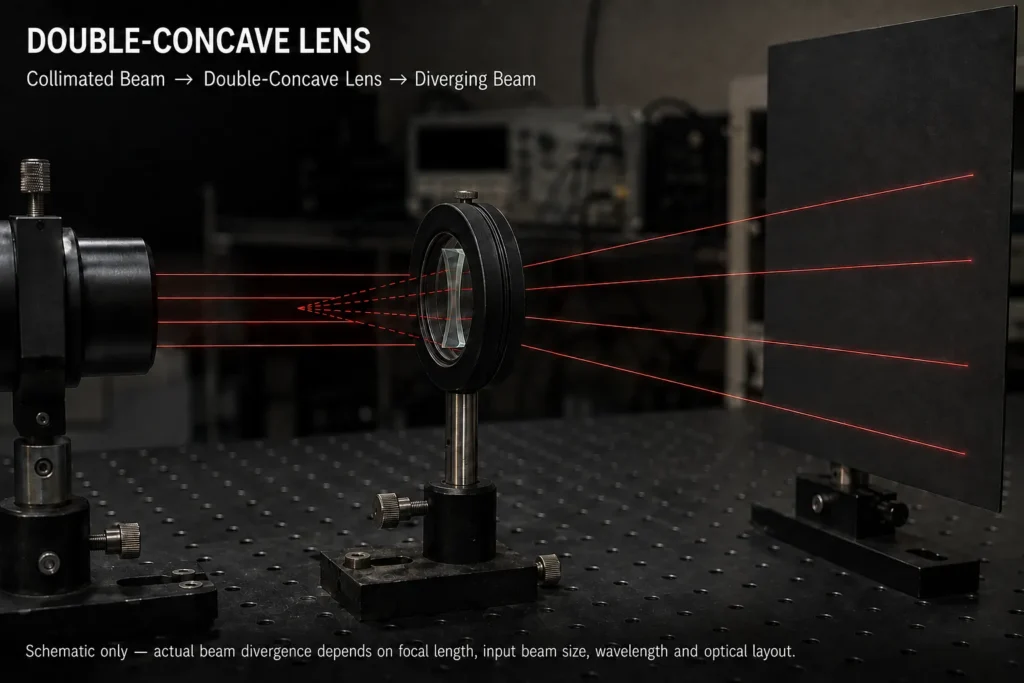 Double-Concave Lens Diverging a Collimated Light Beam
In This Guide
Quick Answer: When Should You Use a Double-Concave Lens?
Use a double-concave lens when a collimated or converging beam needs to be expanded or diverged.
Use a double-concave lens for light projection and image-reduction applications.
Use a double-concave lens with a positive lens to build a Galilean beam expander.
Use a double-concave lens to increase the effective focal length of an existing optical system.
Choose a double-concave lens when both conjugates are finite and relatively similar.
Choose a plano-concave lens instead for many collimated-beam applications with strongly unequal conjugates.
Choose a negative achromatic lens when broadband operation and reduced chromatic aberration are important.
Important: These are general selection guidelines. Final performance depends on focal length, diameter, surface radii, material, wavelength, conjugate ratio, coating and the complete optical design.
What Is a Double-Concave Lens?
A double-concave lens, also called a bi-concave or DCV lens, has:
- Two inward-curved surfaces
- A negative focal length
- A center thickness smaller than its edge thickness
- Negative optical power
When a collimated beam passes through the lens, the rays spread outward. If the diverging rays are traced backward, they appear to originate from a virtual focal point on the input side.
Unlike a positive lens, a double-concave lens cannot focus a collimated beam to a real point by itself. However, it can modify the convergence or divergence of an existing beam and is therefore useful in multi-element systems.
How Does a Double-Concave Lens Work?
The two concave surfaces refract light away from the optical axis. A collimated input beam becomes divergent after passing through the lens.
The amount of divergence depends primarily on:
- Negative focal length
- Input beam diameter
- Lens position
- Refractive index
- Operating wavelength
- Clear aperture
A shorter negative focal length produces stronger divergence. A longer negative focal length produces a smaller change in beam angle.
The focal point of a double-concave lens is virtual. It is located on the same side of the lens as the incoming collimated light.
When the lens is placed in a converging beam, it reduces the convergence angle and moves the final focus farther from the lens system. This allows a double-concave lens to increase the effective focal length or working distance of an optical assembly.
What Are Double-Concave Lenses Used For?
1. Laser Beam Expansion
One of the most common uses is expanding a laser beam.
A negative double-concave lens can be combined with a positive lens to form a Galilean beam expander. The negative lens causes the input beam to diverge, and the positive lens recollimates it at a larger diameter.
A larger beam diameter can be useful for:
- Reducing beam divergence
- Filling the aperture of another optical component
- Reducing optical power density
- Improving downstream focusing
- Supporting laser scanning or processing
Beam-expander performance depends on lens spacing, focal lengths, beam quality and alignment.
2. Light Projection
A double-concave lens spreads light over a wider area. It may be used in illumination and projection systems where a narrow beam must be expanded.
Typical examples include:
- LED illumination
- Projection systems
- Inspection lighting
- Machine-vision illumination
- Scientific instruments
- Laboratory light sources
A diffuser may be more appropriate when uniform intensity is more important than controlled optical divergence.
3. Image Reduction
A double-concave lens can create a smaller virtual image. It may be used for image reduction or as one element in a multi-lens imaging system.
Because a negative singlet introduces chromatic and geometric aberrations, it is normally used for moderate-performance applications or as part of an optimized optical assembly.
4. Increasing System Focal Length
Placing a negative lens in front of or within a positive optical system can increase the effective focal length.
This principle is used in:
- Telephoto optical systems
- Telescope assemblies
- Imaging systems
- Laser focusing systems
- Optical test equipment
The negative lens changes the ray angles before the light reaches the positive focusing group. This can increase focal length without requiring the same physical system length as a single long-focus positive lens.
5. Adjusting a Converging Beam
A double-concave lens placed in a converging beam reduces its convergence.
Depending on its position, the lens can:
- Move the focal point farther away
- Increase working distance
- Reduce numerical aperture
- Modify the beam diameter at another component
- Match a beam to a detector or aperture
Accurate positioning is important because a small spacing change may cause a significant shift in the final focus.
6. Balancing Aberrations
A double-concave lens can be combined with positive optical elements to help balance system aberrations.
A negative lens may contribute negative spherical aberration that partially compensates for positive spherical aberration introduced by another lens.
This is a system-level design function and should be evaluated through optical analysis rather than using the negative lens alone.
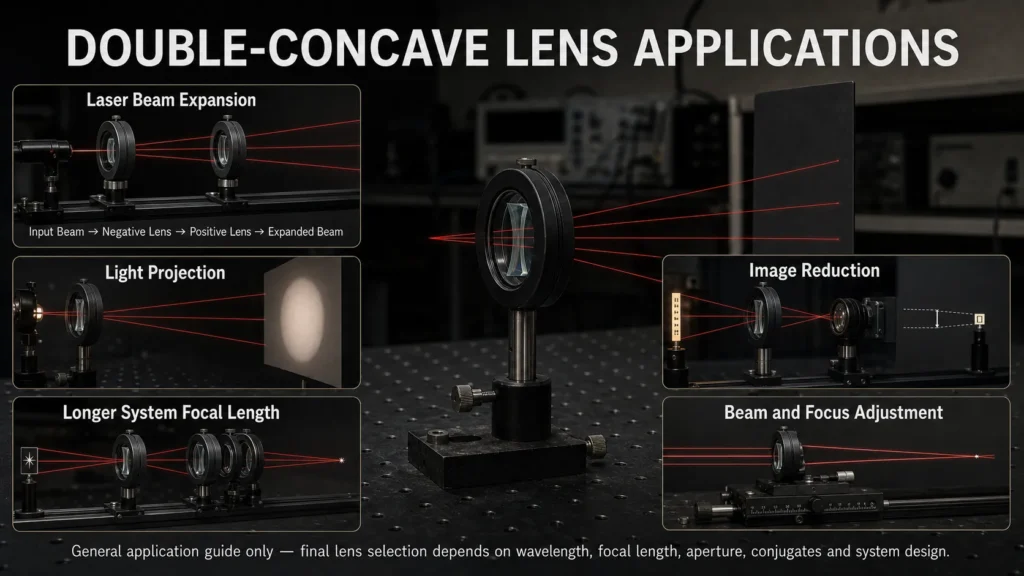 This application guide is intended for preliminary lens selection. Final performance should be confirmed using the complete optical layout, operating wavelength, beam conditions and aberration requirements.
Double-Concave vs Plano-Concave Lenses
Both double-concave and plano-concave lenses have negative focal lengths and cause light to diverge. However, their different shapes suit different optical conditions.
| Feature | Double-concave lens | Plano-concave lens |
|---|---|---|
| Optical surfaces | Two concave surfaces | One concave and one flat surface |
| Focal length | Negative | Negative |
| Main function | Beam divergence and focal-length modification | Beam divergence and expansion |
| Conjugate condition | Often suitable for more balanced finite conjugates | Often suitable for collimated light or unequal conjugates |
| Orientation sensitivity | Low when both surfaces have equal radii | Curved surface normally faces the collimated side |
| Typical uses | Image reduction, beam expansion and multi-element systems | Galilean beam expanders and collimated-beam divergence |
Disclaimer: This table provides general guidance for preliminary lens selection. Actual performance depends on surface radii, focal length, conjugate ratio, aperture, wavelength, material and the complete optical-system design.
How to Select the Focal Length and Diameter
Negative Focal Length
A short negative focal length creates stronger beam divergence. It can produce a larger expansion ratio in a compact system but may also increase aberrations and alignment sensitivity.
A longer negative focal length produces more gradual divergence and usually requires greater spacing between optical elements.
Lens Diameter
The lens diameter must accommodate the beam at the lens position without clipping.
The clear aperture may be smaller than the physical diameter because the outer edge and mounting region are not always optically usable.
A practical drawing should define both:
- Outside diameter
- Minimum clear aperture
Center and Edge Thickness
A double-concave lens is thinner at the center and thicker at the edge.
The center must remain thick enough for safe manufacturing, coating, handling and assembly. Large diameters and short focal lengths may require a relatively thick edge.
How to Select the Lens Material
N-BK7 Optical Glass
N-BK7 is an economical choice for visible and near-infrared applications in controlled environments.
It is commonly used for general beam expansion, projection and laboratory optical systems.
Fused Silica
Fused silica is suitable for UV transmission, thermal stability and many laser applications.
An appropriate UV or laser-grade material should be selected when absorption, fluorescence or laser damage performance is important.
Calcium Fluoride
Calcium fluoride provides broad UV-to-mid-infrared transmission and can be used for spectroscopy and selected UV or infrared systems.
CaF2 requires careful handling because it is softer and more sensitive to thermal and mechanical stress than common optical glass.
Infrared Materials
Silicon, germanium and ZnSe can be used to manufacture infrared double-concave lenses.
- Silicon is commonly used in NIR and MWIR systems.
- Germanium is widely used for MWIR and LWIR thermal imaging.
- ZnSe is used in broadband infrared and CO2 laser systems.
The material should be selected according to wavelength, absorption, temperature, weight and coating requirements.
How to Select an Optical Coating
An AR coating can improve transmission and reduce reflections from the two lens surfaces.
The coating specification should include:
- Operating wavelength or wavelength band
- Angle of incidence
- Required reflectance or transmission
- Polarization, if applicable
- Laser power and pulse conditions
- Environmental durability
- Number of coated surfaces
A narrowband coating may provide low reflection at one laser wavelength. A broadband coating supports a wider spectral range but may have higher residual reflection.
The phrase “AR coated” alone is not a complete coating specification.
Important Double-Concave Lens Specifications
When requesting a custom double-concave lens, provide:
- Optical material and grade
- Operating wavelength
- Outside diameter
- Effective focal length
- Front and rear surface radii
- Center thickness
- Edge thickness
- Surface quality
- Surface irregularity
- Centration
- Clear aperture
- Chamfer or edge requirements
- AR coating
- Laser power, if applicable
- Inspection requirements
- Prototype or production quantity
Unnecessarily tight tolerances can increase manufacturing difficulty, cost and lead time. Each specification should be based on the actual optical-system requirement.
Common Selection Mistakes
Expecting the Lens to Produce a Real Focus
A double-concave lens has a negative focal length. A collimated input beam becomes divergent and does not form a real focus without additional optics.
Choosing Only by Focal Length
Two lenses with the same negative focal length can perform differently because of diameter, surface radii, thickness, material and coating.
Confusing Double-Concave and Plano-Concave Lenses
Both lens types diverge light, but their shapes are suited to different conjugate conditions.
Ignoring Clear Aperture
The physical diameter does not always equal the usable optical aperture. An insufficient clear aperture can clip the beam.
Ignoring Chromatic Aberration
A negative singlet has wavelength-dependent optical power. A negative achromatic lens may be more appropriate for broadband applications.
Specifying Only “AR Coated”
The coating wavelength, reflection requirement, angle of incidence and laser conditions should be provided.
Frequently Asked Questions
Is a Double-Concave Lens Positive or Negative?
A double-concave lens is a negative lens. It has a negative focal length and causes collimated light to diverge.
Can a Double-Concave Lens Focus Light?
It cannot focus a collimated beam to a real point by itself. When combined with positive lenses, it can change the final focus of an optical system.
What Is the Difference Between Double-Concave and Bi-Concave?
There is no functional difference. Double-concave and bi-concave are two names for the same lens geometry.
Does the Orientation of a Double-Concave Lens Matter?
A symmetrical double-concave lens with equal radii has little orientation sensitivity by itself. Position and orientation may still matter when the surfaces have different radii or the lens is part of a multi-element system.
Can a Double-Concave Lens Expand a Laser Beam?
Yes. It can begin diverging the beam and is commonly combined with a positive lens in a Galilean beam expander.
Custom Double-Concave Lenses from Chenyu Optics
Chenyu Optics manufactures custom double-concave lenses for laser, imaging, illumination, spectroscopy, sensing and industrial optical systems.
Custom lenses can be evaluated according to:
- Optical material and grade
- Operating wavelength
- Diameter and negative focal length
- Front and rear surface radii
- Center and edge thickness
- Surface quality
- Surface irregularity
- Centration
- Clear aperture
- Chamfer or edge requirements
- AR coating
- Laser power
- Prototype or production quantity
- Inspection and packaging requirements
Final specifications should be confirmed according to the customer drawing, optical layout, selected material, operating wavelength, coating design and available inspection method.
Need Help Selecting a Double-Concave Lens?
Send us your operating wavelength, input beam diameter, negative focal length, required output beam, coating and application information.
Chenyu Optics can help evaluate the material, lens geometry, tolerances and coating for a manufacturable double-concave lens.