
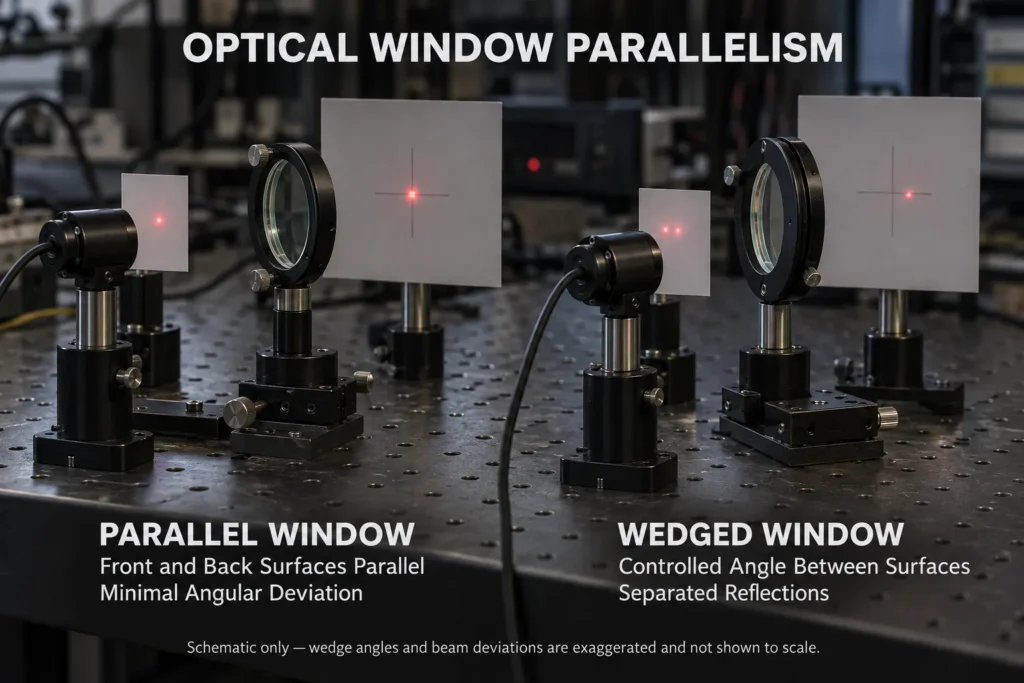
Optical window parallelism describes how closely the front and back surfaces are aligned with one another. The angular separation between their surface normals is the window’s mechanical wedge, while a parallelism tolerance sets the maximum permitted wedge.
Poor parallelism can deflect a transmitted beam, shift an image or create alignment errors. Tight control is therefore important in laser systems, precision imaging, interferometry and other applications that are sensitive to beam direction.
Perfectly parallel surfaces are not always preferred. A deliberate wedge may be specified to separate ghost reflections, reduce etalon fringes or direct unwanted reflections away from a detector or laser cavity.
In This Guide
Quick Answer: How Much Parallelism Do You Need?
Choose a commercial tolerance for protective windows and general instruments where modest beam deviation is acceptable.
Choose a tighter tolerance for machine vision, precision imaging, beam delivery and optical sensors where angular deviation can affect alignment.
Specify arcsecond-level parallelism only for interferometry, precision laser systems or other applications with a calculated need.
Choose an intentional wedge when ghost reflections, etalon fringes or optical feedback must be separated from the main beam.
Specify transmitted beam deviation directly when the system requirement concerns the outgoing ray rather than only the mechanical angle between the surfaces.
Important: Parallelism tolerance, mechanical wedge and transmitted beam deviation are related, but they are not interchangeable. Their relationship depends on refractive index, wavelength, angle of incidence and the surrounding media.
What Is Optical Window Parallelism?
An optical window has two polished surfaces. In an ideal plane-parallel window, the surface normals point in exactly the same direction. In a real component, one surface is usually tilted slightly relative to the other. This angular difference is the mechanical wedge; the parallelism specification limits how large that wedge may be.
Parallelism is commonly specified in degrees, arcminutes or arcseconds:
- 1 degree = 60 arcminutes
- 1 arcminute = 60 arcseconds
- 1 degree = 3,600 arcseconds
A specification such as “parallelism ≤ 1 arcmin” means that the angular separation between the two surface normals must not exceed one arcminute. The drawing should also define the datum, clear aperture and test method when these affect acceptance.
Parallelism is different from center-thickness tolerance and total thickness variation. A window can meet its center-thickness requirement while still having excessive wedge across the clear aperture.
How Does Wedge Affect a Light Beam?
A plane-parallel window at normal incidence produces no net angular deviation in a uniform surrounding medium. When used at oblique incidence, the emerging beam remains parallel to the incident beam but is laterally displaced.
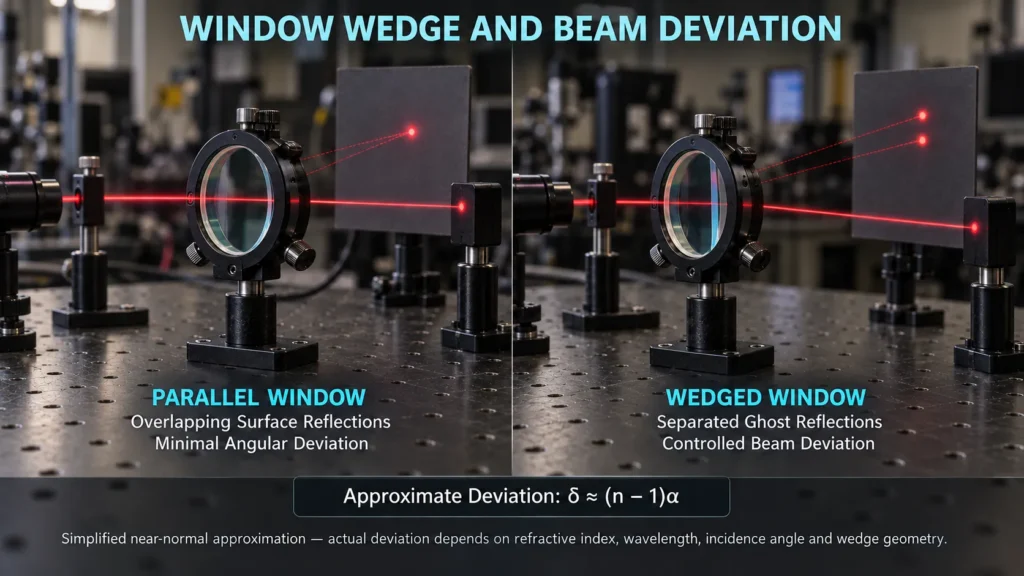
If the two surfaces are not parallel, the window behaves like a weak prism and changes the transmitted beam direction. For a small wedge angle and near-normal incidence in air, the first-order approximation is:
Transmitted beam deviation, δ ≈ (n − 1)α
- n is the refractive index of the window material at the operating wavelength.
- α is the mechanical wedge angle between the two surfaces.
- δ is the approximate angular deviation of the transmitted beam.
For example, the same mechanical wedge produces different beam deviations in fused silica, sapphire and germanium because their refractive indices differ. For larger wedge angles, non-normal incidence or demanding accuracy, use Snell’s law with the actual refractive index, wavelength and surrounding media rather than the small-angle approximation.
Typical Optical Window Parallelism Levels
| Parallelism level | Representative tolerance | Typical starting point |
|---|---|---|
| Commercial | Several arcminutes | Protective windows and general instruments |
| Precision | About 1 arcminute or better | Imaging, sensors and beam delivery |
| High precision | Tens of arcseconds | Precision lasers and optical alignment |
| Very high precision | A few arcseconds | Interferometry and demanding metrology |
Selection note: These are general starting points, not universal acceptance limits. Calculate the allowable beam or image displacement first, then derive a suitable tolerance using refractive index, working distance, incidence angle and the system error budget.
When Is Tight Parallelism Important?
Laser Beam Delivery
A small angular deviation can become a significant beam displacement after a long propagation distance. A window near the source may shift the beam at a downstream scanner, aperture or focusing lens. Tight parallelism can also reduce realignment when windows are replaced.
Imaging Systems
A uniform wedge primarily causes angular deviation and image displacement. Spatially varying wedge, surface form error or a tilted plate in a converging beam can introduce additional aberrations. The effect is especially important when pixel sizes are small, the propagation distance is long, several windows are used or precise registration is required.
Interferometry
Interferometric systems can be sensitive to angular errors and unwanted reflections. Parallelism, surface flatness, transmitted wavefront and material homogeneity may all require separate control.
Optical Filters and Beamsplitters
Filters and plate beamsplitters may require controlled parallelism to maintain beam position. In other designs, an intentional wedge is used so that multiple reflected beams do not overlap.
When Should You Use a Wedged Window?
A wedged window has a deliberate angle between its polished surfaces. It may be selected to:
- Separate front- and back-surface reflections
- Reduce unwanted interference or etalon fringes
- Reduce laser-cavity feedback
- Direct ghost reflections away from a detector
- Create a controlled beam deviation
The specification should include the nominal wedge angle, wedge tolerance, wedge direction or clocking, transmitted beam-deviation requirement, coating orientation and a marked edge if assembly orientation matters. A wedged window is not automatically better than a parallel window: it intentionally changes the outgoing beam direction and must be oriented accordingly.
How Is Parallelism Measured?
Interferometric Measurement
An interferometer can analyze reflections from the two surfaces and determine their angular relationship. This method is well suited to small wedge angles and high-precision components. The report should state whether it gives mechanical wedge, optical wedge or transmitted beam deviation.
Autocollimator Measurement
An autocollimator can measure the angular separation of surface-reflection images. Converting that reading into mechanical wedge may require refractive-index and geometry corrections, depending on the setup. Accuracy depends on alignment, the reference optics, instrument resolution and operator technique.
Thickness-Difference Measurement
For a sufficiently large and uniform wedge, thickness can be measured at defined positions. The thickness difference divided by the separation distance provides a small-angle estimate of mechanical wedge. This approach may not be adequate for arcsecond-level tolerances.
Parallelism vs Other Optical Specifications
Surface Flatness
Flatness describes how far each individual surface departs from an ideal plane. Two surfaces may both be flat but not parallel, or parallel but not sufficiently flat.
Transmitted Wavefront Error
Transmitted wavefront error evaluates the wavefront after it passes through the complete window and can include contributions from both surface forms, wedge and refractive-index homogeneity. Because some reports remove piston, tilt or power during analysis, the drawing and inspection report should state which terms are included or removed.
Thickness Tolerance and Total Thickness Variation
Center-thickness tolerance controls nominal thickness. Total thickness variation describes thickness change across the part and is geometrically related to wedge, but the two should not be substituted without defining the measurement locations and aperture.
Surface Quality
Surface quality describes cosmetic defects such as scratches and digs. It does not indicate parallelism or wedge.
Clear Aperture
Optical requirements should be tied to a defined usable area. The edge and mounting region may be excluded from the clear aperture.
How to Specify Window Parallelism
A complete drawing or RFQ should include:
- Material, grade and operating wavelength
- Outside dimensions and center thickness
- Maximum parallelism or nominal wedge with tolerance
- Maximum transmitted beam deviation, if critical
- Clear aperture and reference datum
- Surface flatness and transmitted wavefront requirements
- Surface quality and coating
- Angle of incidence and surrounding medium when relevant
- Wedge direction, clocking or marked edge when required
- Inspection wavelength, method and reporting conventions
If the actual system limit is a maximum beam displacement at a specified distance, provide that value to the manufacturer. It is usually more useful than choosing an arbitrary parallelism grade.
Common Specification Mistakes
Confusing Parallelism with Flatness
Flat surfaces are not necessarily parallel, and parallel surfaces are not necessarily flat.
Omitting the Unit or Measurement Method
State degrees, arcminutes or arcseconds and identify whether the requirement is mechanical wedge, optical wedge or transmitted beam deviation.
Ignoring Refractive Index and Wavelength
The same mechanical wedge produces different beam deviations in different materials, and refractive index changes with wavelength.
Specifying Tight Parallelism When a Wedge Is Needed
Parallel windows can produce overlapping ghost reflections or etalon fringes. A controlled wedge may be the better system-level solution.
Ignoring Mounting and Temperature
Clamping, sealing and temperature gradients can distort a window after inspection and alter its installed performance.
Frequently Asked Questions
What Is the Difference Between Parallelism and Wedge?
Parallelism describes how closely two surfaces approach an ideal parallel condition. Wedge is the actual angular separation between their surface normals.
Does a Parallel Window Change Beam Direction?
At normal incidence, an ideal plane-parallel window produces no net angular deviation. At oblique incidence in the same surrounding medium, the emerging ray is parallel to the incident ray but laterally displaced.
Is Smaller Wedge Always Better?
No. Tight parallelism is useful when beam direction must be preserved, while intentional wedge is useful for separating reflections and reducing interference effects.
How Does Wedge Cause Beam Deviation?
The nonparallel surfaces act like a weak prism. For a small wedge near normal incidence in air, the transmitted deviation is approximately δ ≈ (n − 1)α.
Is Parallelism the Same as Transmitted Wavefront Error?
No. Transmitted wavefront error is a system-level measurement that can include surface-form error, wedge and material inhomogeneity. The reported result also depends on which fitted terms are removed during analysis.
Custom Parallel and Wedged Windows from Chenyu Optics
Chenyu Optics manufactures custom parallel and wedged optical windows for imaging, laser, sensing, spectroscopy and industrial optical systems.
Final specifications should be confirmed from the customer drawing, material index, operating wavelength, incidence angle, mounting conditions and available inspection method.
Need Help Specifying Window Parallelism?
Send us your window dimensions, material, wavelength, incidence angle, allowable beam deviation, coating and application information.
Chenyu Optics can help determine whether a tightly parallel or intentionally wedged window is more suitable for your optical system.