
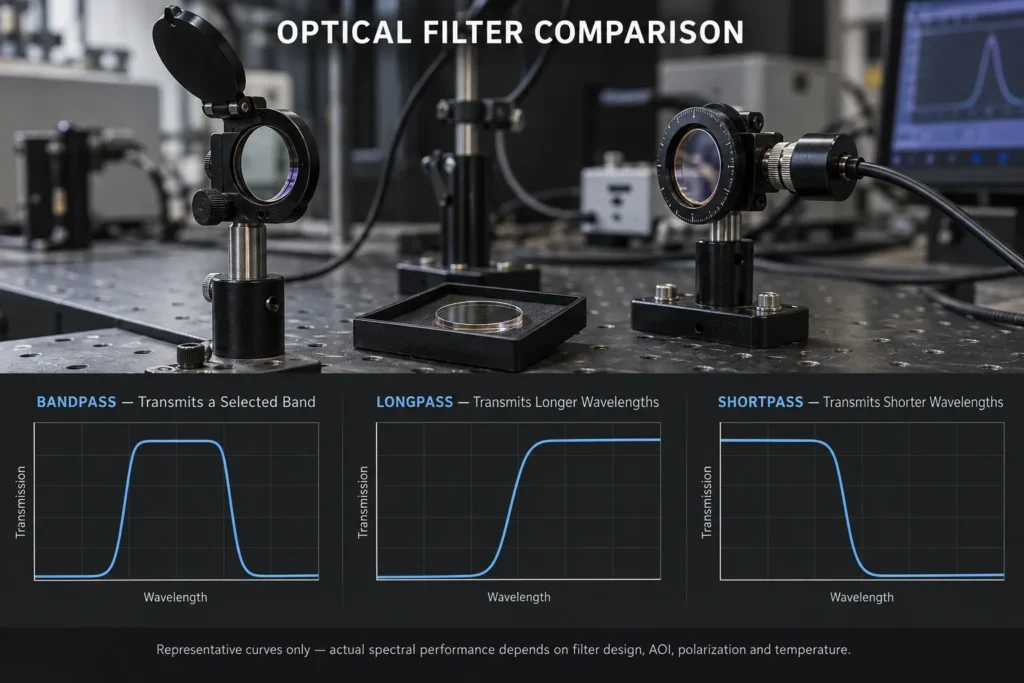
Bandpass, longpass and shortpass filters selectively transmit or block different parts of the optical spectrum. Choosing the correct type depends on whether the system must isolate a wavelength band, remove shorter wavelengths or reject longer wavelengths.
A bandpass filter transmits a defined range while blocking wavelengths on both sides. A longpass filter transmits wavelengths longer than its cut-on point, while a shortpass filter transmits wavelengths shorter than its cut-off point.
The filter type is only the starting point. Center wavelength, bandwidth, blocking range, optical density, angle of incidence and source spectrum must also be specified.
In This Guide
Quick Answer: Which Filter Should You Choose?
Choose a bandpass filter when only a selected wavelength range should reach the detector.
Choose a longpass filter when longer wavelengths must pass while shorter wavelengths are blocked.
Choose a shortpass filter when shorter wavelengths must pass while longer wavelengths are blocked.
Combine a longpass and shortpass filter when a standard bandpass filter does not provide the required custom passband.
Specify optical density and blocking range when unwanted wavelengths could saturate the detector or reduce measurement accuracy.
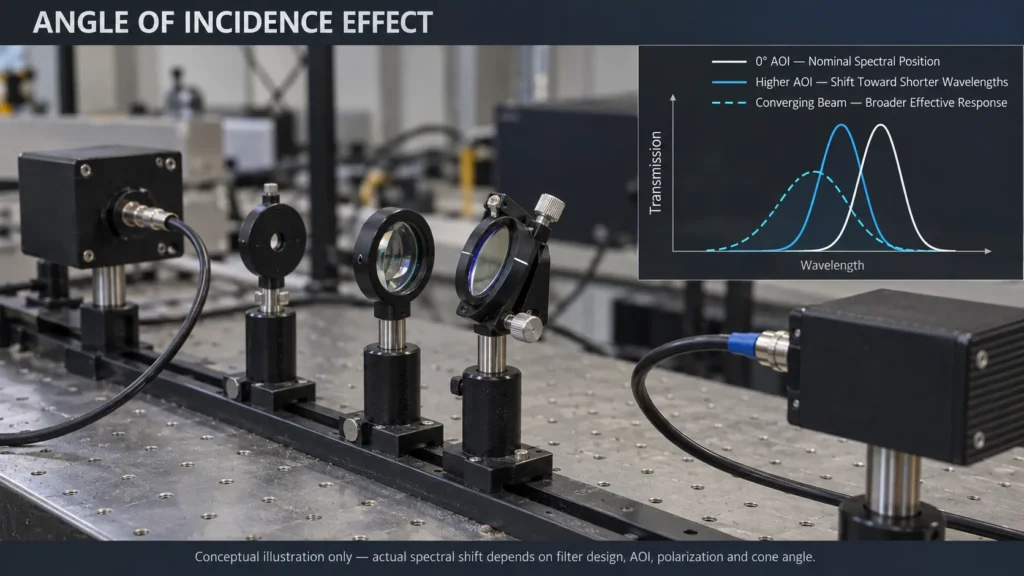
Specify angle of incidence and cone angle because interference-filter edges and passbands shift toward shorter wavelengths at increasing incidence angles.
Important: A wavelength printed in a filter name does not fully define its performance. Review the complete transmission and blocking curve.
What Is a Bandpass Filter?
A bandpass filter transmits a selected wavelength range and blocks wavelengths below and above that range.
Important bandpass specifications include:
- Center wavelength
- Full width at half maximum
- Peak or average transmission
- Blocking range
- Optical density
- Edge steepness
- Angle of incidence
- Polarization
The center wavelength, or CWL, is normally located near the center of the transmitted band.
Full width at half maximum, or FWHM, describes the wavelength separation between the two points where transmission is 50% of the filter’s peak transmission.
A narrowband filter may isolate a laser line or fluorescence emission. A wider bandpass filter may select a color range or detector band.
Typical applications include:
- Fluorescence imaging
- Machine vision
- Laser-line cleanup
- Spectroscopy
- Chemical detection
- Multispectral imaging
- Optical sensing
A narrow FWHM improves spectral selectivity but can make the filter more sensitive to AOI, temperature and manufacturing variation.
What Is a Longpass Filter?
A longpass filter blocks shorter wavelengths and transmits longer wavelengths above a specified cut-on point.
Longpass filters are commonly used to:
- Block UV while transmitting visible and IR light
- Separate fluorescence emission from a shorter-wavelength excitation source
- Remove blue light from an imaging system
- Transmit NIR or IR wavelengths
- Divide a spectrum into reflected and transmitted paths
- Create a custom bandpass with a shortpass filter
The cut-on wavelength is often defined at a specified transmission level, commonly near 50% of the passband transmission. Definitions vary by manufacturer, so the reference transmission level and test conditions should be confirmed.
A longpass filter does not necessarily block every shorter wavelength equally. The required blocking range and optical density should be stated.
What Is a Shortpass Filter?
A shortpass filter transmits shorter wavelengths and blocks wavelengths above its cut-off point.
Typical uses include:
- Blocking infrared radiation
- Removing unwanted heat from illumination
- Protecting visible detectors from NIR
- Separating shorter-wavelength fluorescence signals
- UV or visible spectral selection
- Combining with a longpass filter to create a bandpass
Shortpass interference filters reject longer wavelengths primarily through reflection. Absorptive heat-control glass may instead absorb IR energy and require thermal management.
As with longpass filters, the cut-off wavelength alone does not define the complete component. Transmission range, blocking range, slope and optical density must also be reviewed.
Bandpass vs Longpass vs Shortpass Filters
| Filter type | Transmitted wavelengths | Blocked wavelengths | Typical applications |
|---|---|---|---|
| Bandpass | A defined wavelength band | Below and above the passband | Fluorescence, spectroscopy and laser cleanup |
| Longpass | Longer than the cut-on wavelength | Shorter wavelengths | Emission separation, UV blocking and NIR detection |
| Shortpass | Shorter than the cut-off wavelength | Longer wavelengths | IR rejection, heat control and visible imaging |
Disclaimer: This table provides general selection guidance. Actual filter behavior depends on spectral design, transition slope, blocking range, optical density, angle of incidence, polarization and temperature.
Important Optical Filter Specifications
Center Wavelength and FWHM
CWL and FWHM are primarily used for bandpass filters.
The filter should be selected so that the complete signal band remains inside the passband after considering:
- Source wavelength tolerance
- Filter manufacturing tolerance
- Temperature shift
- Angle-of-incidence shift
- Detector response
Cut-On and Cut-Off Wavelength
Longpass filters are commonly described by a cut-on wavelength, while shortpass filters are described by a cut-off wavelength. The percentage-transmission points used to define these values are not universal and should be stated on the drawing or quotation request.
The transition does not occur at one perfectly sharp point. Edge steepness describes the wavelength interval between blocking and high transmission.
A steeper edge can improve spectral separation but may increase coating complexity and cost.
Optical Density
Optical density describes blocking:
OD = −log10(T)
Where T is fractional transmission.
Examples include:
- OD2 = 1% transmission
- OD3 = 0.1% transmission
- OD4 = 0.01% transmission
Higher OD means stronger blocking. Specify the wavelength range over which the OD requirement applies.
Passband Transmission
Higher passband transmission improves signal throughput, but the required value should be realistic across the full band.
Distinguish between:
- Peak transmission
- Average transmission
- Minimum transmission
These are not equivalent specifications.
How Angle of Incidence Affects Filter Performance
Thin-film interference filters are angle-sensitive. Increasing the angle of incidence beyond the design condition normally shifts their spectral response toward shorter wavelengths. Absorptive filters behave differently, so the manufacturer’s spectral data should be checked for the actual filter construction.
This blue shift can change:
- Bandpass center wavelength
- Longpass cut-on wavelength
- Shortpass cut-off wavelength
- Passband shape
- Edge steepness
- s- and p-polarized performance
A converging beam contains a range of incidence angles. This cone angle may broaden the passband or edge transition even when the filter is mechanically mounted at 0°.
For accurate filter selection, specify:
- Nominal AOI
- Maximum AOI range
- Cone half-angle
- Polarization
- Filter orientation
A filter designed for 0° should not automatically be used at 45°. Dichroic edge filters are often specifically designed for 45° operation.
Can Longpass and Shortpass Filters Create a Bandpass?
Yes. A longpass filter and a shortpass filter can be stacked so their transmission ranges overlap.
For example:
- A 500 nm longpass transmits above 500 nm.
- A 600 nm shortpass transmits below 600 nm.
- Together, they create an approximate 500–600 nm passband.
This approach is useful for prototypes or uncommon wavelength ranges. The combined spectral transmission is approximately the product of the two filters’ transmission curves, so the result is not identical to an ideal single-component bandpass. Stacking filters can also introduce:
- Additional reflection losses
- Lower total transmission
- Ghost reflections
- Increased thickness
- Alignment sensitivity
- Multiple-surface interference
A custom single-component bandpass filter may provide better performance for production systems.
How to Choose the Correct Filter
Use this practical sequence:
- Identify the wavelengths that must be transmitted.
- Define the wavelengths that must be blocked.
- Select bandpass, longpass or shortpass behavior.
- Specify CWL and FWHM or cut-on/cut-off wavelength.
- Define passband transmission.
- Define blocking range and optical density.
- Specify AOI, cone angle and polarization.
- Review temperature and environmental conditions.
- Confirm dimensions, clear aperture and orientation.
- Review the complete spectral curve before approval.
The least restrictive filter that meets the system requirement is usually the most economical choice.
Common Selection Mistakes
Selecting Only by the Filter Name
A “500 nm filter” may refer to a bandpass center, longpass cut-on or shortpass cut-off.
Ignoring the Blocking Range
High OD at one wavelength does not guarantee equivalent blocking across the full unwanted spectrum.
Ignoring AOI and Cone Angle
Interference-filter performance shifts and may broaden when used at non-zero angles or in converging beams.
Confusing Peak and Minimum Transmission
A high peak value does not guarantee strong transmission across the complete passband.
Requesting Unnecessary Edge Steepness or OD
Excessively steep transitions and deep blocking can increase cost without improving system performance.
Frequently Asked Questions
What Is the Difference Between Bandpass and Longpass Filters?
A bandpass transmits a limited wavelength range and blocks both sides. A longpass transmits wavelengths above its cut-on point.
What Is the Difference Between Longpass and Shortpass Filters?
A longpass transmits longer wavelengths, while a shortpass transmits shorter wavelengths.
What Does FWHM Mean?
FWHM is the width of a bandpass measured between the two wavelengths where transmission reaches 50% of its peak value.
What Does OD4 Blocking Mean?
OD4 corresponds to 0.01% transmission within the specified blocking range.
Can I Tilt a Filter to Adjust Its Wavelength?
Tilting an interference filter can shift its response toward shorter wavelengths, but it may also change bandwidth, polarization response and image quality.
Custom Optical Filters from Chenyu Optics
Chenyu Optics provides custom bandpass, longpass and shortpass filters for imaging, laser, spectroscopy, fluorescence, sensing and industrial optical systems.
Filters can be evaluated according to:
- Center wavelength and FWHM
- Cut-on or cut-off wavelength
- Passband transmission
- Blocking range and optical density
- Edge steepness
- Angle of incidence
- Polarization
- Dimensions and clear aperture
- Surface quality and wavefront
- Environmental durability
- Prototype or production quantity
- Spectral inspection requirements
Final specifications should be confirmed according to the light source, detector, optical layout, AOI and available measurement method.
Need Help Selecting an Optical Filter?
Send us your required transmission band, blocking wavelengths, optical density, angle of incidence, polarization, dimensions and application information.
Chenyu Optics can help evaluate a practical bandpass, longpass or shortpass filter specification.