
Protected aluminum, enhanced aluminum, protected silver and protected gold are common metallic mirror coatings. Each offers a different balance of wavelength coverage, reflectance, durability and environmental performance.
Protected aluminum is often selected for broad spectral coverage. Enhanced aluminum improves reflectance over a chosen wavelength band. Silver provides high reflectance through much of the visible and infrared, while gold is generally preferred for near-infrared, MWIR and LWIR applications.
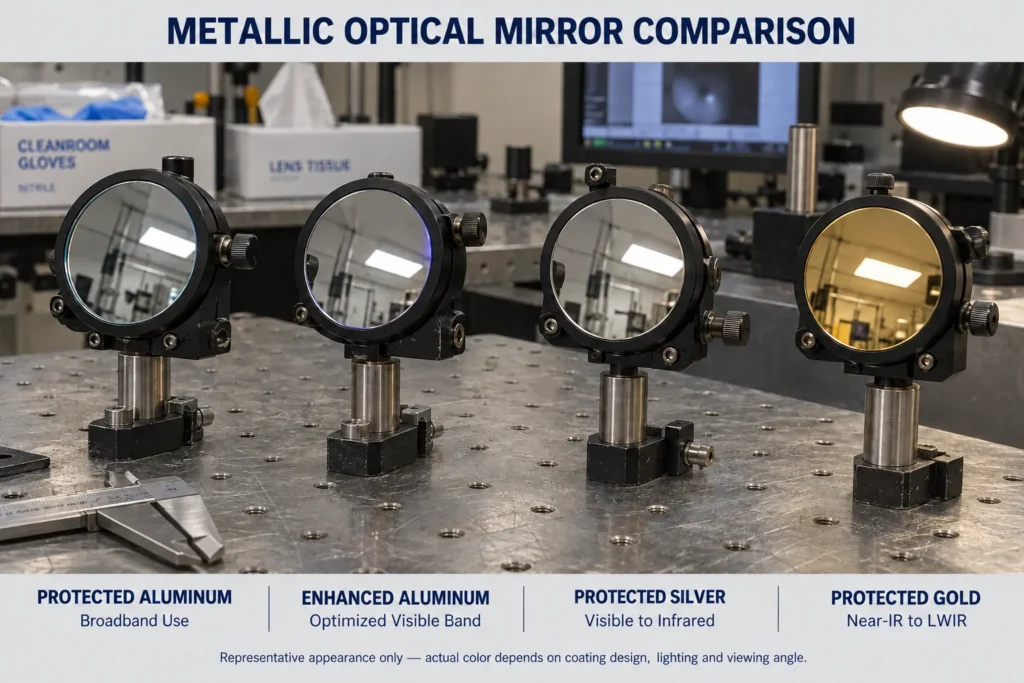 Protected Aluminum Enhanced Aluminum Silver and Gold Mirrors
In This Guide
Quick Answer
Choose protected aluminum when:
- Broad wavelength coverage is required
- UV or visible reflectance is important
- Moderate cost and practical durability are priorities
- Maximum reflectance over one narrow band is not required
Choose enhanced aluminum when:
- Higher reflectance is needed over a selected visible or near-UV band
- The operating wavelength and angle are clearly defined
- A dielectric enhancement layer is acceptable
Choose protected silver when:
- High visible and near-infrared reflectance is required
- UV performance is not the main priority
- Suitable environmental protection is available
- Neutral visible response is beneficial
Choose protected gold when:
- The system operates mainly in the near-infrared, MWIR or LWIR
- Visible reflectance is not required
- Infrared performance is more important than broadband visible use
These are general starting points. Final selection should use guaranteed reflectance data for the required wavelength, angle of incidence and polarization.
What Is a Protected Aluminum Mirror?
A protected aluminum mirror uses an aluminum reflective layer with a transparent protective overcoat.
Bare aluminum forms a natural oxide layer and can be mechanically delicate. The protective coating improves resistance to handling and environmental exposure.
Protected aluminum is valued for broad spectral performance, but its usable UV-to-IR range depends on the overcoat design. It is commonly used in:
- UV and visible instruments
- Broadband imaging
- Spectroscopy
- Telescope systems
- Illumination
- General beam steering
- Scientific equipment
Its reflectance is broad but may be lower than an optimized coating within a selected band.
The overcoat material and thickness affect the final spectrum. “Protected aluminum” should therefore be supported by a measurable reflectance requirement.
What Is an Enhanced Aluminum Mirror?
Enhanced aluminum combines an aluminum reflective layer with dielectric layers designed to improve reflectance over a selected wavelength range.
Enhancement can be optimized for:
- Near-UV
- Visible spectrum
- A selected laser wavelength
- A defined broadband region
Compared with standard protected aluminum, enhanced aluminum may provide higher reflectance inside its design band. Outside that band, the advantage may decrease or spectral behavior may change.
Enhanced aluminum performance can also be more sensitive to:
- Angle of incidence
- Polarization
- Coating-layer tolerances
- Operating wavelength
- Temperature
The RFQ should identify the actual wavelength band, AOI and polarization rather than requesting only “enhanced aluminum,” because its advantage is design-specific.
What Is a Protected Silver Mirror?
Silver provides high reflectance across much of the visible, near-infrared and infrared spectrum.
It is frequently used in:
- Imaging systems
- Broadband visible and NIR instruments
- Spectroscopy
- Illumination
- Solar simulation
- Sensor systems
- Beam steering
Unprotected silver can tarnish when exposed to sulfur-containing compounds and other environmental contaminants. A protective or enhanced overcoat is therefore commonly applied.
Silver generally performs poorly in parts of the ultraviolet compared with aluminum. It should not be selected for a UV system based only on its high visible reflectance.
Long-term durability depends on coating quality, overcoat integrity, edge sealing, humidity and cleaning method; initial reflectance alone is not sufficient for selection.
What Is a Protected Gold Mirror?
Gold provides strong reflectance from much of the near-infrared through the MWIR and LWIR, while its short-wavelength visible performance is limited. It is often selected for:
- Near-infrared systems
- MWIR instruments
- LWIR thermal imaging
- Infrared spectroscopy
- CO₂ laser systems
- Infrared detectors
- Aerospace and scientific instruments
Gold has a characteristic yellow appearance because its visible reflectance is not uniform. It is generally unsuitable when high blue or broadband visible reflectance is required.
A protective coating may improve durability, but the overcoat must be designed for the intended infrared wavelength range.
Gold coatings can also be applied to different substrates, including glass, fused silica, silicon and metal components.
Metallic Mirror Coating Comparison
| Comparison | Protected Aluminum | Enhanced Aluminum | Protected Silver | Protected Gold |
|---|---|---|---|---|
| Main spectral use | Broadband use; exact UV–IR range depends on the overcoat | Selected near-UV, visible or laser band | Visible to infrared; limited in the UV | Near-IR to LWIR |
| UV performance | Generally the strongest starting point | Can be optimized for near-UV | Usually limited | Poor |
| Visible reflectance | Good broadband performance | Higher in the designed band | Generally high | Uneven and limited |
| Infrared performance | Useful depending on wavelength | Design dependent | High over broad regions | Generally strong |
| Environmental durability | Good with suitable protection | Good with suitable design | Requires strong tarnish protection | Good with suitable protection |
| Spectral sensitivity | Moderate | More design-band dependent | Coating dependent | Coating dependent |
| Typical appearance | Silver-gray | Silver with colored reflection | Bright silver | Gold |
| Typical use | Broadband and UV systems | Optimized visible systems | Imaging and NIR systems | Infrared systems |
| Cost | Generally practical | Higher than standard aluminum | Coating dependent | Coating and substrate dependent |
This table provides general guidance. Actual reflectance bands and durability must be confirmed from the specific coating design.
Spectral Performance
Mirror selection should be based on required reflectance over the operating band.
A measurable requirement may state:
Ravg ≥90% from 450–650 nm at 45° AOI
For a laser mirror:
R ≥98% at 1064 nm at 45° AOI for s-polarization
These are only examples. The actual requirement should match the optical system.
Important spectral specifications include:
- Minimum reflectance
- Average reflectance
- Wavelength band
- Angle of incidence
- Polarization
- Number of reflections
- Permitted spectral variation
Small reflectance differences can become important in a system containing several mirrors because the total throughput is the product of the reflectance at each surface.
Angle of Incidence and Polarization
Metallic mirrors usually provide broader angular performance than narrowband dielectric mirrors, but AOI can still affect reflectance and phase.
Enhanced aluminum is particularly influenced by the dielectric enhancement layers.
At oblique incidence, s- and p-polarized light may have different performance. The difference may be important in:
- Laser systems
- Polarization-sensitive imaging
- Interferometry
- Multiple-mirror beam paths
- High-incidence-angle systems
Always state nominal AOI, angular range and polarization when they affect system performance.
Environmental Durability
The protective layer is part of the finished mirror specification.
Environmental conditions may include:
- Humidity
- Temperature cycling
- Outdoor exposure
- Salt or chemical contamination
- Vacuum
- Dust
- Repeated cleaning
- Shock and vibration
Protected aluminum generally offers practical durability for many systems. Silver requires careful environmental protection because coating defects or damaged edges can permit tarnishing.
Gold is chemically stable, but a thin optical coating can still be scratched or damaged. No metallic mirror coating should be treated as mechanically indestructible.
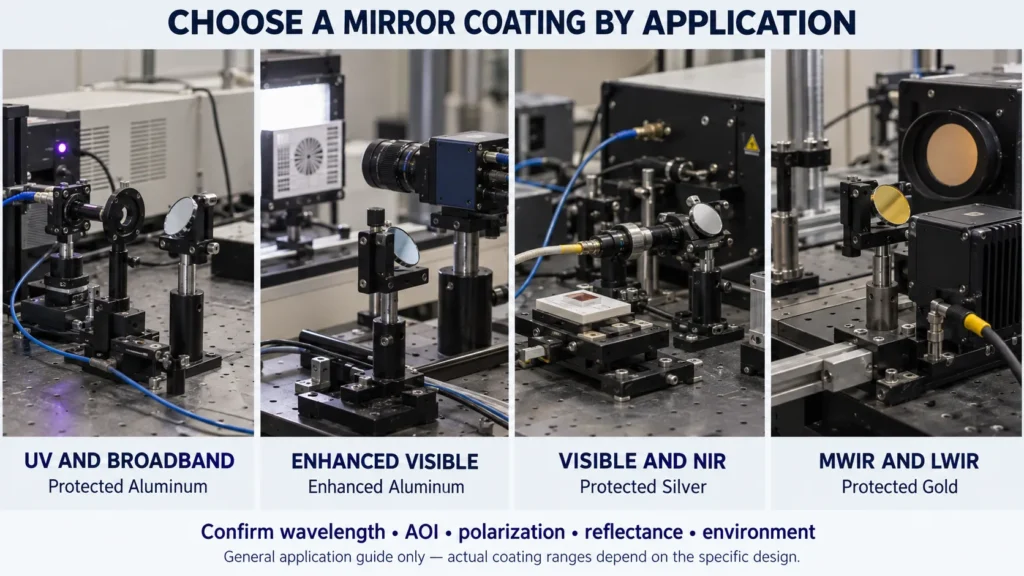 Metallic Mirror Coating Selection Guide
Cleaning and Handling
Protected metallic mirrors are more durable than bare metal coatings, but incorrect cleaning can damage the overcoat.
Recommended handling principles include:
- Wear clean gloves
- Avoid touching the clear aperture
- Remove loose particles before wiping
- Use only approved solvents
- Apply minimal cleaning pressure
- Protect coated edges
- Store mirrors in clean individual packaging
Do not assume that all protected coatings use the same cleaning procedure. Follow the coating supplier’s instructions.
Substrate and Surface Flatness
The same coating can be applied to different substrates, but finished performance depends on the substrate.
Common mirror substrates include:
- Fused silica
- BK7 or equivalent optical glass
- Low-expansion glass-ceramic
- Silicon
- Aluminum
- Other metal substrates
Specify surface flatness or surface figure at a defined wavelength and clear aperture.
Coating stress can change the shape of a thin substrate. When wavefront performance is important, request final inspection after coating.
Surface Quality and Roughness
Surface quality controls localized scratches and digs. Surface roughness describes microscopic surface texture.
Both can affect scatter, but they are separate specifications.
A custom drawing may include:
- Surface quality: 60-40, 40-20 or another value
- Surface roughness: Maximum RMS value
- Clear aperture
- Reflected wavefront
- Edge-chip limits
High-power laser and low-scatter applications may require closer control of surface condition, coating defects and cleanliness.
Laser Applications
No metallic coating should be selected for a laser using reflectance alone.
Also provide:
- Laser wavelength
- Continuous-wave or pulsed operation
- Average power
- Pulse energy
- Pulse duration
- Repetition rate
- Beam diameter
- AOI and polarization
- Required damage threshold
A protective overcoat can affect both reflectance and laser-damage performance. The available test conditions should match the intended application as closely as practical.
Which Mirror Is Better for Different Applications?
UV Beam Steering
Protected or UV-enhanced aluminum is normally the stronger starting point.
Broadband Visible Imaging
Protected silver may provide high reflectance, while enhanced aluminum may be selected for a defined visible band.
General Scientific Instruments
Protected aluminum is often practical when broad coverage and durability are important.
Near-Infrared Systems
Protected silver or gold may be considered depending on the wavelength and visible requirements.
MWIR and LWIR Systems
Protected gold is commonly selected for infrared reflectance.
Outdoor or Humid Environments
Compare verified durability data. Silver requires particular attention to protection and edge sealing.
Common Selection Mistakes
Choosing Only by Peak Reflectance
Consider the entire operating band and the total number of mirror reflections.
Using Silver for UV Without Checking Performance
Silver’s visible and IR advantages do not automatically extend into the UV.
Using Gold for Broadband Visible Systems
Gold is mainly relevant to infrared applications and has uneven visible reflectance.
Ignoring AOI and Polarization
Enhanced coatings can change with angle and polarization.
Assuming “Protected” Means Scratch-Proof
Protective coatings improve durability but still require careful handling and cleaning.
Frequently Asked Questions
Which Mirror Coating Has the Broadest Use?
Protected aluminum is a common broadband choice, especially when UV performance is also required.
Is Silver More Reflective Than Aluminum?
Silver often provides higher reflectance through much of the visible and infrared, but performance depends on wavelength and coating design.
Why Is Gold Used for Infrared Mirrors?
Gold provides strong reflectance across many near-infrared, MWIR and LWIR wavelengths.
What Is Enhanced Aluminum?
It is an aluminum mirror coating with dielectric layers designed to improve reflectance over a selected band.
What Information Is Needed for a Custom Mirror Quote?
Provide the substrate, dimensions, wavelength, AOI, polarization, reflectance, flatness, surface quality, environment and quantity.
Custom Metallic Mirrors from Chenyu Optics
Chenyu Optics supports drawing-based custom aluminum-, silver- and gold-coated mirrors for imaging, laser, sensing and industrial systems.
Requirements can be reviewed according to:
- Mirror substrate
- Dimensions and thickness
- Operating wavelength
- Angle of incidence
- Polarization
- Required reflectance
- Surface flatness or figure
- Surface quality
- Surface roughness
- Clear aperture
- Environmental requirements
- Quantity and inspection
Final coating specifications should be confirmed according to the application, approved drawing and available coating design.
Request a Custom Optical Mirror Quote
Send Chenyu Optics your drawing, substrate, wavelength, AOI, polarization, reflectance requirement, dimensions and quantity. If the coating choice has not been finalized, provide the required spectral performance and operating environment for review.