
A plano-convex lens is a positive lens with one flat surface and one outward-curved surface. It is commonly used to focus a collimated beam or collimate light from a point source.
Plano-convex lenses are found in laser systems, illumination equipment, optical sensors, beam expanders and laboratory instruments. They work best when one conjugate is much longer than the other, such as when parallel light is focused to a point.
Lens orientation is important. When focusing a collimated beam, the curved surface should normally face the incoming light and the flat surface should face the focal point. This arrangement helps reduce spherical aberration.
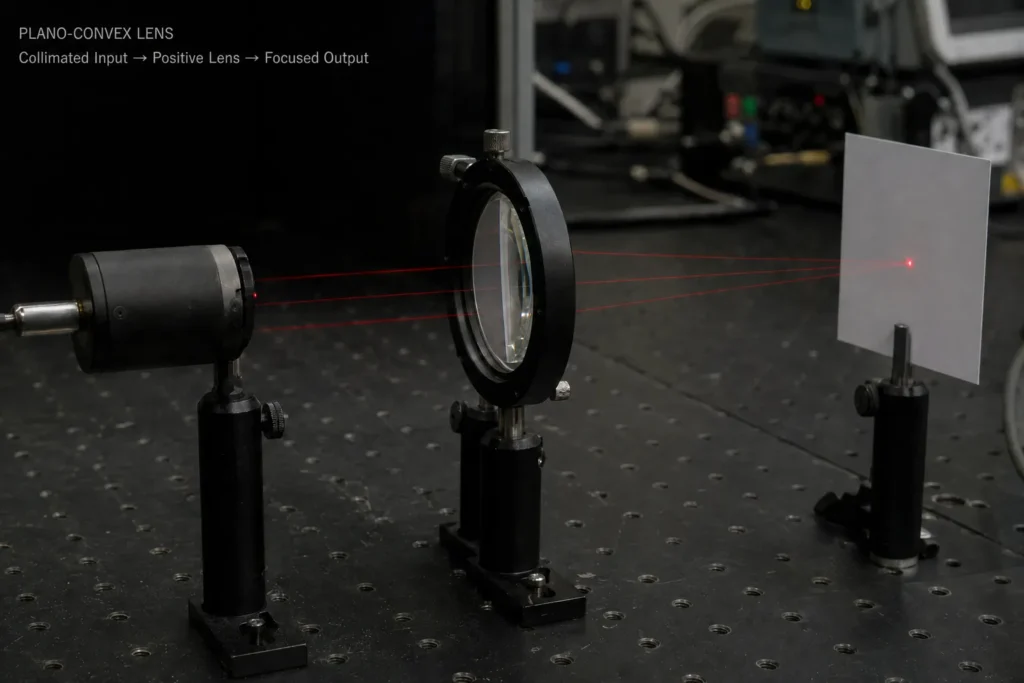
Plano-Convex Lens Focusing a Collimated Light Beam
In This Guide
Quick Answer: When Should You Use a Plano-Convex Lens?
Use a plano-convex lens to focus a collimated beam to a point.
Use a plano-convex lens to collimate light from a point source positioned near its focal plane.
Use a plano-convex lens when the object and image distances are strongly unequal.
Choose a bi-convex lens instead when the object and image distances are relatively similar.
Choose an achromatic doublet when broadband light is used and chromatic aberration must be reduced.
Choose an aspheric lens when a small focused spot, high numerical aperture or reduced spherical aberration is required.
Important: These are general selection guidelines. Final performance depends on focal length, diameter, f-number, material, wavelength, lens orientation and the complete optical design.
What Is a Plano-Convex Lens?
A plano-convex lens, commonly abbreviated as PCX, has:
- One flat surface
- One convex spherical surface
- A positive focal length
- A center thickness greater than its edge thickness
The lens converges parallel light rays toward a focal point. When used in the reverse direction, it can convert light from a small source into an approximately collimated beam.
A plano-convex lens is a spherical singlet, so it does not remove every optical aberration. Its performance depends on the lens shape, material, aperture, wavelength and conjugate ratio.
It is most effective in optical systems where one side of the lens receives or produces approximately collimated light.
How Does a Plano-Convex Lens Work?
The curved surface provides most of the lens’s focusing power. When parallel rays pass through the lens, they are refracted toward the optical axis and converge near the focal point.
When a small source is placed near the focal plane, the process is reversed and the output beam becomes approximately collimated.
The specified effective focal length and back focal length should not be treated as identical:
- Effective focal length is measured from the lens’s principal plane.
- Back focal length is measured from the final optical surface to the focal point.
For mechanical installation, the back focal length may be more useful because it helps determine the physical distance between the lens and the detector, fiber or target.
Which Way Should a Plano-Convex Lens Face?
Correct orientation helps reduce spherical aberration.
Focusing a Collimated Beam
The curved surface should normally face the incoming collimated beam. The flat surface should face the focal point.
Collimating a Point Source
The point source should normally face the flat surface. The collimated output then exits through the curved surface.
A simple rule is:
The curved surface faces the collimated side, while the flat surface faces the focal point.
This rule applies to common on-axis focusing and collimating systems. Specialized optical layouts should be verified through optical analysis.
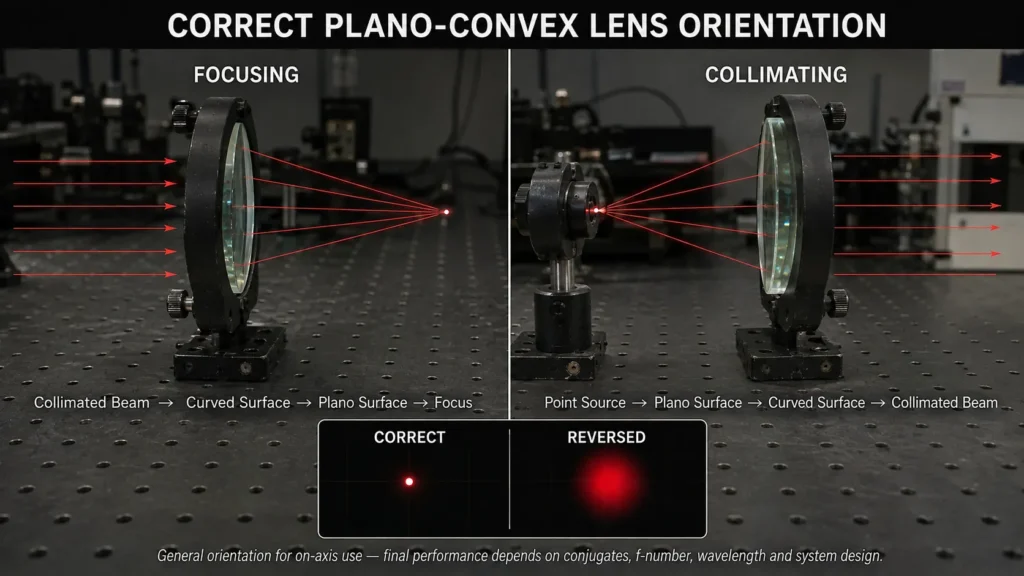 Correct Plano-Convex Lens Orientation for Focusing and Collimating
When Should You Use a Plano-Convex Lens?
Focusing a Collimated Laser Beam
Focusing a collimated laser beam is one of the most common applications.
Typical uses include:
- Laser material processing
- Detector illumination
- Fiber coupling
- Optical testing
- Laser scanning
- Spectroscopy
- Laboratory beam delivery
A plano-convex lens is a practical choice when the required spot size and aberration performance can be achieved with a spherical singlet.
Collimating a Point Source
A plano-convex lens can collimate light from a fiber, LED or other small source.
The source is positioned near the focal plane on the flat side of the lens. Accurate spacing is important because a position error can leave the output beam converging or diverging.
An extended LED cannot produce the same low-divergence beam as an ideal point source or small fiber core.
Laser Beam Expanders
Plano-convex lenses can be combined with positive or negative lenses to build laser beam expanders.
The focal-length ratio determines the approximate beam-expansion ratio. Lens orientation, spacing, AR coating and laser damage resistance must be matched to the operating wavelength and power.
Light Collection
A plano-convex lens can collect light from an emitter, sample or scattering region and direct it toward a detector.
Collection efficiency depends on lens diameter, focal length, source size, numerical aperture, working distance and detector area.
Simple Imaging Systems
A plano-convex lens can form an image when the required resolution is moderate and the conjugates are strongly unequal.
For close-to-1:1 imaging, broadband imaging or higher resolution, a bi-convex lens, achromatic doublet or multi-element imaging lens may provide better performance.
Plano-Convex vs Bi-Convex vs Aspheric Lenses
| Lens type | Best suited for | Main advantage | Main limitation |
|---|---|---|---|
| Plano-convex | Collimation and focusing with unequal conjugates | Simple, economical positive lens | Spherical and chromatic aberration |
| Bi-convex | Finite-conjugate imaging closer to 1:1 | More balanced ray bending | Not normally optimal for collimated-to-focus use |
| Achromatic doublet | Broadband imaging and focusing | Reduced chromatic and spherical aberration | Higher cost and more surfaces |
| Aspheric lens | High-NA focusing and compact systems | Reduced spherical aberration | More complex manufacturing and alignment |
| Plano-convex cylindrical | Focusing in one dimension | Produces a line focus | Does not focus equally in both axes |
Disclaimer: This table provides general guidance for preliminary lens selection. Actual performance depends on conjugate ratio, focal length, aperture, f-number, wavelength, material, orientation and system-level aberration requirements.
How Do Focal Length and Diameter Affect Performance?
A shorter focal length produces stronger focusing and a larger convergence angle. It can also increase spherical aberration when a simple spherical lens is used.
A longer focal length generally offers:
- A smaller convergence angle
- Easier alignment
- Greater working distance
- Lower spherical aberration for the same beam diameter
The lens diameter must be large enough to accept the beam without clipping. The clear aperture may be smaller than the physical diameter because the edge and mounting area are not always optically usable.
A lower f-number provides stronger focusing but normally increases aberration. When a very small focused spot is required, an aspheric lens or multi-element objective may be more appropriate.
How to Select the Lens Material
N-BK7 Optical Glass
N-BK7 is an economical choice for visible and near-infrared applications in controlled environments.
It is commonly used in illumination systems, imaging instruments and low-to-moderate-power laser applications.
Fused Silica
Fused silica is suitable for UV transmission, thermal stability and many laser systems.
The exact material grade should be specified when UV transmission, fluorescence, absorption or laser damage performance is important.
Calcium Fluoride
Calcium fluoride provides broad UV-to-mid-infrared transmission and is used in spectroscopy, UV systems and selected infrared applications.
It requires more careful handling and mounting than common optical glass.
Infrared Materials
Silicon, germanium and ZnSe can be used to manufacture plano-convex lenses for infrared applications.
Silicon is commonly used in NIR and MWIR systems, germanium in MWIR and LWIR thermal imaging, and ZnSe in broadband IR and CO2 laser systems.
Material selection must be based on the exact operating wavelength, temperature and optical-power requirements.
How to Select an Optical Coating
An AR coating can increase transmission and reduce ghost reflections.
The coating specification should include:
- Operating wavelength or wavelength band
- Angle of incidence
- Required reflectance or transmission
- Polarization, if applicable
- Laser power and pulse conditions
- Environmental durability
- Number of coated surfaces
A narrowband coating may provide very low reflection at one laser wavelength. A broadband coating supports a wider spectral range but may have higher residual reflection.
The phrase “AR coated” alone is not a complete specification.
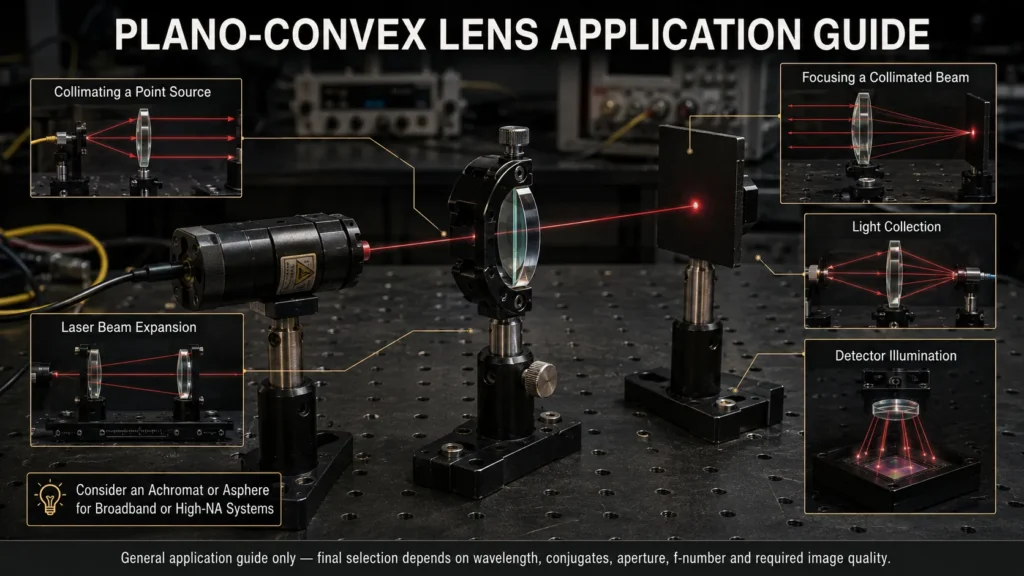 Typical Plano-Convex Lens Applications
Important Plano-Convex Lens Specifications
When requesting a custom plano-convex lens, provide:
- Optical material and grade
- Operating wavelength
- Outside diameter
- Effective focal length
- Back focal length, if critical
- Radius of curvature
- Center and edge thickness
- Surface quality
- Surface flatness
- Surface irregularity
- Centration
- Clear aperture
- Chamfer or edge requirements
- AR coating
- Laser power, if applicable
- Inspection and documentation requirements
- Prototype or production quantity
Specifications should reflect the actual system requirements. Unnecessarily tight tolerances can increase manufacturing difficulty, cost and lead time.
Common Selection Mistakes
Installing the Lens Backward
When focusing a collimated beam, the flat surface should not normally face the incoming beam. This orientation can increase spherical aberration.
Confusing Effective and Back Focal Length
Effective focal length is measured from a principal plane, while back focal length is measured from the final lens surface.
Selecting Only by Focal Length
Lenses with the same focal length may perform differently because of diameter, material, orientation, coating and f-number.
Ignoring Chromatic Aberration
A plano-convex singlet focuses different wavelengths at different distances. An achromatic doublet is more suitable when broadband chromatic correction is important.
Using Too Much of the Aperture
A large beam and low f-number can increase spherical aberration. Reducing the usable beam diameter may improve the focused spot, although it also reduces collected optical power.
Specifying Only “AR Coated”
The coating wavelength, reflectance, angle of incidence and laser conditions should be provided.
Frequently Asked Questions
Is a Plano-Convex Lens a Positive Lens?
Yes. A plano-convex lens has a positive focal length and causes collimated light to converge.
Which Side Should Face a Collimated Laser Beam?
The curved surface should normally face the incoming collimated beam. The flat surface should face the focal point.
Can a Plano-Convex Lens Collimate Light?
Yes. A small light source can be placed near the focal plane on the flat side of the lens. The output leaves through the curved surface as an approximately collimated beam.
What Is the Difference Between a Plano-Convex and Bi-Convex Lens?
A plano-convex lens is generally better for strongly unequal conjugates. A bi-convex lens is often more suitable when the object and image distances are relatively similar.
Does Every Plano-Convex Lens Need an AR Coating?
No. An uncoated lens may be acceptable when reflection loss is not critical. An AR coating is commonly used to improve transmission and reduce ghost reflections.
Custom Plano-Convex Lenses from Chenyu Optics
Chenyu Optics manufactures custom plano-convex lenses for imaging, laser, sensing, illumination, spectroscopy and industrial optical systems.
Custom lenses can be evaluated according to:
- Optical material and grade
- Operating wavelength
- Diameter and focal length
- Radius of curvature
- Center and edge thickness
- Surface quality
- Surface flatness
- Surface irregularity
- Centration
- Clear aperture
- Chamfer or edge requirements
- AR coating
- Laser power
- Prototype or production quantity
- Inspection and packaging requirements
Final specifications should be confirmed according to the customer drawing, optical layout, selected material, operating wavelength, coating design and available inspection method.
Need Help Selecting a Plano-Convex Lens?
Send us your operating wavelength, beam diameter, focal-length requirement, lens dimensions, coating and application information.
Chenyu Optics can help evaluate the material, geometry, tolerances and coating for a manufacturable plano-convex lens.