
Calcium fluoride (CaF2) and barium fluoride (BaF2) are crystalline optical materials used for ultraviolet, visible and infrared windows. Both provide broad spectral transmission and relatively low refractive indices, but they differ in infrared coverage, hardness, water sensitivity, weight and resistance to thermal shock.
CaF2 is generally the more practical choice when mechanical durability, lower weight, low water solubility or UV-grade availability is important. BaF2 extends farther into the infrared and is useful for spectroscopy and selected thermal-imaging applications, but it is softer, more water-sensitive and more susceptible to thermal shock.
The correct choice depends on the operating wavelength, material grade, window thickness, environment, mechanical design and coating.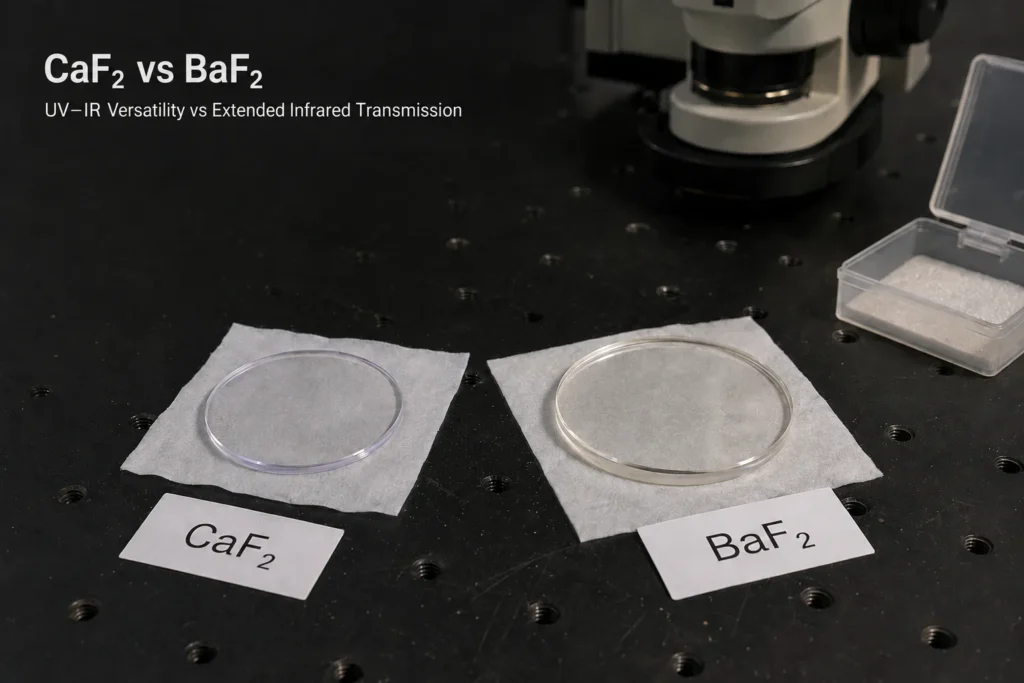 Calcium Fluoride and Barium Fluoride Optical Window Comparison
Quick Answer: CaF2 or BaF2?
Choose CaF2 for UV applications, excimer-laser windows, spectroscopy and broadband UV-to-mid-IR optical systems.
Choose CaF2 when lower weight, greater hardness and better resistance to moisture are important.
Choose BaF2 when transmission beyond the practical long-wavelength range of CaF2 is required.
Choose BaF2 for selected infrared spectroscopy and thermography applications where its extended IR coverage provides a useful advantage.
Evaluate BaF2 carefully when the window may encounter moisture, rapid temperature changes, mechanical stress or frequent handling.
Specify the exact material grade because IR-grade CaF2 or BaF2 may not provide the UV performance associated with high-purity UV-grade material.
Important: Published transmission ranges describe representative bulk-material performance. Finished-window transmission depends on material grade, thickness, wavelength, surface finish, temperature and coating.
What Is Calcium Fluoride?
Calcium fluoride is a cubic crystalline material used to manufacture optical windows, lenses, prisms and spectroscopy components.
High-purity CaF2 provides useful transmission from the vacuum ultraviolet through the visible and into the infrared. It is frequently selected for UV spectroscopy, excimer-laser windows, fluorescence-sensitive instruments and broadband optical systems.
Because CaF2 has a cubic crystal structure, it is generally treated as optically isotropic and does not introduce the birefringence associated with materials such as sapphire.
Different CaF2 grades are produced for different applications. A material selected for general infrared use may not provide the purity or short-wavelength performance required for UV, VUV, excimer-laser or Raman applications.
Best for:
- UV and VUV optical windows
- Excimer-laser systems
- UV-to-mid-IR spectroscopy
- Raman spectroscopy with an appropriate grade
- Cryogenic optical systems
- Broadband optical instruments
Consider carefully:
- Exact material grade
- Thermal-shock conditions
- Surface and edge damage
- Mounting stress
- Window diameter and thickness
- Coating wavelength
What Is Barium Fluoride?
Barium fluoride is also a cubic crystalline fluoride material. It is used for infrared spectroscopy, thermography viewports and other applications requiring transmission farther into the infrared than CaF2.
For an equivalent thickness, BaF2 generally extends approximately 1 µm farther into the infrared than CaF2. However, its useful transmission does not necessarily cover the entire 8–14 µm atmospheric band at a required system transmission level.
BaF2 is softer and more soluble in water than CaF2. It also cleaves relatively easily and is highly susceptible to thermal shock. These properties make handling, cleaning, edge design and mounting particularly important.
High-purity BaF2 is also used as a scintillator in high-energy physics, although scintillator-grade requirements are different from ordinary optical-window requirements.
Best for:
- Infrared spectroscopy
- Selected thermography viewports
- Applications requiring slightly longer IR transmission than CaF2
- Specialized radiation and scintillation applications
- Broadband UV-to-IR systems with suitable material grades
Consider carefully:
- Water and humidity exposure
- Thermal shock
- Low hardness
- Cleavage and edge damage
- Component weight
- Material purity and grade
CaF2 vs BaF2: Key Differences
| Property | Calcium Fluoride | Barium Fluoride |
|---|---|---|
| Chemical formula | CaF2 | BaF2 |
| Representative bulk range | Approximately 0.13–10 μm | Approximately 0.2–11 μm |
| Refractive index | Approximately 1.40 at 5 μm | Approximately 1.45 at 5 μm |
| Density | Approximately 3.18 g/cm3 | Approximately 4.83 g/cm3 |
| Knoop hardness | Approximately 158 | Approximately 82 |
| Water solubility | Very low | Significantly higher than CaF2 |
| Thermal expansion | Approximately 18.85 × 10⁻⁶/K | Approximately 18.1 × 10⁻⁶/K |
| Thermal-shock sensitivity | Requires careful design | More susceptible |
| Main advantage | Greater durability and strong UV-to-IR versatility | Longer-wavelength IR transmission |
| Typical applications | UV optics, spectroscopy and excimer systems | IR spectroscopy and selected thermography windows |
Disclaimer: These values are representative reference data rather than guaranteed finished-window specifications. Properties may vary according to material grade, crystal quality, wavelength, temperature, manufacturing method and supplier.
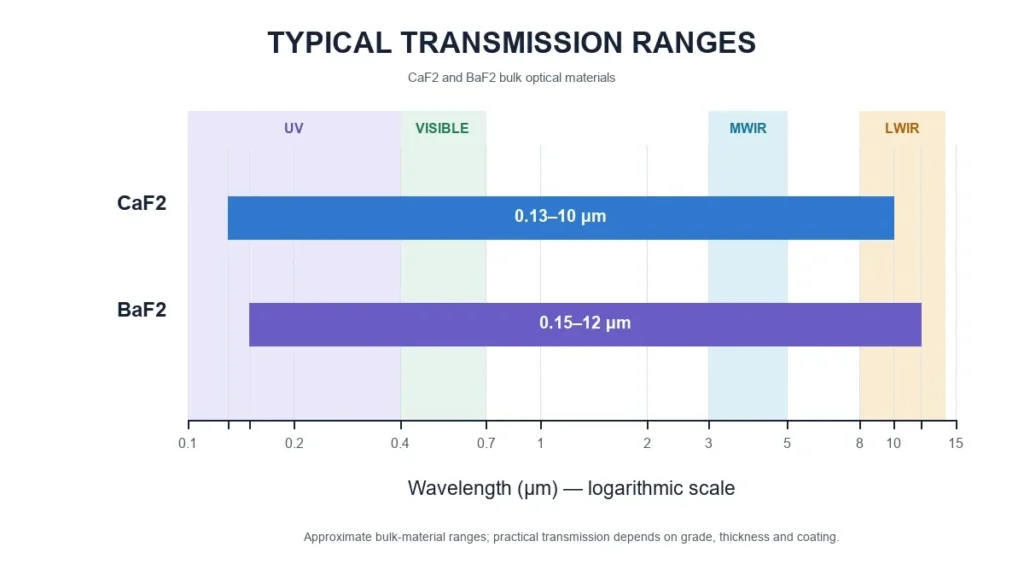
1. Transmission Range
Both CaF2 and BaF2 cover broad portions of the ultraviolet, visible and infrared spectrum.
Representative bulk-material data commonly places CaF2 at approximately 0.13–10 µm and BaF2 at approximately 0.2–11 µm. These limits should not be interpreted as uniform or guaranteed finished-window transmission.
CaF2 is often the preferred starting point for UV applications because specially selected high-purity grades are available for UV, VUV and excimer-laser systems.
BaF2 provides an advantage toward longer infrared wavelengths. It may be selected when CaF2 transmission decreases before the required upper wavelength.
Useful transmission can be narrower because of:
- Material purity
- UV, IR, Raman or scintillator grade
- Window thickness
- Surface reflection
- Internal absorption
- Operating temperature
- Coating range
- Required minimum transmission
The material should be evaluated at the actual wavelength and window thickness rather than only by its nominal endpoints.
2. Material Grade
Material grade is especially important for fluoride crystals.
CaF2 produced for general infrared applications may contain impurities that restrict UV or VUV transmission. UV, excimer and Raman systems normally require specially selected material.
The purchase specification should identify whether the application requires:
- General IR grade
- UV grade
- VUV grade
- Excimer-laser grade
- Raman grade
- Low-fluorescence material
- Scintillator-grade material
BaF2 intended for infrared use may also have restricted short-wavelength performance compared with high-purity UV-grade material.
Writing only “CaF2” or “BaF2” on the drawing may therefore be insufficient for a demanding optical system.
3. Hardness and Mechanical Durability
CaF2 is relatively soft compared with common optical glass and sapphire, but it is approximately twice as hard as BaF2 based on representative Knoop hardness values.
BaF2 is more mechanically fragile and can cleave easily. Particular care is required during fabrication, cleaning, assembly and use.
Mechanical reliability depends on:
- Window diameter
- Thickness
- Clear aperture
- Edge finish
- Chamfer design
- Mounting pressure
- Pressure differential
- Shock and vibration
- Cleaning method
A sharp or damaged edge can become a starting point for fracture. The component drawing should therefore specify a suitable chamfer or edge-break requirement.
Neither material should be mounted with excessive clamping force. A compliant mounting design may be required to accommodate dimensional changes and reduce localized stress.
4. Water and Humidity Resistance
CaF2 has very low water solubility and is generally more suitable than BaF2 when occasional moisture exposure is possible.
BaF2 is considerably more soluble in water. Direct water contact, condensation or unsuitable aqueous cleaning fluids can degrade its polished surface.
For a BaF2 window, review:
- Expected humidity
- Condensation risk
- Outdoor exposure
- Cleaning solution
- Storage conditions
- Sealing or purging
- Protective coating
- Packaging requirements
BaF2 should not automatically be selected for an exposed outdoor window simply because it provides longer infrared transmission.
5. Thermal Performance
CaF2 and BaF2 have similar representative coefficients of thermal expansion, but this does not mean they provide identical resistance to thermal shock.
BaF2 is particularly susceptible to rapid temperature changes. Sudden heating, cooling or an uneven temperature gradient may cause cracking or cleavage.
For thermally demanding systems, specify:
- Minimum and maximum temperature
- Temperature-change rate
- Thermal gradients
- Optical power
- Window dimensions
- Mounting material
- Heating or cooling method
- Thermal cycling requirements
CaF2 also requires careful thermal design, especially for large or thin windows. Neither fluoride material should be treated like ordinary durable optical glass.
6. Weight and Component Size
BaF2 has a density of approximately 4.83 g/cm³, compared with approximately 3.18 g/cm³ for CaF2.
A BaF2 window will therefore be substantially heavier than a CaF2 window with the same dimensions.
CaF2 may be preferred when:
- Component weight is limited
- The optic is installed in a moving assembly
- The system contains several large optical elements
- Mounting load must be reduced
- A larger aperture is required
Material availability, crystal diameter, thickness and required grade must also be confirmed before completing the design.
7. Surface Reflection and Coating
CaF2 and BaF2 have relatively low refractive indices compared with germanium, silicon or ZnSe. Their uncoated surface reflection is therefore lower than that of many common IR materials.
An AR coating may still be required when:
- Maximum transmission is important
- The system contains multiple transmissive surfaces
- Ghost reflections must be controlled
- The window operates at a non-zero angle of incidence
- A specific laser wavelength is used
- Surface protection is required
The coating specification should include:
- Wavelength or wavelength band
- Angle of incidence
- Required reflectance or transmission
- Polarization, if applicable
- Number of coated surfaces
- Environmental durability
- Cleaning requirements
- Laser damage requirement
A coating designed for UV use may not provide the required IR performance, and a broadband IR coating may restrict short-wavelength transmission.
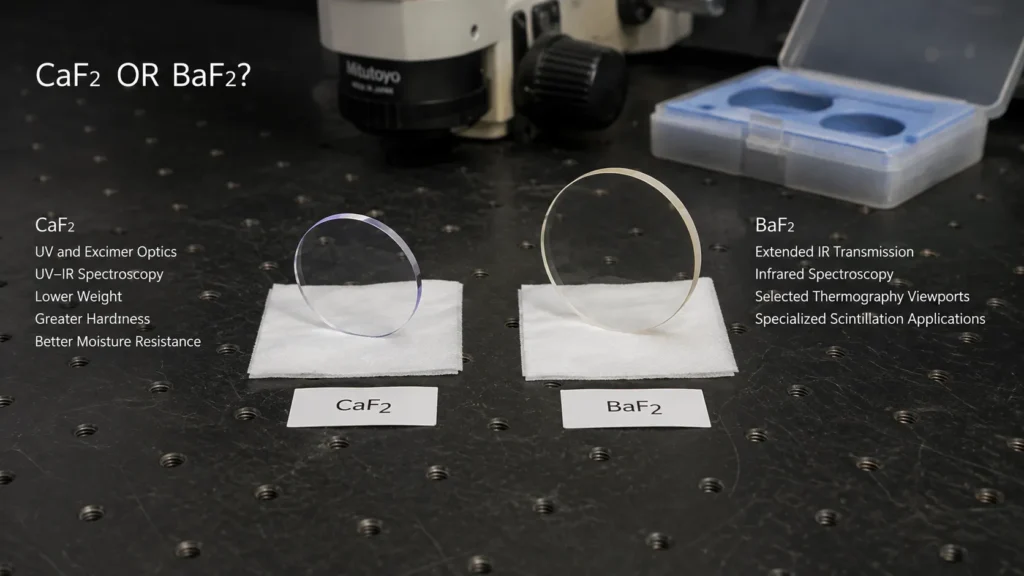
Which Material Is Better for Different Applications?
UV and Excimer-Laser Windows
High-purity CaF2 is normally the more relevant starting point. It is widely used for UV, VUV and excimer-laser applications.
The required grade should be stated because general IR-grade CaF2 may not provide suitable UV transmission.
UV-to-IR Spectroscopy
Both materials may be used.
CaF2 is generally preferred when greater hardness, lower weight and better moisture resistance are important. BaF2 may be considered when the measurement must extend farther into the infrared.
Infrared Spectroscopy
BaF2 provides longer-wavelength coverage than CaF2 and may be useful for infrared spectroscopy.
However, the required transmission should be checked at the actual thickness, particularly near the material’s long-wavelength limit.
Thermography Viewports
BaF2 can be used for selected passive infrared and thermography viewports. However, it does not necessarily provide complete high transmission across the entire 8–14 µm atmospheric band.
The detector band, window thickness, environment and required minimum transmission should be confirmed before selection.
Moist or Outdoor Environments
CaF2 is normally the safer choice because it is much less soluble in water.
For direct exposure to rain, condensation or aggressive cleaning, another more durable window material may be more appropriate than either fluoride.
Thermally Demanding Systems
CaF2 is generally preferred over BaF2 when thermal shock is a concern. The temperature-change rate, mount and window geometry must still be evaluated carefully.
How to Choose Between CaF2 and BaF2
Use this practical selection sequence:
- Define the complete operating wavelength band.
- Set the required finished-window transmission.
- Identify the required UV, IR or spectroscopy grade.
- Confirm the window diameter and thickness.
- Review humidity, water and cleaning exposure.
- Define the operating temperature and change rate.
- Evaluate pressure, shock, vibration and mounting stress.
- Select the AR or protective coating.
- Confirm material availability and manufacturing limits.
- Approve the complete finished-window specification.
Important: These recommendations are starting points rather than universal design rules. Final performance must be evaluated using the exact material grade, component geometry, coating and actual operating conditions.
Common Selection Mistakes
Choosing Only by the Published Transmission Endpoints
A stated material range does not guarantee high transmission throughout that range.
Treating Every CaF2 or BaF2 Grade as Equal
UV, IR, Raman and scintillator grades can have different purity and transmission characteristics.
Assuming BaF2 Covers the Entire LWIR Band
BaF2 extends farther into the infrared than CaF2, but it should not automatically be presented as providing complete 8–14 µm transmission.
Ignoring Water Sensitivity
BaF2 is significantly more water-soluble than CaF2. Humidity, condensation and cleaning methods must be considered.
Ignoring Thermal Shock
BaF2 is particularly susceptible to rapid temperature changes and uneven heating.
Overlooking Edge and Mounting Stress
Both materials can cleave. Edge quality, chamfer design and mounting force can affect component survival.
Frequently Asked Questions
Is BaF2 Better Than CaF2 for Infrared Optics?
Not for every application. BaF2 extends farther into the infrared, while CaF2 is harder, lighter, less water-soluble and generally easier to use in demanding environments.
Which Material Is Better for UV Windows?
High-purity CaF2 is commonly preferred for UV and excimer-laser windows. The exact UV or excimer grade should be specified.
Which Material Is More Durable?
CaF2 is generally more mechanically durable. It has a higher representative Knoop hardness and is less susceptible to moisture than BaF2.
Does BaF2 Transmit Across 8–14 µm?
BaF2 transmits into part of this region, but it does not necessarily provide suitable performance across the complete 8–14 µm band. Actual transmission depends on thickness, grade, temperature and coating.
Are CaF2 and BaF2 Water-Soluble?
Both have measurable water solubility, but BaF2 is significantly more soluble. CaF2 is generally more suitable where limited moisture exposure is possible.
Do CaF2 and BaF2 Require AR Coatings?
Not always. Their relatively low refractive indices produce lower reflection than high-index IR materials. An AR coating is still useful when maximum transmission or reflection control is required.
Are CaF2 and BaF2 Birefringent?
Both have cubic crystal structures and are normally treated as optically isotropic. They do not have the inherent birefringence associated with non-cubic crystals such as sapphire.
Custom CaF2 and BaF2 Optical Windows from Chenyu Optics
Chenyu Optics manufactures custom calcium fluoride and barium fluoride optical windows and substrates for UV, infrared, spectroscopy, laser, sensing and scientific optical systems.
Custom components can be evaluated according to:
- CaF2 or BaF2 material
- UV, IR, Raman or other material grade
- Operating wavelength
- Diameter or rectangular dimensions
- Thickness and dimensional tolerance
- Surface flatness
- Transmitted wavefront error
- Surface quality
- Parallelism or wedge
- Clear aperture
- Optical coating
- Temperature and environmental requirements
- Prototype or production quantity
- Inspection and packaging requirements
Final specifications should be confirmed according to the customer drawing, operating wavelength, selected material grade, coating design, environmental conditions and available inspection methods.
Need Help Choosing CaF2 or BaF2?
Send us your operating wavelength, window dimensions, transmission target, material-grade requirement, coating and working environment.
Chenyu Optics can help evaluate CaF2 and BaF2 options and prepare a manufacturable optical window specification.