
Germanium (Ge) and silicon (Si) are widely used to manufacture infrared windows, lenses and optical filter substrates. Both materials transmit important infrared wavelengths and have relatively high refractive indices, but they differ significantly in spectral coverage, weight, thermal behavior and cost.
Silicon is often preferred for near-infrared and mid-wave infrared systems, especially when low weight and good thermal conductivity are important. Germanium is a common starting point when the optical system must cover the long-wave infrared band, including the commonly used 8–14 µm thermal-imaging range. Thin, suitably selected and coated silicon may also be viable in some LWIR applications.
The correct choice depends on the operating wavelength, required transmission, temperature, component geometry, coating and environmental conditions.
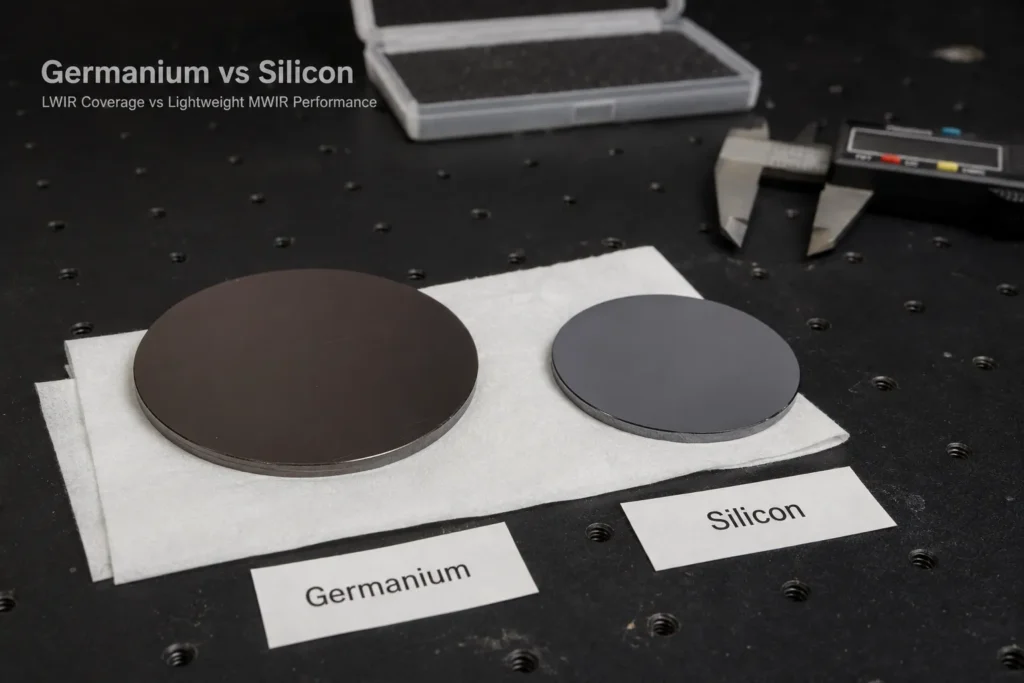 Germanium and Silicon Infrared Optical Window Comparison
Quick Answer: Germanium or Silicon?
Choose germanium as a common starting point when the system requires broadband LWIR performance, particularly across the 8–14 µm thermal-imaging band. Thin, suitably selected and coated silicon may also work in some 8–12 µm or 7–14 µm applications, so verify the grade, thickness and finished-window transmission.
Choose silicon for many 3–5 µm MWIR systems, NIR imaging and weight-sensitive infrared assemblies.
Choose germanium when broad MWIR-to-LWIR coverage is more important than low weight.
Choose silicon when lower density, higher thermal conductivity and greater hardness are important.
Evaluate germanium carefully when the optic will operate at elevated temperatures because its refractive index and absorption are strongly temperature-dependent.
Use an AR coating on either material when high finished-window transmission is required. Both materials have high refractive indices and therefore produce substantial reflection when uncoated.
Important: Germanium and silicon material ranges are not equivalent to guaranteed finished-window transmission. Actual performance depends on material grade, resistivity, thickness, wavelength, temperature, surface condition and coating.
What Is Germanium?
Germanium is a crystalline infrared optical material widely used for thermal-imaging windows, lenses, filter substrates and attenuated total reflection components.
It transmits across important portions of the mid-wave and long-wave infrared regions. Its coverage of the 8–14 µm band makes it especially useful for uncooled thermal cameras and other LWIR systems.
Germanium has a very high refractive index—approximately 4 in the LWIR—so uncoated surfaces reflect a large portion of the incident energy. An application-specific antireflection coating is normally required for efficient transmission.
Germanium is also relatively dense. A germanium optic can weigh more than twice as much as a silicon component of the same dimensions.
Best for:
- MWIR and LWIR thermal imaging
- 8–14 µm infrared systems
- FLIR windows and lenses
- Infrared filter substrates
- ATR spectroscopy components
Consider carefully:
- High surface reflection
- Component weight
- Temperature-dependent refractive index
- Increased absorption at elevated temperatures
- Coating durability
- Material availability and cost
What Is Silicon?
Silicon is another crystalline material used for infrared windows, lenses and filter substrates. It is commonly selected for near-infrared and mid-wave infrared applications, particularly around the 3–5 µm atmospheric transmission band.
Silicon has a lower density than germanium, making it attractive for airborne, portable and other weight-sensitive optical assemblies. It also provides high thermal conductivity and a relatively low coefficient of thermal expansion.
The practical transmission of silicon depends on material purity, resistivity, thickness and wavelength. Optical-grade silicon must therefore be selected according to the intended spectral band.
Like germanium, silicon has a high refractive index. Uncoated silicon windows experience significant reflection and normally require an AR coating when high transmission is needed.
Best for:
- NIR and MWIR imaging
- 3–5 µm infrared systems
- Infrared spectroscopy
- IR filter substrates
- Weight-sensitive optical assemblies
- Selected laser and THz applications
Consider carefully:
- No visible transparency
- Limited suitability for standard 8–14 µm imaging
- Material resistivity and free-carrier absorption
- Surface reflection
- Coating wavelength range
Germanium vs Silicon: Key Differences
| Property | Germanium | Silicon |
|---|---|---|
| Main spectral use | MWIR and LWIR | NIR and MWIR |
| Representative bulk range | Typical optical use approximately 2–14 μm; longer-wave performance depends on grade, thickness and temperature | Common optical use approximately 1.2–7 μm; longer-wave performance depends strongly on grade |
| Common imaging band | 8–14 μm | 3–5 μm |
| Refractive index | Approximately 4.0 in the LWIR | Approximately 3.42 at 5 μm |
| Density | Approximately 5.33 g/cm3 | Approximately 2.33 g/cm3 |
| Relative weight | Heavier | Lighter |
| Thermal conductivity | Moderate | Significantly higher |
| Temperature sensitivity | High | Lower than germanium, but still requires evaluation |
| Relative material cost and availability | Usually higher and more exposed to supply-price changes | Usually lower, with broader semiconductor-industry availability; optical grade still matters |
| Surface reflection | Very high when uncoated | High when uncoated |
| Typical applications | LWIR imaging, FLIR and thermal sensing | MWIR imaging, spectroscopy and lightweight IR systems |
Disclaimer: The values shown are representative reference data rather than guaranteed finished-component specifications. Properties may vary according to material grade, resistivity, wavelength, temperature, manufacturing method and supplier.
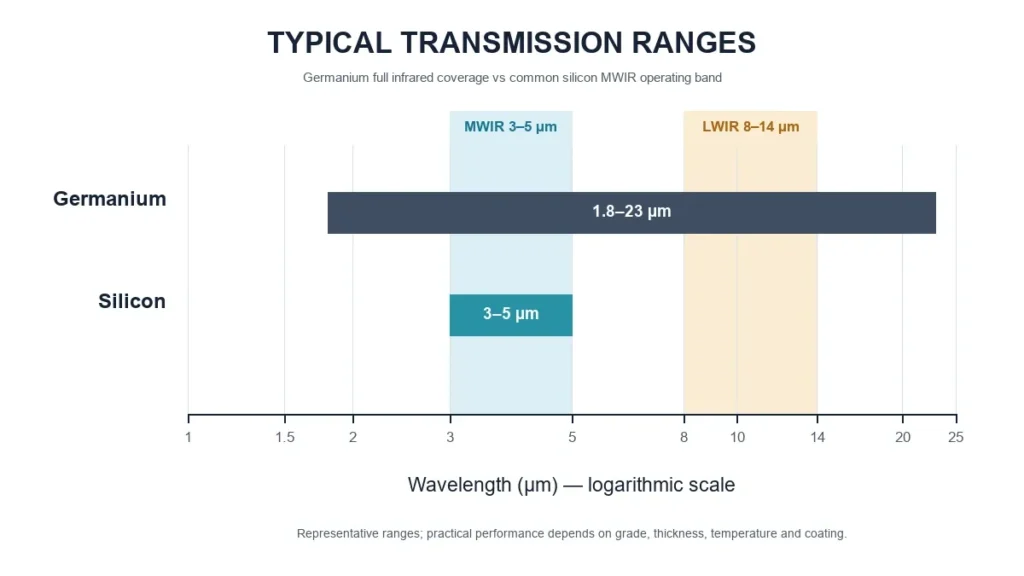 Representative transmission ranges for material comparison only. Actual transmission depends on material grade, thickness, surface condition and coating
1. Transmission Range
The operating wavelength is normally the first factor when choosing between germanium and silicon.
Germanium covers the important 8–14 µm thermal-imaging band and is therefore widely used in LWIR cameras. It can also be used in parts of the MWIR, depending on the complete optical design.
Silicon is commonly used in the 3–5 µm MWIR band and selected near-infrared applications. Although specialized high-resistivity silicon can transmit at longer wavelengths, standard optical silicon should not automatically be treated as a direct replacement for germanium in an 8–14 µm system.
Published transmission curves normally describe bulk material under specific test conditions. The useful range of a finished component may be narrower because of:
- Material grade
- Electrical resistivity
- Component thickness
- Surface reflection
- AR coating range
- Operating temperature
- Required minimum transmission
2. Refractive Index and Surface Reflection
Both germanium and silicon have much higher refractive indices than common visible optical glasses.
Germanium has a refractive index of approximately 4 in the LWIR. Silicon has a refractive index of approximately 3.42 at 5 µm. These high indices create substantial Fresnel reflection at uncoated surfaces.
An AR coating should be specified according to:
- Operating wavelength or wavelength band
- Angle of incidence
- Required average or maximum reflectance
- Required minimum transmission
- Polarization, if applicable
- Number of coated surfaces
- Environmental durability
- Cleaning conditions
A coating designed for 3–5 µm is not automatically suitable for 8–12 µm or 8–14 µm operation.
3. Weight and Density
Silicon has a density of approximately 2.33 g/cm³, while germanium has a density of approximately 5.33 g/cm³.
For two windows with the same diameter and thickness, the germanium component can therefore weigh more than twice as much as the silicon component.
Silicon may be preferred for:
- Airborne imaging systems
- Portable thermal instruments
- Gimbals
- Drones
- Weight-sensitive sensor assemblies
- Systems containing multiple IR elements
Weight alone should not determine the material. If the system requires standard LWIR transmission, germanium may still be necessary despite its higher density.
4. Cost, Availability and Total Ownership
Germanium is generally more expensive than silicon and its price can vary with global supply. Silicon is more widely available, but optical-grade material, resistivity requirements, diameter and coating can still have a major effect on price.
Compare the complete finished component rather than raw material price alone. Important cost drivers include:
- Material grade, certification and usable blank size
- Diameter, thickness and edge geometry
- Surface figure, surface quality and parallelism
- Silicon resistivity or germanium homogeneity requirements
- AR, DLC or other protective coating
- Environmental testing, inspection and documentation
- Expected replacement interval in the operating environment
A lower-cost silicon blank is not automatically the lowest-cost solution if it cannot meet the required LWIR transmission. Likewise, germanium may justify its higher price when broad 8–14 µm performance is essential. For a broader comparison, see our optical window material selection guide.
5. Mechanical Properties
Both materials can be manufactured into precision windows and lenses, but silicon is generally harder than germanium.
Greater hardness can help silicon resist some forms of scratching and handling damage. However, neither material should be treated as indestructible.
Mechanical reliability also depends on:
- Window diameter
- Component thickness
- Clear aperture
- Edge finish
- Mounting stress
- Pressure differential
- Shock and vibration
- Cleaning method
- Coating durability
For an exposed front optic, a durable coating may be required. Diamond-like carbon coatings are often considered for germanium windows used in demanding environments, although coating performance must be confirmed for the required wavelength band.
6. Thermal Performance
Thermal behavior is one of the most important differences between germanium and silicon.
Germanium has a strongly temperature-dependent refractive index. Temperature changes can alter focus, wavefront performance and system calibration. Germanium absorption also increases at elevated temperatures, which can limit its usefulness in hot environments.
Silicon offers higher thermal conductivity and a lower coefficient of thermal expansion. This can help distribute heat and improve dimensional stability.
However, the complete assembly must still be evaluated because thermal performance depends on:
- Minimum and maximum temperature
- Temperature-change rate
- Thermal gradients
- Window dimensions
- Absorbed optical power
- Mounting material
- Coating absorption
- Required imaging performance
Material selection should therefore be part of the system’s athermalization and thermal-management design.
7. Material Grade and Resistivity
The term “optical silicon” does not describe one universal material performance level.
Silicon transmission—particularly at longer infrared wavelengths—can depend strongly on doping and electrical resistivity. Free carriers can increase infrared absorption.
The RFQ or drawing should identify:
- Required transmission band
- Silicon grade
- Resistivity requirement, if applicable
- Maximum acceptable absorption
- Component thickness
- Inspection method
Germanium grade and material quality can also affect absorption, homogeneity and finished optical performance. For critical systems, the required material certification should be stated in the purchase specification.
8. AR and Protective Coatings
Because germanium and silicon both produce high uncoated reflection, coating performance is a major part of the material decision.
Common requirements may include:
- Single-band AR coating
- Broadband AR coating
- High-durability AR coating
- Diamond-like carbon protective coating
- One-side AR and one-side protective coating
- Environmental resistance
- Adhesion and abrasion testing
The coating requirement should be written as a measurable optical specification rather than only “AR coated.” See our AR coating selection guide for the parameters that should be defined.
For example, specify the wavelength band, angle of incidence, required reflectance and environmental conditions.
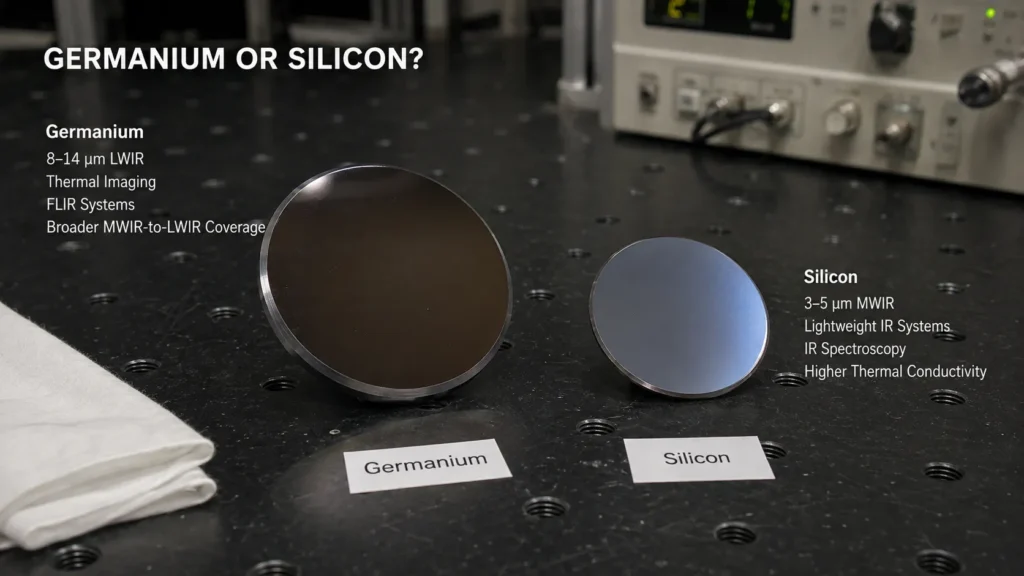 General application guide for preliminary material selection. Final selection should be confirmed using the required wavelength band, material grade, component thickness, operating temperature, mechanical design and coating performance.
Need help choosing an IR material for your design?
Send us the wavelength band, component dimensions, operating temperature, transmission target, coating and environmental requirements. We can compare germanium and silicon as finished components rather than relying only on bulk-material data.
Which Material Is Better for Different Applications?
3–5 µm MWIR Imaging
Silicon is often the preferred starting point because it provides useful MWIR transmission, low density and good thermal conductivity.
Germanium can also operate in this region, but its additional weight and thermal sensitivity may not provide an advantage when LWIR coverage is unnecessary.
8–14 µm LWIR Thermal Imaging
Germanium is normally the more relevant choice because it covers the standard 8–14 µm thermal-imaging band.
Standard silicon should not be selected for an LWIR system based only on a broad published bulk-material range. The actual silicon grade, resistivity, thickness and transmission requirement would need to be verified.
Weight-Sensitive Infrared Systems
Silicon is generally preferred when low component weight is a major requirement. Its density is less than half that of germanium.
The final choice must still satisfy the required wavelength band.
High-Temperature Environments
Silicon is often easier to manage thermally because it provides higher thermal conductivity and is less optically temperature-sensitive than germanium.
Germanium performance should be evaluated carefully when the operating temperature can rise significantly above room temperature.
Rugged External Windows
Either material may be used depending on the required wavelength.
The design should evaluate window thickness, edge condition, mounting stress, impact, abrasion and coating durability. A durable AR or protective coating may be necessary for an externally exposed surface.
Infrared Filter Substrates
Both germanium and silicon can be used as filter substrates. Selection depends on the filter band, blocking requirement, thickness, temperature and coating design.
How to Choose Between Germanium and Silicon
Use this practical selection sequence:
- Identify the operating wavelength or complete spectral band.
- Confirm whether the system requires MWIR, LWIR or both.
- Define the required finished-window transmission.
- Evaluate the minimum and maximum operating temperatures.
- Determine the allowable component weight.
- Define the required diameter and thickness.
- Review pressure, impact, vibration and abrasion.
- Select the material grade and silicon resistivity, if applicable.
- Define the AR or protective coating.
- Confirm performance using the finished-component specification.
Important: Material recommendations are starting points rather than universal design rules. Final performance must be evaluated using the complete component specification and actual operating conditions.
Common Selection Mistakes
Assuming Germanium and Silicon Cover the Same IR Bands
Germanium is widely used in the 8–14 µm LWIR band, while silicon is more commonly selected for 3–5 µm MWIR systems.
Choosing Only by a Published Transmission Range
A bulk-material range does not guarantee the transmission of a finished optic. Grade, resistivity, thickness, temperature and coating must also be considered.
Ignoring Germanium’s Temperature Sensitivity
Germanium’s refractive index and absorption change significantly with temperature. This can affect focus and transmission.
Ignoring Surface Reflection
Both materials have high refractive indices. Uncoated windows can lose a substantial amount of energy through reflection.
Specifying Only “IR Coated”
The required wavelength band, angle of incidence, reflectance, transmission and environmental durability should be stated.
Ignoring Component Weight
Germanium is considerably denser than silicon. The weight difference can be important in portable, airborne or multi-element optical systems.
Frequently Asked Questions
Is Germanium Better Than Silicon for Infrared Optics?
Not for every application. Germanium is usually more suitable for LWIR systems, while silicon is often preferred for MWIR and weight-sensitive applications.
Can Silicon Replace Germanium in a Thermal Camera?
Silicon may be suitable for a 3–5 µm MWIR camera, but standard silicon is not normally a direct replacement for germanium in an 8–14 µm LWIR camera.
The detector band and required finished-optic transmission must be confirmed.
Which Material Is Lighter?
Silicon is significantly lighter. Its density is approximately 2.33 g/cm³, compared with approximately 5.33 g/cm³ for germanium.
Which Material Handles Temperature Better?
Silicon generally offers higher thermal conductivity and lower optical sensitivity to temperature than germanium.
The complete optic, coating and mount must still be evaluated over the specified temperature range.
Do Germanium and Silicon Windows Need AR Coatings?
An AR coating is normally recommended when high transmission is required. Both materials have high refractive indices and produce substantial reflection when uncoated.
Which Is More Expensive: Germanium or Silicon?
Germanium is usually more expensive as a raw material and is more sensitive to supply-price changes. The final component cost also depends on size, tolerances, material grade, coating, testing and quantity. Compare quotations using the same finished-optic requirements.
What Information Should I Include in an RFQ?
Include the wavelength band, minimum transmission, dimensions, material grade or silicon resistivity, surface figure, surface quality, parallelism, coating, operating temperature, environmental requirements and quantity. Our optical component RFQ guide provides a complete checklist.
Can Germanium Transmit Visible Light?
No. Germanium is opaque in the visible spectrum and is used primarily for infrared applications.
Can Silicon Transmit Visible Light?
No. Optical silicon is also opaque in the visible region.
Custom Germanium and Silicon Optics from Chenyu Optics
Chenyu Optics manufactures custom germanium and silicon optical windows, lenses and substrates for thermal imaging, infrared sensing, spectroscopy, laser and industrial optical systems.
Custom components can be evaluated according to:
- Germanium or optical silicon material
- Silicon resistivity or material grade
- Operating wavelength
- Diameter or rectangular dimensions
- Thickness and dimensional tolerance
- Surface flatness
- Transmitted wavefront error
- Surface quality
- Parallelism or wedge
- Clear aperture
- AR or protective coating
- Temperature and environmental requirements
- Prototype or production quantity
- Inspection and packaging requirements
Final specifications should be confirmed according to the customer drawing, required wavelength band, selected material grade, coating design, operating conditions and available inspection methods.
Need Help Choosing Germanium or Silicon?
Send us your operating wavelength, dimensions, transmission target, coating requirements and working environment.
Chenyu Optics can help you evaluate germanium and silicon options and prepare a manufacturable infrared optical component specification.