
Zinc selenide (ZnSe) and zinc sulfide (ZnS) are widely used for infrared optical windows, lenses and protective components. Both materials transmit important infrared wavelength bands, but they differ in absorption, visible transparency, mechanical durability, thermal behavior and suitability for laser or harsh-environment applications.
The correct choice depends on the operating wavelength, required transmission, environmental exposure, optical power, coating and mechanical design.
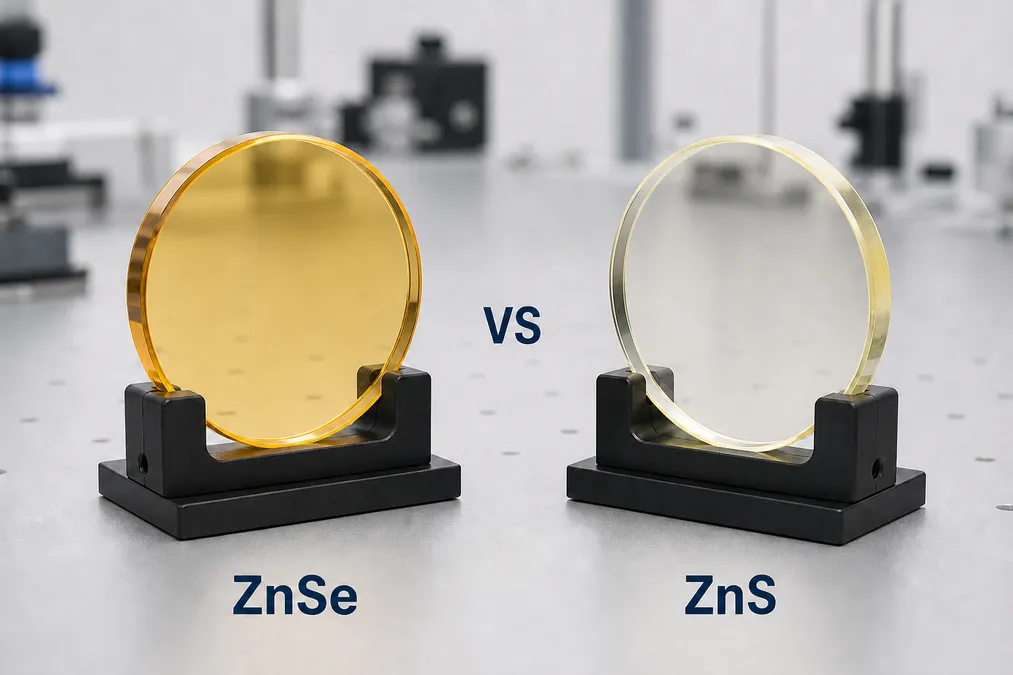 ZnSe vs ZnS Infrared Optical Window Comparison
Quick Answer: ZnSe or ZnS?
Choose ZnSe when very low absorption is critical in infrared laser systems, especially near the 10.6 µm CO₂ laser wavelength.
Choose ZnS when the window needs greater mechanical strength, hardness or resistance to demanding outdoor and airborne environments.
Choose multispectral ZnS when one window must transmit both visible and infrared wavelengths.
Important: Standard ZnS, FLIR-grade ZnS and multispectral ZnS are not interchangeable. Supplier grade names and performance ranges vary, so the exact grade and datasheet should be confirmed in the drawing or quotation request.
What Is Zinc Selenide?
Zinc selenide is a polycrystalline infrared optical material commonly produced by chemical vapor deposition.
ZnSe is widely used for infrared windows, lenses, beamsplitters and CO₂ laser optics. It provides broad infrared transmission and has very low bulk absorption at 10.6 µm when the material quality and manufacturing process are properly controlled.
ZnSe transmits part of the visible spectrum, giving it a characteristic yellow or orange appearance. In some systems, partial transmission near the red edge of the visible spectrum can help with alignment, but ZnSe is not water-clear and should not be treated as a general-purpose visible window.
ZnSe has a relatively high refractive index, so uncoated surfaces produce significant reflection. An application-specific antireflection coating is normally required when high finished-window transmission is needed.
What Is Zinc Sulfide?
Zinc sulfide is another polycrystalline infrared optical material used for windows, lenses and protective infrared components.
Two grades are especially important:
ZnS FLIR Grade
ZnS FLIR grade is mainly selected for thermal infrared systems. It is typically pale yellow and translucent in the visible region rather than optically clear.
It is commonly considered for exposed infrared windows where strength, hardness and environmental durability are important.
ZnS Multispectral Grade
Multispectral ZnS undergoes additional processing to improve visible transmission and reduce optical scatter.
It can support common-aperture systems combining visible, near-infrared and thermal infrared sensors. Coherent describes its ZnS MS as transmitting from approximately 400 nm to 12 µm, while Crystran lists a representative material range of approximately 0.37–13.5 µm. These are material-level ranges, not guaranteed finished-window transmission values.
ZnSe vs ZnS: Key Differences
ZnSe
- Range: approximately 0.6–21 µm
- Appearance: yellow or orange
- Best for: low absorption near 10.6 µm and CO₂ laser optics
- Limit: relatively soft; careful handling and mounting are required
- Coating: AR coating normally required
ZnS FLIR
- Range: supplier-dependent; optimized especially for 8–12 µm
- Appearance: pale yellow and translucent
- Best for: exposed thermal-imaging windows and harsh environments
- Advantage: greater strength and durability than ZnSe
- Coating: match the coating to the infrared band
ZnS Multispectral
- Range: approximately 0.37–13.5 µm, depending on grade
- Appearance: clear to water-clear, depending on supplier and finish
- Best for: common-aperture visible and infrared systems
- Limit: not selected for minimum CO₂ laser absorption
- Coating: multispectral designs may be required
1. Transmission Range
ZnSe provides broad infrared transmission and is widely used across near-infrared, mid-wave infrared and long-wave infrared applications.
Material suppliers often publish a broad nominal transmission range for ZnSe. However, the useful operating range of a finished window may be narrower because of:
- Window thickness
- Material absorption
- Surface reflection
- AR coating range
- Operating temperature
- Required minimum transmission
ZnS performance depends strongly on grade.
Standard or FLIR-grade ZnS is mainly used in the thermal infrared, while multispectral ZnS is processed to provide improved visible and infrared transmission.
Therefore, an article should not state that all ZnS windows transmit clearly from the visible through the LWIR.
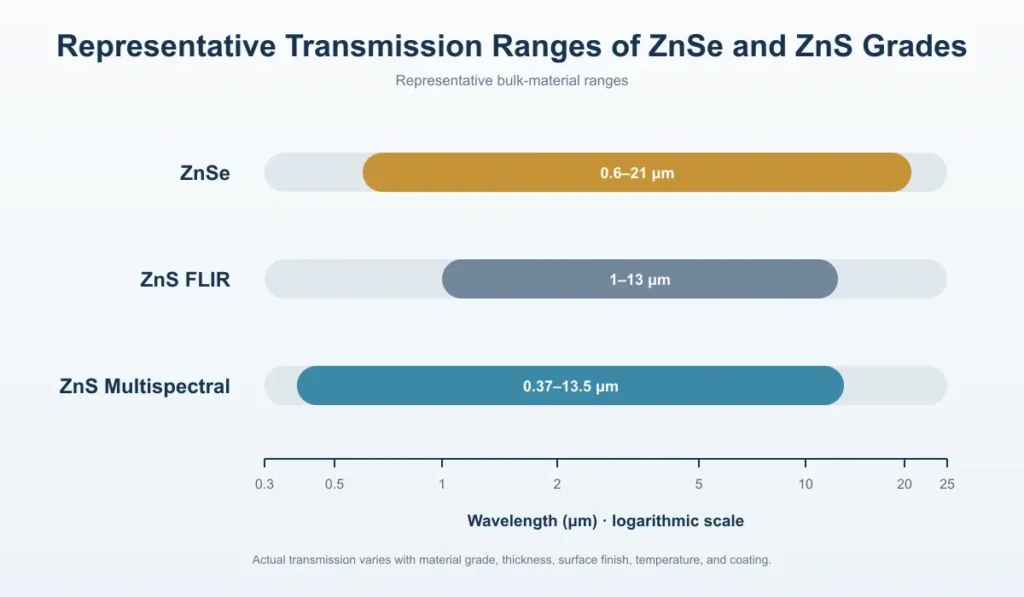
Representative transmission ranges for material comparison only. Actual transmission depends on material grade, thickness, surface condition and coating
2. CO₂ Laser Performance
ZnSe is widely used for CO₂ laser windows and lenses operating near 10.6 µm because suitable optical-grade ZnSe can provide very low bulk absorption at this wavelength.
For high-power laser applications, material name alone is not enough. The following factors must also be reviewed:
- Bulk absorption
- Internal defects
- Surface quality
- Edge condition
- Coating absorption
- Beam diameter
- Laser power and power density
- Cooling and mounting design
ZnS may be used in selected laser systems, but it should not automatically be presented as a direct replacement for ZnSe in high-power CO₂ laser optics.
3. Mechanical Strength and Environmental Durability
ZnS is generally selected over ZnSe when mechanical strength, hardness and resistance to harsh environments are major priorities.
FLIR-grade ZnS is used as a tough front optic in thermal imaging systems exposed to demanding environmental conditions. It may be considered for airborne, outdoor and protective infrared windows.
ZnSe is softer and should be handled carefully during cleaning, assembly and use. Surface damage or coating damage can reduce optical performance.
However, ZnS is not indestructible. Window thickness, mounting stress, impact conditions and environmental testing requirements must still be considered.
4. Thermal Performance
Both ZnSe and ZnS can be affected by temperature.
ZnSe has a significant temperature-dependent refractive index. This can change system focus or optical performance as temperature varies.
ZnS generally provides stronger mechanical performance, while multispectral ZnS may offer higher thermal conductivity than ZnSe. However, thermal performance must be evaluated using the exact material grade.
For thermally demanding systems, specify:
- Minimum and maximum temperature
- Temperature-change rate
- Temperature gradient
- Optical power
- Window dimensions and thickness
- Mounting material
- Required thermal cycling or environmental test
5. Surface Reflection and AR Coating
Both ZnSe and ZnS have relatively high refractive indices. Their uncoated surfaces can therefore produce substantial Fresnel reflection.
An AR coating is normally selected according to:
- Operating wavelength or wavelength band
- Angle of incidence
- Required average or minimum transmission
- Laser power, if applicable
- Environmental durability
- Number of coated surfaces
Common coating requirements may include:
- Single-band AR coating
- Broadband infrared AR coating
- Dual-band or multispectral coating
- Durable protective coating
- One-side AR and one-side environmental protection
The coating requirement should be written as a measurable wavelength and performance specification, not only as “AR coated.”
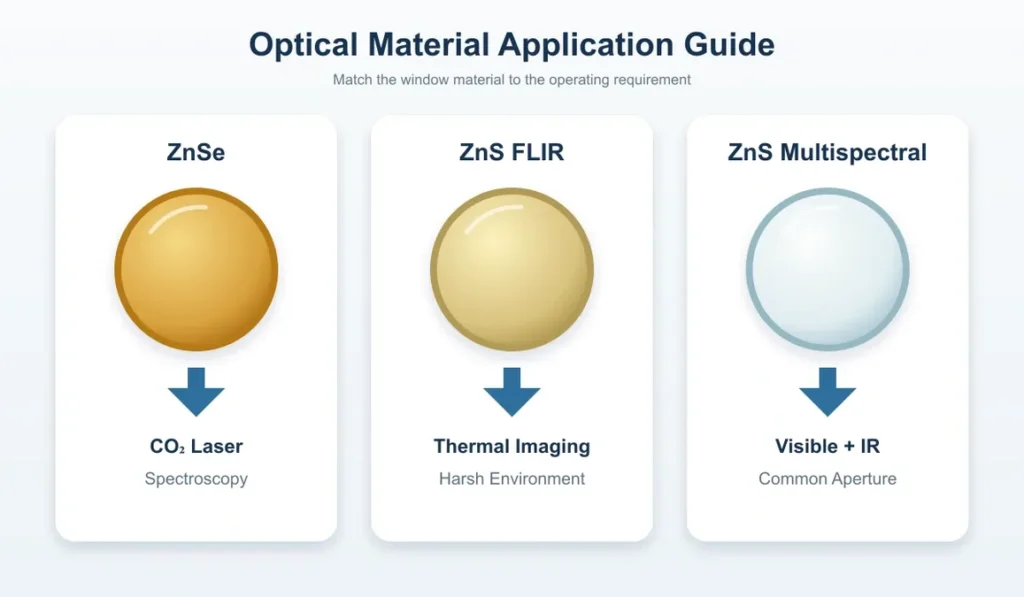 General application guide for preliminary material selection. Final selection should be confirmed using the required wavelength band, material grade, component thickness, operating temperature, mechanical design and coating performance.
6. Which Material Is Better for Different Applications?
CO₂ Laser Windows
ZnSe is generally the preferred starting point because of its low absorption around 10.6 µm.
The final design must still consider coating absorption, laser power density and thermal management.
Thermal Imaging Windows
Both materials may be used.
ZnSe is suitable when infrared transmission and optical performance are the main priorities. ZnS FLIR may be preferred when the external window must withstand a more demanding mechanical environment.
Multispectral Sensor Windows
Multispectral ZnS is normally the more relevant option when visible and infrared sensors must operate through the same aperture.
The drawing should explicitly specify multispectral or clear ZnS rather than simply “ZnS.”
Harsh-Environment Windows
ZnS is generally the stronger candidate when resistance to rain erosion, dust, particles or mechanical wear is important.
System-level environmental testing requirements should still be supplied.
Laboratory and Spectroscopy Systems
ZnSe is widely used for infrared spectroscopy components and windows when low infrared absorption and broad spectral performance are required.
How to Choose Between ZnSe and ZnS
Use this practical selection sequence:
Choose ZnSe When:
- The system operates at or near 10.6 µm
- Low bulk absorption is important
- The component is used in a CO₂ laser system
- The environment is controlled
- Partial visible transmission helps alignment
Choose ZnS FLIR When:
- The window is primarily used in thermal infrared imaging
- Mechanical strength and durability are important
- The window is exposed to a harsh environment
- Visible optical clarity is not required
Choose Multispectral ZnS When:
- Visible and infrared sensors share one optical aperture
- Reduced visible scatter is required
- The design requires visible-to-infrared transmission
- The higher cost of multispectral processing is justified
Material Handling and Safety
Do not grind, cut or polish ZnSe or ZnS optics outside a properly equipped optical-processing facility. Damaged components and any generated dust should be handled according to the supplier’s safety data sheet. Machining must be performed only by trained personnel using suitable dust-control and waste-disposal procedures.
Common Selection Mistakes
Treating All ZnS Grades as the Same
FLIR ZnS and multispectral ZnS have different visible transmission and mechanical characteristics.
Choosing Only by the Published Transmission Range
Published material ranges do not equal the guaranteed transmission of a finished coated window.
Ignoring Surface Reflection
Both materials normally require AR coating for high system transmission.
Assuming ZnS Is Automatically Suitable for CO₂ Lasers
ZnSe generally provides much lower absorption near 10.6 µm.
Ignoring the Operating Environment
A window with good optical transmission may still fail because of abrasion, thermal stress, cleaning or mounting problems.
Custom ZnSe and ZnS Windows from Chenyu Optics
Chenyu Optics supports drawing-based custom ZnSe and ZnS optical window production for infrared imaging, laser, sensing and industrial optical systems.
Available requirements can be reviewed according to:
- ZnSe, ZnS FLIR or multispectral ZnS material requirement
- Operating wavelength
- Diameter, rectangular size or custom shape
- Thickness and dimensional tolerance
- Surface quality and surface flatness
- Parallelism, wedge and clear aperture
- AR or application-specific coating
- Laser power or environmental requirements
- Prototype, small-batch and repeat-production quantities
- Inspection and packaging requirements
Final specifications should be confirmed according to the drawing, material grade, coating design and available inspection method.
Need help selecting ZnSe or ZnS?
Send us the wavelength range, dimensions, coating requirements and operating environment. We will help you choose the appropriate material and grade.