
Optical windows protect cameras, detectors, lasers and other optical assemblies while allowing the required wavelengths to pass through. Although a window has no intended focusing power, its material can still affect transmission, wavefront quality, thermal stability and system durability.
Choosing the right optical window material requires more than comparing published transmission ranges. The operating wavelength, required transmission, environment, mechanical load, optical power, coating and budget must all be considered.
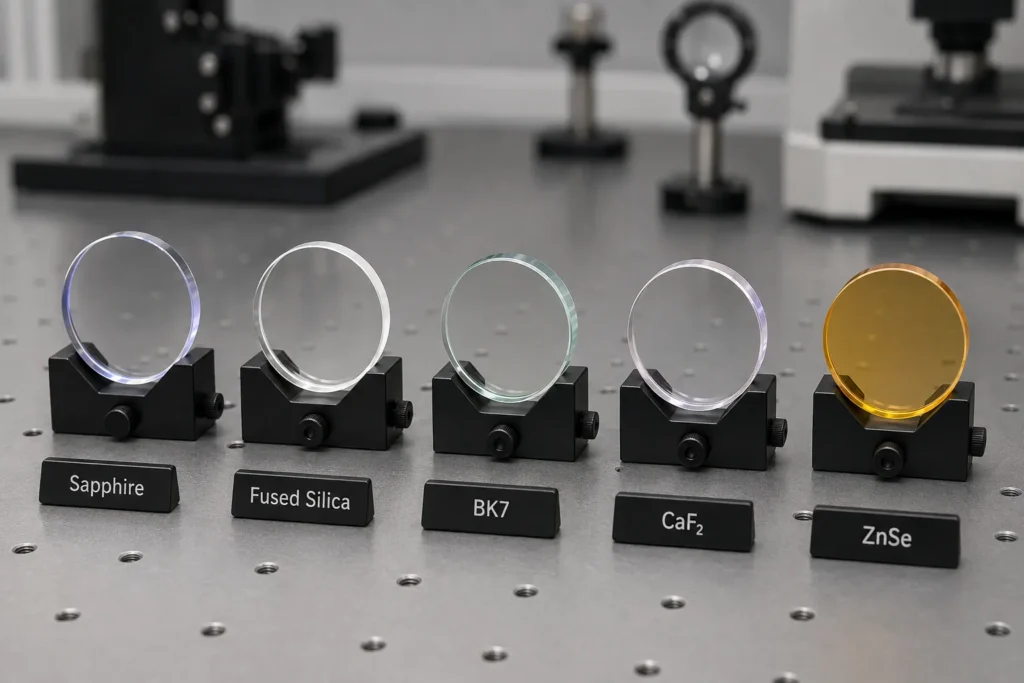 Common optical window materials for UV, visible and infrared applications
Quick Answer: Which Optical Window Material Should You Choose?
Choose N-BK7 for economical visible and near-infrared windows used in controlled environments.
Choose fused silica for UV transmission, low thermal expansion, laser systems and demanding optical-quality requirements.
Choose sapphire when scratch resistance, mechanical strength and harsh-environment durability are priorities.
Choose calcium fluoride (CaF2) for broad UV-to-mid-infrared transmission and spectroscopy applications.
Choose silicon for many near-infrared and MWIR systems where visible transmission is not required.
Choose germanium for MWIR and LWIR thermal-imaging windows.
Choose zinc selenide (ZnSe) for broadband infrared applications and CO2 laser systems near 10.6 µm.
Important: A published material range represents typical bulk-material performance. The transmission of a finished optical window also depends on material grade, thickness, surface finish, wavelength, temperature and coating.
What Is an Optical Window?
An optical window is normally a flat, plane-parallel component installed between an optical system and its operating environment.
Optical windows may be used to:
- Protect cameras, detectors and internal optics
- Seal an enclosure against dust or moisture
- Separate vacuum or pressurized environments
- Resist impact, abrasion or chemical exposure
- Provide a transmissive aperture for imaging or laser energy
A window can introduce reflection, optical path changes, transmitted wavefront error and ghost images. Its material, dimensions, tolerances, coating and mounting method should therefore be evaluated as one complete specification.
Common Optical Window Materials
N-BK7 Optical Glass
N-BK7 is a widely used optical crown glass for visible and near-infrared systems. It offers good optical homogeneity, reliable polishability and economical production.
It is commonly used in machine vision, inspection equipment, laboratory instruments and protective camera windows.
Best for: economical visible and NIR applications.
Consider carefully: UV transmission, thermal expansion and operating temperature.
Fused Silica
Fused silica provides good UV, visible and near-infrared transmission. Its very low coefficient of thermal expansion makes it suitable for temperature changes and precision optical systems.
Common applications include UV imaging, laser instrumentation, spectroscopy and interferometry.
UV-grade, IR-grade and laser-grade fused silica are not always interchangeable. The exact material grade should be confirmed for demanding applications.
Best for: UV systems, laser windows and thermally stable optical assemblies.
Consider carefully: material grade, homogeneity, absorption, fluorescence and laser damage requirements.
Sapphire
Sapphire is an extremely hard and durable crystalline material. It is often selected for windows exposed to scratches, particles, pressure, vibration or frequent cleaning.
Typical applications include aerospace sensors, industrial inspection systems, pressure windows and exposed protective covers.
Because sapphire is birefringent, crystal orientation may affect polarization-sensitive or high-resolution optical systems.
Best for: harsh environments, scratch resistance and mechanically demanding windows.
Consider carefully: crystal orientation, birefringence, fabrication cost and mounting stress.
Calcium Fluoride
Calcium fluoride provides broad transmission from the UV into the mid-infrared and has low optical dispersion.
It is used in spectroscopy, UV systems, excimer-laser applications and selected cryogenic thermal-imaging systems.
CaF2 is softer and more sensitive to handling and thermal shock than fused silica or sapphire.
Best for: UV-to-mid-IR transmission and spectroscopy.
Consider carefully: thermal shock, edge condition, handling and mounting stress.
Silicon
Optical silicon is mainly used in near-infrared and MWIR systems. It is not transparent in the visible region.
Its relatively low density is useful for weight-sensitive systems, while its thermal conductivity can help distribute heat.
Silicon has a high refractive index, so an AR coating is normally required when high transmission is needed.
Best for: MWIR imaging, IR spectroscopy and weight-sensitive infrared systems.
Consider carefully: visible opacity, surface reflection, material resistivity and coating range.
Germanium
Germanium is widely used for MWIR and LWIR thermal-imaging windows. It offers useful transmission in important thermal-camera bands and moderate mechanical durability, but it still requires careful handling and may benefit from a protective coating.
However, germanium is heavy and has a very high refractive index. Its optical performance also changes significantly with temperature.
Best for: thermal imaging, FLIR systems and infrared sensing.
Consider carefully: weight, high surface reflection, coating performance and operating temperature.
Zinc Selenide
Zinc selenide offers broad infrared transmission and is commonly used for thermal imaging, spectroscopy and CO2 laser optics.
Suitable optical-grade ZnSe can provide low bulk absorption near the 10.6 µm CO2 laser wavelength. For high-power applications, material absorption, coating absorption and laser damage resistance must be confirmed.
Best for: CO2 laser windows and broadband infrared systems.
Consider carefully: material certification, surface quality, coating absorption, handling and mounting.
Optical Window Material Comparison
| Material | Main spectral use | Main advantage | Typical applications |
|---|---|---|---|
| N-BK7 | Visible and NIR | Economical and easy to manufacture | Machine vision and instruments |
| Fused silica | UV, visible and NIR | Low thermal expansion | UV systems and laser windows |
| Sapphire | UV, visible and selected IR | High hardness and durability | Harsh-environment windows |
| CaF2 | UV to mid-IR | Broad transmission and low dispersion | Spectroscopy and UV systems |
| Silicon | NIR and MWIR | Low density and good thermal conductivity | MWIR imaging |
| Germanium | MWIR and LWIR | Useful thermal-IR performance | Thermal imaging and FLIR |
| ZnSe | Broad infrared | Low absorption at 10.6 μm with suitable grades | CO2 lasers and IR systems |
Note: This table provides a general comparison for preliminary material selection. Actual performance depends on the exact material grade, window thickness, surface finish, coating, operating temperature and supplier data.
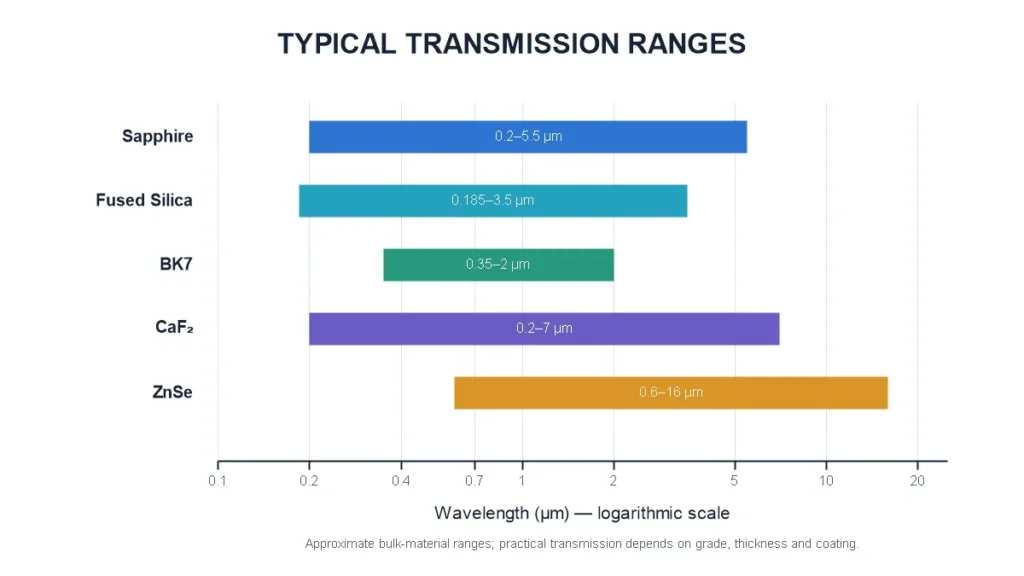
Representative transmission ranges for material comparison only. Actual transmission depends on material grade, thickness, surface condition and coating
1. Start with the Operating Wavelength
The first step is to identify the exact wavelength or wavelength band that must pass through the window.
Define:
- Center wavelength or full operating band
- Required average or minimum transmission
- Angle of incidence
- Polarization, if relevant
- Detector or laser wavelength
- Whether visible alignment light must also pass
Do not select a material only because its published range includes the required wavelength. Performance near the edge of a transmission range may be insufficient, particularly when the window is relatively thick.
2. Define the Required Transmission
Every uncoated optical surface reflects part of the incident light. Reflection becomes especially important for high-index materials such as silicon, germanium and ZnSe.
Instead of specifying only “AR coated,” define:
- Coating wavelength or wavelength band
- Average or maximum reflectance
- Required minimum transmission
- Angle of incidence
- Polarization condition
- Number of coated surfaces
- Environmental durability
- Laser damage requirement, if applicable
A narrowband coating may provide high performance at one wavelength. A broadband coating can cover a wider range but may involve tradeoffs in transmission, angle sensitivity, durability and cost.
3. Evaluate the Operating Environment
The window material must survive the actual working conditions.
Consider:
- Minimum and maximum temperature
- Temperature-change rate
- Humidity and outdoor exposure
- Dust, rain and particle erosion
- Cleaning frequency
- Chemical exposure
- Pressure differential or vacuum
- Shock, vibration and impact
Sapphire is often selected for abrasion resistance. Fused silica is useful when low thermal expansion is important. Softer materials may require a protective coating, recessed mounting position or replaceable external window.
4. Check Mechanical Requirements
Window strength depends on more than the material name. Clear aperture, unsupported diameter, thickness, edge finish, pressure differential and mounting method all affect mechanical reliability.
Increasing thickness can improve stiffness, but it may also increase weight, material absorption and optical path length.
Pressure and vacuum windows should be evaluated using the actual aperture, support geometry, operating temperature, pressure differential and required safety factor.
5. Match Optical Quality to the System
A simple protective cover may not require the same tolerances as a laser or precision imaging window.
Relevant specifications can include:
- Surface quality
- Surface flatness
- Transmitted wavefront error
- Parallelism or wedge
- Thickness and thickness tolerance
- Clear aperture
- Refractive-index homogeneity
- Stress birefringence
Unnecessarily tight tolerances increase manufacturing difficulty, inspection cost and lead time. Each requirement should be based on its effect on the complete optical system.
6. Review Laser and Thermal Performance
For laser windows, even small substrate or coating absorption can generate heat and cause thermal lensing, stress or coating damage.
Provide the manufacturer with:
- Laser wavelength
- Continuous-wave or pulsed operation
- Average and peak power
- Beam diameter and beam profile
- Pulse duration
- Repetition rate
- Power or energy density
- Cooling and mounting conditions
Laser damage values should only be compared when the test conditions are relevant to the actual application.
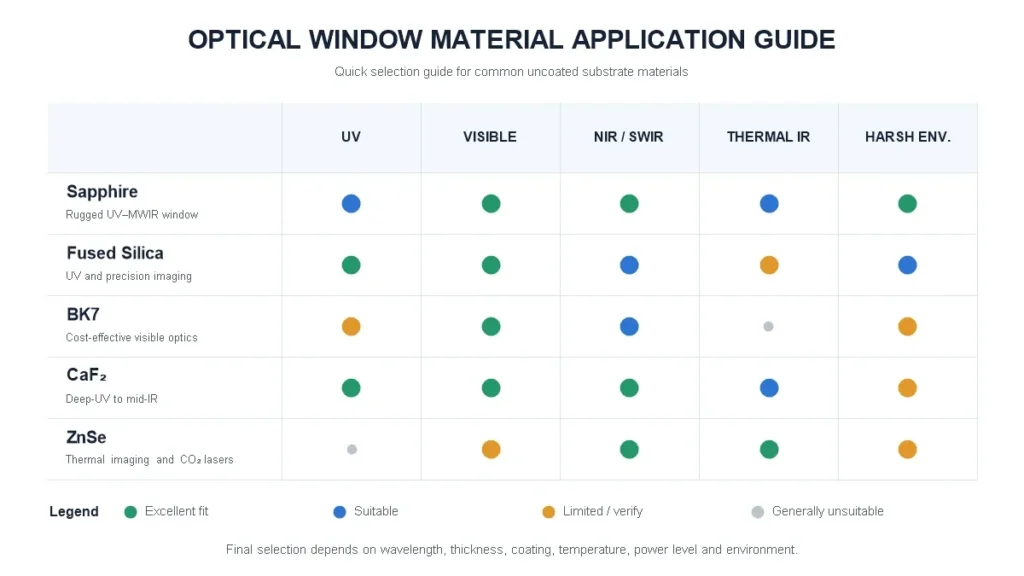 General application guide for preliminary material selection. Final selection should be confirmed using the required wavelength band, material grade, component thickness, operating temperature, mechanical design and coating performance.
Which Material Is Better for Different Applications?
Visible Imaging and Machine Vision
N-BK7 is normally an economical starting point. Choose fused silica when UV transmission or improved thermal stability is required. Choose sapphire when the external surface may be scratched or impacted.
UV Imaging and Spectroscopy
UV-grade fused silica is commonly selected for UV imaging and laser systems. CaF2 or MgF2 may be considered when shorter-wavelength or broader UV-to-IR transmission is required.
The exact material grade, window thickness and coating should be checked at the actual operating wavelength.
High-Power Laser Windows
Material purity, bulk absorption, surface quality and coating performance are critical.
Fused silica is widely used at many UV, visible and near-IR laser wavelengths. Low-absorption ZnSe is commonly considered for CO2 laser systems near 10.6 µm.
Final selection must be based on the actual wavelength, power, beam size and operating conditions.
Thermal-Imaging Windows
Silicon is often considered for MWIR systems, while germanium is widely used for MWIR and LWIR thermal imaging.
ZnSe and suitable ZnS grades may be selected for broader infrared requirements. The operating temperature and required environmental durability must also be evaluated.
Harsh-Environment Windows
Sapphire is a strong candidate when scratch resistance and mechanical durability are priorities.
For infrared systems, germanium, silicon, ZnS and protected IR materials may also be considered. Environmental performance should be confirmed through the applicable component-level or system-level testing.
A Practical Optical Window Selection Process
Use the following sequence:
- Define the operating wavelength or band.
- Set the required transmission.
- Describe the temperature and environment.
- Confirm pressure and mechanical loads.
- Determine the required optical quality.
- Provide laser parameters, if applicable.
- Select the AR or protective coating.
- Compare material availability and cost.
- Confirm the exact material grade.
- Approve the complete finished-window specification.
Important: These recommendations are starting points rather than universal design rules. Final window performance must be evaluated using the complete component specification and actual operating conditions.
Common Selection Mistakes
Choosing Only by the Published Transmission Range
A broad material range does not guarantee high transmission throughout that range. Published bulk-material data may not include thickness, surface reflection, coating loss or temperature effects.
Treating Every Material Grade as Equivalent
Different grades of fused silica, silicon, ZnS and other materials may have different absorption, scatter, homogeneity and certification.
Ignoring Surface Reflection
High-index materials can lose substantial energy at uncoated surfaces. Coating design should be considered during material selection.
Specifying Only “AR Coated”
“AR coated” is not a complete coating specification. The wavelength, angle of incidence, polarization and required reflection or transmission should be stated.
Ignoring the Operating Environment
A window with suitable optical transmission may still fail because of abrasion, thermal shock, pressure, chemical exposure or mounting stress.
Over-Specifying Optical Tolerances
Extremely tight flatness, surface quality or parallelism can increase cost without improving the complete optical system.
Frequently Asked Questions
What Is the Best Material for a Visible Optical Window?
N-BK7 is normally an economical choice for visible systems in controlled environments. Fused silica is more suitable when UV transmission or low thermal expansion is required. Sapphire is often preferred for demanding mechanical environments.
What Is the Best Material for an Infrared Window?
There is no single best infrared material. Silicon is commonly used in MWIR systems, germanium in MWIR and LWIR thermal imaging, and ZnSe in broadband IR and CO2 laser systems.
The correct choice depends on the wavelength band, required transmission, temperature and environment.
Does Every Optical Window Need an AR Coating?
No. An uncoated window may be acceptable when reflection loss is not critical or maximum surface durability is required.
An AR coating is commonly considered when transmission, contrast or ghost reflections are important.
Is Sapphire an Optical Glass?
No. Sapphire is crystalline aluminum oxide, while optical glass has an amorphous structure. Sapphire’s crystal structure produces direction-dependent optical properties.
Is a Wider Transmission Range Always Better?
No. The material only needs to perform within the required wavelength band. Mechanical durability, thermal behavior, coating availability and cost may be more important than unused spectral coverage.
Does Published Material Transmission Equal Finished-Window Transmission?
No. Published data normally represents the material under particular test conditions. Finished-window transmission also depends on thickness, surface reflection, coating, temperature and angle of incidence.
What Information Should Be Included in an Optical Window RFQ?
For material evaluation and quotation, provide:
- Application and operating wavelength
- Preferred material and grade, if known
- Required transmission or reflection
- Diameter or rectangular dimensions
- Thickness and dimensional tolerance
- Clear aperture
- Surface quality
- Surface flatness
- Transmitted wavefront error, if required
- Parallelism or wedge
- Coating band and angle of incidence
- Laser parameters, if applicable
- Operating temperature
- Pressure and environmental exposure
- Inspection and documentation requirements
- Prototype and production quantities
- Customer drawing or applicable standard
Final specifications should be agreed upon according to the application, customer drawing, selected material grade, coating design and available inspection methods.
Custom Optical Windows from Chenyu Optics
Chenyu Optics manufactures custom optical windows for imaging, laser, sensing, industrial and scientific optical systems.
Custom optical windows can be evaluated according to:
- Operating wavelength
- Material and material grade
- Diameter or rectangular dimensions
- Thickness and dimensional tolerance
- Surface flatness
- Transmitted wavefront error
- Surface quality
- Parallelism or wedge
- Clear aperture
- Optical coating
- Temperature and environmental requirements
- Prototype or production quantity
- Inspection and packaging requirements
Final specifications should be confirmed according to the customer drawing, application requirements, selected material grade, coating design and available inspection methods.
Need Help Choosing an Optical Window Material?
Send us your operating wavelength, window dimensions, transmission target, coating requirements and working environment. We will help you choose the appropriate material and grade.