
Sapphire and fused silica are two widely used materials for optical windows, protective covers and laser system components. Both materials offer good optical transmission and environmental stability, but they perform differently in wavelength range, hardness, thermal behavior, polarization effects and manufacturing cost.
Use this guide to compare the two materials and identify the better starting point for your application.
Sapphire or Fused Silica?
Choose sapphire when:
The window must withstand scratching, abrasion, high mechanical loads or harsh environments.
Choose fused silica when:
The application requires low thermal expansion, good UV transmission, low birefringence or cost-effective precision performance.
Neither material is universally better. The correct choice depends on wavelength, optical requirements, environment, dimensions and budget.
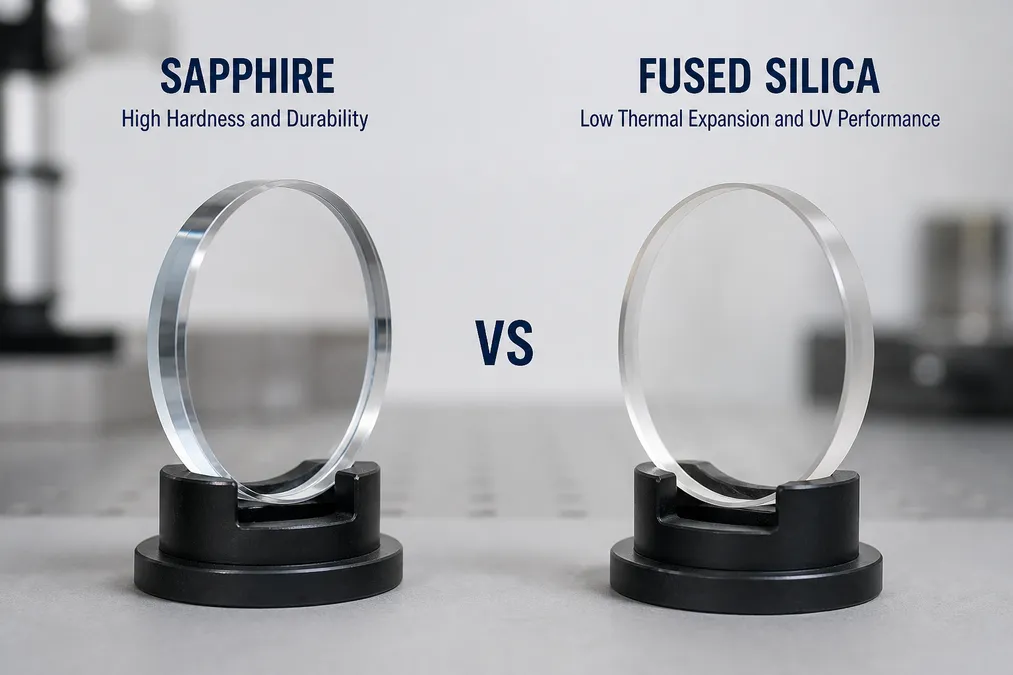
Illustrative comparison of sapphire and fused silica optical windows
What Is a Sapphire Optical Window?
A sapphire optical window is made from single-crystal aluminum oxide, with the chemical formula Al₂O₃.
Sapphire combines optical transparency with high hardness, mechanical strength, wear resistance and chemical stability. These properties make sapphire windows suitable for exposed optical surfaces, protective sensor covers and optical systems operating in demanding environments.
Because sapphire is crystalline and birefringent, crystal orientation may need to be considered in polarization-sensitive or high-precision optical systems.
What Is a Fused Silica Optical Window?
Fused silica is a high-purity, non-crystalline form of silicon dioxide.
It offers low thermal expansion, good optical homogeneity and transmission from the ultraviolet through the visible and into the near-infrared range. Different fused silica grades are available for UV, visible, laser and infrared applications.
Unlike sapphire, fused silica is intrinsically isotropic. However, residual stress introduced during manufacturing or mounting can still cause birefringence. This generally makes fused silica easier to use in systems where low birefringence and polarization stability are important.
Sapphire vs Fused Silica: Key Differences
| Selection Factor | Sapphire | Fused Silica |
|---|---|---|
| Material Structure | Single-crystal Al₂O₃ | Amorphous SiO₂ glass |
| Optical Range | UV, visible and into the mid-infrared, depending on grade and thickness | UV, visible and near-infrared; performance depends on grade and OH content |
| Scratch Resistance | Excellent | Moderate |
| Thermal Expansion | Higher than fused silica; depends on crystal orientation | Very low |
| Thermal Conductivity | Higher | Lower |
| Birefringence | Present; crystal orientation may matter | Intrinsically isotropic; residual stress birefringence depends on grade and processing |
| Machining Difficulty | More difficult | Generally easier |
| Relative Cost | Usually higher | Usually lower |
| Typical Applications | Protective windows and harsh environments | UV, laser, imaging and precision optical systems |
The comparison above provides general material-level guidance. Actual optical window performance depends on material grade, thickness, surface finish, coating, operating temperature and mounting method.
1. Optical Transmission Range
Sapphire offers a broad transmission range extending from the ultraviolet and visible regions into the mid-infrared. This makes it useful for multispectral systems and applications that require both visible and infrared transmission.
Fused silica is widely selected for UV, visible and near-infrared systems. UV-grade fused silica is commonly used when short-wavelength transmission, low fluorescence or laser performance is important.
However, “fused silica” is not a single optical grade. OH content, purity, manufacturing process and material grade can affect UV and infrared transmission.
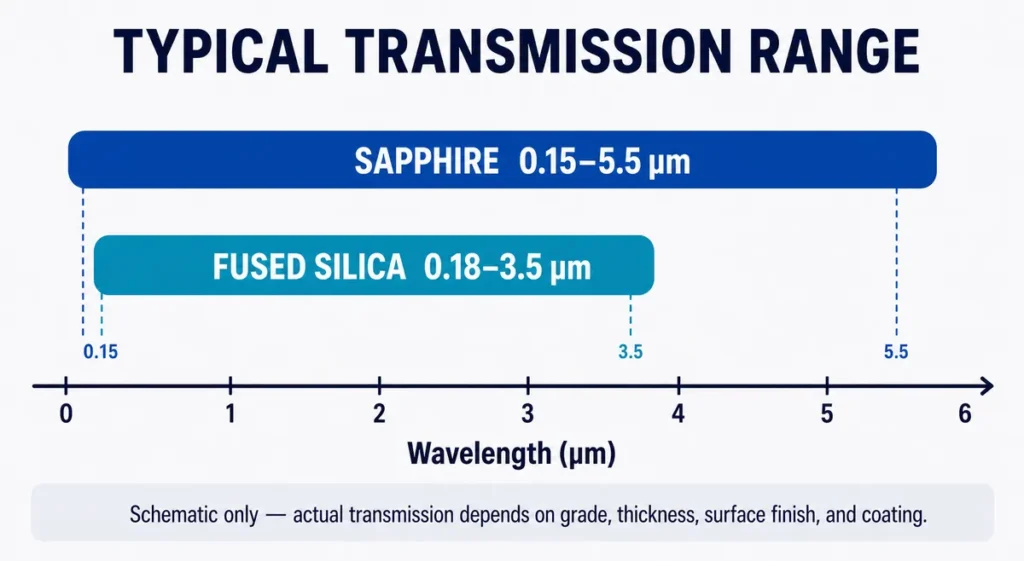 Representative transmission ranges for material comparison only. Actual transmission depends on material grade, thickness, surface condition and coating
2. Hardness and Environmental Durability
Sapphire is significantly more resistant to scratching and abrasion than fused silica. It is therefore often chosen for exposed optical windows, protective sensor covers and equipment used in dusty, sandy or mechanically demanding environments.
Its combination of hardness, strength and chemical resistance makes sapphire suitable for aerospace, industrial sensing, high-pressure systems and outdoor optical equipment.
Fused silica is durable enough for many laboratory, laser and imaging applications, but its surface is more easily scratched than sapphire. Protective handling, suitable packaging and appropriate coatings may therefore be required.
3. Thermal Performance
Fused silica has an extremely low coefficient of thermal expansion. This helps maintain dimensional stability when the operating temperature changes and makes fused silica a strong choice for precision optical systems and thermal cycling applications.
Sapphire has higher thermal conductivity, which can help transfer heat away from a localized area. It also retains useful mechanical properties at elevated temperatures. However, higher thermal conductivity does not automatically mean better thermal-shock performance; thermal expansion, window geometry and mounting stress must also be considered.
The better choice depends on the actual thermal problem:
- Choose fused silica when low thermal expansion and dimensional stability are the priority.
- Consider sapphire when heat conduction, surface durability and mechanical strength are more important.
- Review the mount design when the window will experience rapid temperature changes or a large temperature gradient.
4. Polarization and Optical Precision
Fused silica is generally preferred for applications requiring low birefringence, good homogeneity and stable polarization performance.
Sapphire is a birefringent crystal. Its refractive index depends on crystal orientation and polarization direction. For general protective windows this may not be critical, but it should be evaluated in polarization-sensitive imaging, interferometry and some laser systems.
If sapphire is being considered for a precision optical system, the customer should specify whether crystal orientation or polarization performance is controlled.
5. Cost and Manufacturing Considerations
Sapphire is harder and more difficult to grind and polish. Material cost, processing time and achievable geometry can make a sapphire window more expensive than a similar fused silica window.
Fused silica is usually a more economical choice for standard precision windows, especially when extreme scratch resistance is not required.
However, material price should not be the only consideration. A lower-cost fused silica window may require additional protection or more frequent replacement in an abrasive environment. In such cases, sapphire may offer a lower long-term operating cost.
How to Choose Between Sapphire and Fused Silica
Before selecting the material, confirm the following factors:
Operating Wavelength
Specify the complete wavelength range rather than only a single center wavelength. Material grade and AR coating should match the actual spectral band.
Mechanical Environment
Determine whether the window will face abrasion, particles, high pressure, vibration or direct physical contact.
Temperature Conditions
Provide the operating temperature, temperature change rate and any expected temperature gradient.
Polarization Requirements
Tell the supplier whether the system is sensitive to birefringence, changes in polarization or crystal orientation.
Optical Specifications
Confirm surface quality, surface flatness, transmitted wavefront, parallelism and clear aperture requirements.
Coating Requirements
Specify whether the window needs no coating, single-band AR, broadband AR or another application-specific coating.
Budget and Quantity
Prototype quantity, production volume, repeat-order requirements and target cost may affect the recommended material and specification.
Typical Applications
Sapphire Optical Windows
- Protective camera and sensor windows
- Aerospace and defense optical systems
- Pressure-resistant viewports and inspection windows, subject to engineering verification of window diameter, thickness, edge geometry, mounting method and safety factor
- Industrial equipment exposed to abrasion
- Harsh-environment optical instruments
- High-temperature viewing systems
Fused Silica Optical Windows
- UV optical systems
- Laser systems
- Spectroscopy instruments
- Scientific imaging systems
- Precision measurement equipment
- Semiconductor and analytical equipment
Custom Sapphire and Fused Silica Windows from Chenyu Optics
Chenyu Optics manufactures custom optical windows according to customer drawings for imaging, laser, sensing and industrial optical systems. Sapphire and fused silica window requirements can be evaluated based on the customer’s wavelength range, dimensions, surface specifications, coating design and operating environment.
Available customization may include:
- Custom diameter, rectangular size and non-standard shape
- Custom thickness and dimensional tolerance
- Surface quality and surface flatness specified by drawing
- Parallelism, bevel and clear-aperture requirements
- Uncoated or application-specific AR coating
- Prototype, small-batch and repeat production
- Inspection requirements agreed upon before production
For sapphire windows, crystal orientation should be specified when it affects the optical system. For fused silica windows, the required spectral range, OH content and laser-damage requirements should be confirmed before quotation.
In summary: Choose sapphire when surface durability, mechanical strength and harsh-environment performance are the main priorities. Choose fused silica when low thermal expansion, UV performance, optical homogeneity or polarization stability is more important. The final selection should be confirmed against the full wavelength range, dimensions, mounting method and budget.
Related Optical Windows and Materials
CUSTOM OPTICAL WINDOWS
Ready to Discuss Your Window Requirements?
Send us your wavelength range, dimensions, quantity and operating environment. Our team will help evaluate a suitable material, specification and coating.