
Plano-convex and double-convex lenses are positive lenses used to focus light, collimate beams and form images. Both are thicker at the center than at the edge, but their different surface shapes make them suitable for different optical arrangements.
A plano-convex lens is often preferred when one conjugate is much farther from the lens than the other, such as focusing a collimated beam. A double-convex lens is commonly considered when the object and image distances are more similar. The final choice depends on conjugate ratio, focal length, wavelength, aperture and required image quality.
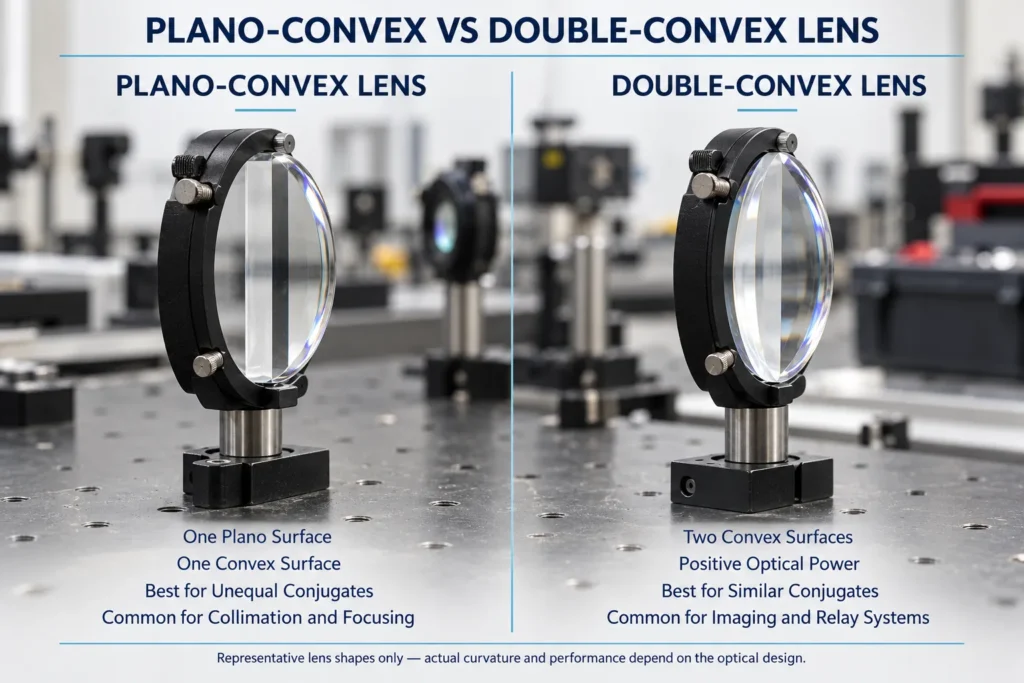
Plano-Convex vs Double-Convex Lens
In This Guide
Quick Answer
Choose a plano-convex lens when:
- A collimated beam must be focused
- A point source must be collimated
- One conjugate distance is much longer than the other
- A simple and economical positive lens is required
- A plano surface is useful as a mechanical reference, provided the mount does not load the clear aperture or introduce stress
Choose a double-convex lens when:
- The object and image distances are similar
- The system operates closer to a 1:1 conjugate ratio
- Light must be transferred between two finite distances
- A more symmetrical positive lens is suitable
- Imaging or relay applications require balanced curvature
These are general starting points. As a practical guideline, a symmetrical double-convex lens is commonly considered for finite-conjugate ratios from approximately 0.2 to 5, with particularly balanced performance near 1:1. Outside that range, a plano-convex lens is often the better starting point. The ratio convention should be stated, and final performance must be verified for the actual prescription, orientation, aperture and wavelength.
What Is a Plano-Convex Lens?
A plano-convex lens has one flat surface and one outward-curved spherical surface. It has positive optical power and can converge parallel light toward a focus.
Plano-convex lenses are commonly used for:
- Focusing collimated laser beams
- Collimating point sources
- Illumination systems
- Detector focusing
- Beam-expander assemblies
- Simple imaging
- Optical instruments
For a common focusing arrangement, the curved surface normally faces the collimated beam and the plano surface faces the focus. For collimation, the point source is generally placed near the plano side.
This orientation can reduce spherical aberration compared with reversing the same lens. However, final orientation should be confirmed for the actual conjugates and optical design.
What Is a Double-Convex Lens?
A double-convex lens, also called a biconvex lens, has two outward-curved surfaces. The two radii may be equal or different depending on the design.
It is also a positive lens and can focus collimated or divergent light.
Double-convex lenses are commonly used for:
- Finite-conjugate imaging
- Relay systems
- Magnification systems
- Projection systems
- Beam focusing
- Laboratory optical setups
- Simple telescopes and microscopes
A symmetrical double-convex lens can provide balanced performance when the object and image distances are similar. If the two radii are different, orientation may still affect aberration.
Plano-Convex vs Double-Convex Lens
| Comparison | Plano-Convex Lens | Double-Convex Lens |
|---|---|---|
| Surface shape | One plano and one convex surface | Two convex surfaces |
| Optical power | Positive | Positive |
| Typical conjugates | One long and one short conjugate; often outside an absolute ratio of 0.2–5 | Finite conjugates; commonly an absolute ratio of about 0.2–5 and especially near 1:1 |
| Common use | Collimation and focusing | Finite-conjugate imaging and relay systems |
| Typical orientation | Curved side toward collimated beam | Depends on radii and conjugate ratio |
| Spherical aberration | Low when correctly oriented for unequal conjugates | Often more balanced for similar conjugates |
| Mounting | Plano surface may simplify mounting | Requires support around curved surfaces |
| Manufacturing | Usually simple and economical | Two curved surfaces must be controlled |
| Available designs | Standard and custom | Symmetrical or asymmetric |
| Final selection | Based on complete system requirements | Based on complete system requirements |
This table provides general selection guidance. Actual performance depends on lens shape, focal length, aperture, material, wavelength and system geometry.
Lens Shape and Conjugate Ratio
The conjugate ratio describes the relationship between object distance and image distance.
When one conjugate is effectively infinite, the light on that side of the lens is collimated. This is a common condition for laser focusing and source collimation.
A plano-convex lens often performs well in this arrangement because most of the refraction can occur at the curved surface.
When the object and image distances are approximately equal, a symmetrical double-convex lens distributes refraction more evenly between its two surfaces. This can reduce spherical aberration compared with an unsuitable plano-convex arrangement. Catalog guidance commonly recommends symmetrical double-convex lenses for finite-conjugate ratios of approximately 0.2 to 5, but this is a starting range rather than a guaranteed design limit.
The conjugate ratio is therefore more useful than selecting a lens only from its appearance.
Plano-Convex Lens Orientation
For focusing a collimated beam:
Collimated Beam → Curved Surface → Plano Surface → Focus
For collimating a point source:
Point Source → Plano Surface → Curved Surface → Collimated Beam
The general principle is to place the curved surface toward the longer conjugate and the plano surface toward the shorter conjugate.
Reversing the lens does not change its nominal focal length, but it can increase spherical aberration and enlarge the focused spot.
This guidance is mainly for on-axis use with typical spherical plano-convex lenses. High numerical aperture, off-axis operation or unusual conjugates may require optical simulation.
Double-Convex Lens Orientation
A symmetrical double-convex lens has equal radii and may be used in either direction under symmetrical conditions.
An asymmetric double-convex lens has different front and back radii. Its orientation can influence spherical aberration and image quality.
For an asymmetric lens, the more strongly curved surface is often placed toward the longer conjugate, but the correct orientation should be verified using the lens prescription and system geometry.
Do not assume that every double-convex lens is symmetrical.
Spherical Aberration
Spherical aberration occurs because rays passing through different zones of a spherical lens do not all focus at exactly the same axial position.
Its effect generally becomes more noticeable with:
- Larger aperture
- Shorter focal length
- Lower f-number
- Incorrect lens orientation
- High numerical aperture
- Large conjugate imbalance
A plano-convex or double-convex singlet may be sufficient for simple focusing and illumination. If a small spot, high resolution or wide field is required, an achromatic doublet, best-form lens or aspheric lens may provide better performance.
Stopping down the aperture can reduce spherical aberration, although it also reduces collected light.
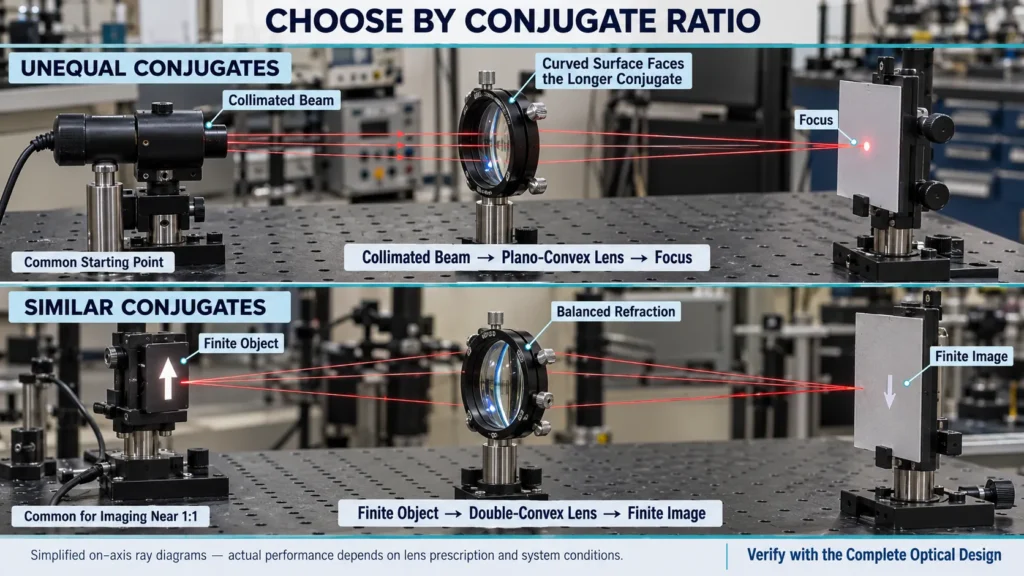
Positive Lens Selection by Conjugate Ratio
Focal Length and Working Distance
Both lens types are available in different focal lengths.
Important values include:
- Effective focal length
- Back focal length
- Front focal length
- Working distance
- Center thickness
- Principal-plane position
Effective focal length and back focal length are not interchangeable. Back focal length is measured from the final lens surface to the focal point, while effective focal length is referenced to the lens principal plane.
A plano-convex and double-convex lens with the same effective focal length may therefore have different center thicknesses and back focal lengths.
Material and Wavelength
Lens material should be selected for the operating wavelength and environment.
Common materials include:
- Optical glass
- Fused silica
- Calcium fluoride
- Sapphire
- Silicon
- Germanium
- Zinc selenide
N-BK7 or similar optical glass is widely used for visible and near-infrared applications. Fused silica may be preferred for ultraviolet transmission, thermal stability and selected laser applications.
Infrared materials are required for MWIR or LWIR systems. The lens shape alone does not determine spectral suitability.
Refractive index also affects lens curvature, focal length and aberration. A design should use refractive-index data at the actual operating wavelength.
Optical Coating
Uncoated lens surfaces reflect part of the incident light. Because a plano-convex lens and a double-convex lens both have two air-to-glass surfaces, either type may require an antireflection coating.
Specify:
- Operating wavelength or wavelength band
- Angle of incidence
- Polarization when relevant
- Required transmission or reflectance
- Laser power when applicable
- Environmental durability
Avoid requesting only “AR coated.” A measurable coating specification provides a clearer basis for quotation and inspection.
Which Lens Is Better for Different Applications?
Focusing a Collimated Laser Beam
A correctly oriented plano-convex lens is commonly used as an economical starting point.
Collimating a Point Source
A plano-convex lens is commonly selected with the plano surface toward the point source.
Finite-Conjugate Imaging
A double-convex lens may be more suitable when the object and image distances are similar.
Simple Illumination Systems
Either lens may be used. Selection depends on source geometry, required uniformity and available space.
Precision Imaging
A spherical singlet may not provide sufficient correction. Consider an achromatic doublet, aspheric lens or multi-element design.
Common Selection Mistakes
Choosing Only by Focal Length
Two lenses with the same focal length can have different shapes, thicknesses and aberration performance.
Reversing a Plano-Convex Lens
Incorrect orientation can increase spherical aberration even though the focal length remains similar.
Assuming Every Double-Convex Lens Is Symmetrical
The two radii may be different, so orientation can still matter.
Ignoring the Conjugate Ratio
Object and image distances are important when selecting the best lens form.
Expecting a Singlet to Correct Every Aberration
Plano-convex and double-convex singlets do not correct chromatic aberration and may not meet precision imaging requirements.
How to Choose Between Them
Use this practical sequence:
- Define the wavelength.
- Determine whether the input is collimated or divergent.
- Identify object and image distances.
- Select the required focal length and working distance.
- Define the usable aperture and f-number.
- Estimate the acceptable spot size or image quality.
- Select the material and coating.
- Verify lens orientation.
- Confirm performance in the complete optical system.
Frequently Asked Questions
Is a Double-Convex Lens Stronger Than a Plano-Convex Lens?
Not automatically. Mechanical strength depends on material, diameter, center and edge thickness, edge geometry, mounting method and applied loads. It cannot be determined only from the number of curved surfaces.
Can a Double-Convex Lens Focus Collimated Light?
Yes. However, a correctly oriented plano-convex lens may provide lower spherical aberration in some unequal-conjugate applications.
Which Side of a Plano-Convex Lens Should Face the Laser?
For focusing a collimated beam, the curved surface generally faces the incoming beam and the plano surface faces the focus.
Is a Double-Convex Lens Better for Imaging?
It can be a useful singlet when object and image distances are similar. Precision imaging may require an achromatic or multi-element system.
Do Both Lens Types Need an AR Coating?
Not always, but AR coatings are commonly used when higher transmission and lower ghost reflection are required.
Custom Positive Lenses from Chenyu Optics
Chenyu Optics supports drawing-based custom plano-convex and double-convex lenses for imaging, laser, sensing, industrial and scientific systems.
Requirements can be reviewed according to:
- Optical material
- Lens diameter
- Effective focal length
- Surface radius
- Center and edge thickness
- Surface quality
- Surface figure
- Centration
- Clear aperture
- Optical coating
- Prototype and production quantities
- Inspection and packaging requirements
Final specifications should be confirmed according to the optical design, approved drawing, material and available inspection method.
Need Help Choosing a Positive Lens?
Send Chenyu Optics your wavelength, focal length, lens diameter, object distance, image distance, coating requirement and quantity. We can review the manufacturing requirements and prepare a quotation based on the approved drawing.