
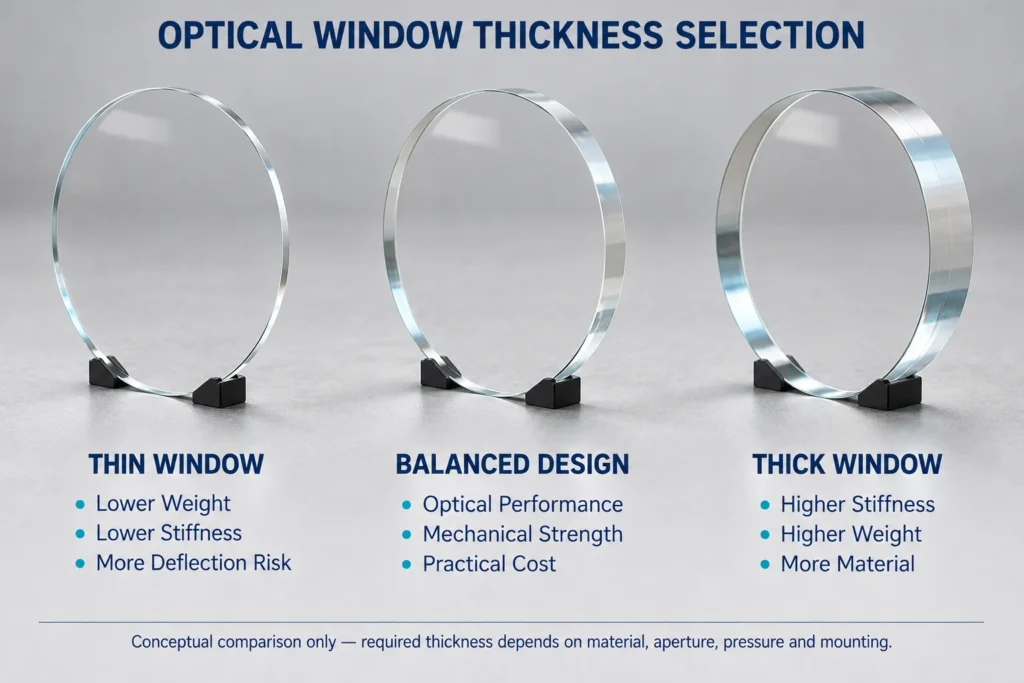
Optical window thickness affects mechanical strength, weight, transmission, optical path length and resistance to pressure or mounting stress. A window that is too thin may bend or break, while an unnecessarily thick window can increase weight, absorption and material cost.
There is no single thickness suitable for every optical window. The correct value depends on the window material, unsupported aperture, pressure difference, mounting method, operating temperature and required optical performance.
In This Guide
Quick Answer
Choose optical window thickness by reviewing:
- Window material
- Outside dimensions
- Unsupported clear aperture
- Pressure difference
- Mounting and sealing method
- Shock and vibration
- Minimum and maximum temperature
- Allowable window deflection
- Required transmitted wavefront
- Operating wavelength
- Material absorption
- Weight and space limitations
- Safety factor
- Relevant environmental testing
Do not select thickness using diameter alone. Two windows with the same diameter may require different thicknesses because of differences in material strength, mounting support, pressure, temperature and acceptable optical deformation.
Pressure windows and safety-critical windows should be evaluated by a qualified engineer using the actual material data, geometry, support condition and applicable safety requirements.
1. Why Does Optical Window Thickness Matter?
An optical window should transmit light while protecting the components behind it. Its thickness influences both mechanical and optical performance.
Increasing thickness generally improves stiffness and reduces bending under a given load. However, a thicker window also uses more material and may increase:
- Component weight
- Raw material cost
- Processing time
- Bulk absorption
- Optical path length
- Thermal mass
- Mounting requirements
A thinner window may be desirable in compact or lightweight equipment, but it can be more sensitive to pressure, clamping stress and accidental impact.
The objective is not to select the thickest possible window. It is to choose a practical thickness that provides sufficient strength and stable optical performance.
2. Consider the Unsupported Aperture
The unsupported aperture is the area of the window that is not mechanically supported by the mount.
It may be smaller than the outside diameter because part of the window rests on a shoulder or sealing surface. Mechanical deflection depends more directly on the unsupported aperture than on the full component diameter.
For example, two windows may both have a 50 mm outside diameter. One may be supported close to its edge, while another may span a much smaller opening. Their loading conditions will therefore be different.
When requesting a window for a pressure or vacuum application, provide:
- Outside diameter
- Clear aperture
- Unsupported aperture
- Support diameter
- Window thickness
- Edge engagement
- Mounting geometry
The manufacturer cannot reliably evaluate thickness from the outside diameter alone.
3. Evaluate the Optical Material
Different optical materials have different mechanical, thermal and optical characteristics.
Important properties may include:
- Elastic modulus
- Flexural strength
- Fracture behavior
- Hardness
- Density
- Thermal expansion
- Thermal conductivity
- Refractive index
- Spectral absorption
Fused silica is widely used where low thermal expansion and good optical performance are important. Sapphire provides high hardness and good mechanical durability, but its crystalline and birefringent properties must be considered.
Infrared materials such as germanium, silicon, zinc selenide and zinc sulfide have different densities, strengths and temperature-dependent properties. A thickness suitable for fused silica should not automatically be applied to an infrared material.
Published material values can also vary according to grade, surface condition, edge quality and test method. Use data applicable to the actual supplied material whenever structural performance is critical. Because optical glasses and crystals are brittle materials, their practical strength can vary with surface finish, edge condition, flaw population and component size; a single handbook strength value should not be treated as a guaranteed allowable stress.
Optical Window Thickness Selection Checklist
| Design Factor | Information to Review | Possible Effect on Thickness |
|---|---|---|
| Material | Strength, stiffness and fracture behavior | Different materials require different thicknesses |
| Unsupported aperture | Diameter of the unsupported area | A larger span normally needs greater stiffness |
| Pressure difference | Maximum differential pressure | Higher pressure generally increases the required thickness |
| Mounting method | Clamped, bonded, retained or sealed | Changes edge support and stress distribution |
| Optical requirement | Wavefront and allowable deflection | Tighter optical performance may require a stiffer window |
| Environment | Temperature, shock and vibration | May require additional design margin |
| Transmission | Wavelength and material absorption | Excess thickness may reduce transmission |
| Weight | System mass limitation | May limit the practical thickness |
| Safety factor | Application and failure consequence | Critical systems may need a higher design margin |
| Manufacturing | Diameter-to-thickness ratio and edge condition | Affects processing and handling feasibility |
This checklist provides general design guidance and does not replace structural analysis or application-specific safety evaluation.
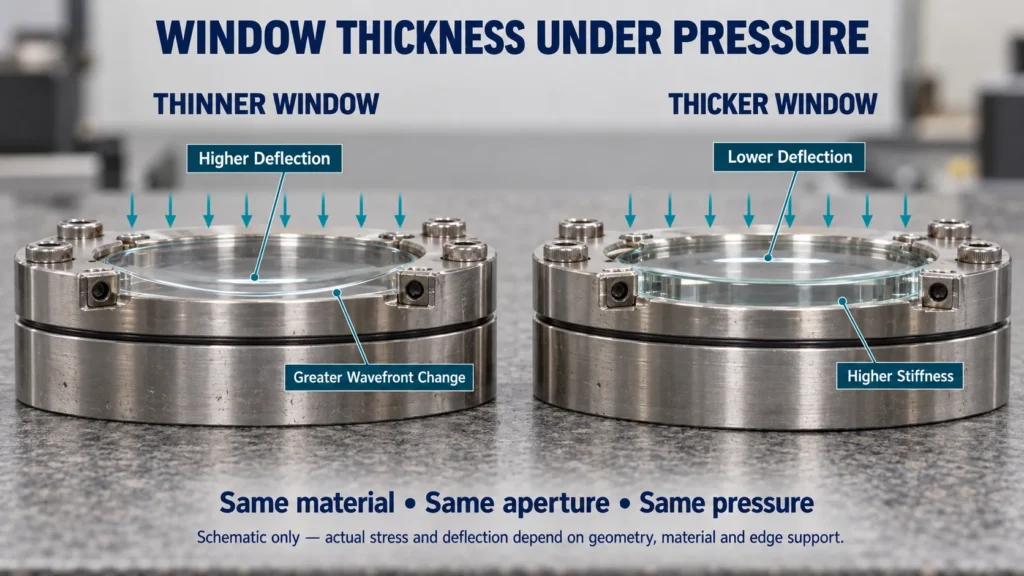
4. Account for Pressure Difference
Pressure difference is a major consideration for windows used in vacuum chambers, sealed sensors and pressurized enclosures.
The load depends on the difference between the pressures on the two sides of the window. Even a moderate pressure difference can create a substantial total force over a large aperture.
The resulting stress and deflection depend on:
- Window shape
- Unsupported diameter
- Thickness
- Material properties
- Edge support
- Pressure distribution
- Surface and edge condition
A circular window supported around its edge behaves differently from a rectangular window or a window held at only a few points.
A pressure window should not be specified using a general diameter-to-thickness ratio without checking the real boundary conditions. The design should also consider manufacturing variation, material variability and the consequences of failure.
5. Control Deflection and Wavefront Error
A window may remain mechanically intact but still deform enough to affect optical performance. Mechanical survival and optical suitability are therefore separate design checks.
Pressure, gravity, clamping force and temperature gradients can bend the window. When light passes through a deformed window, the transmitted wavefront may change.
This is especially important in:
- High-resolution imaging
- Interferometry
- Collimated laser beams
- Precision metrology
- Large-aperture optical systems
If optical deformation is critical, specify the maximum allowable transmitted wavefront under the actual mounting and loading conditions. A free-state interferometric measurement may not represent performance after installation.
Increasing thickness can reduce deformation, but material homogeneity, mounting stress and temperature must also be controlled.
6. Consider Transmission and Absorption
The internal transmission of an optical material normally decreases as the optical path through the material becomes longer. The importance of this effect depends on the material and wavelength.
For materials with very low absorption over the operating band, a moderate change in thickness may have little effect. For infrared materials or wavelengths near an absorption region, thickness can have a more noticeable influence.
Finished-window transmission also depends on surface reflection. A thicker window does not eliminate Fresnel losses, so an antireflection coating may still be required.
Request transmission for the actual material thickness and coating configuration rather than relying only on a broad published material range.
7. Review Optical Path Length
A plane-parallel window inserted into an optical path changes the optical path length because its refractive index is higher than that of air.
In converging or diverging beams, the window can also shift focus and introduce aberrations. These effects depend on:
- Window thickness
- Refractive index
- Wavelength
- Angle of incidence
- Beam convergence
- Window position
At non-normal incidence, a plane-parallel window also produces a lateral beam displacement whose magnitude depends on thickness, refractive index and incidence angle.
For precision imaging systems, the optical design should use the actual finished thickness and its tolerance.
Thickness tolerance may therefore affect focus position even when mechanical fit is not critical.
8. Evaluate Mounting Stress
The mount should support the window without applying excessive concentrated force.
Possible mounting methods include:
- Retaining ring
- Elastomeric seal
- Adhesive bonding
- Mechanical clamp
- Brazed or soldered assembly
- Hermetic sealing
Rigidly clamping a window can create stress, distort the optical surfaces or cause damage during temperature changes. A suitable design normally allows for dimensional variation and differential thermal expansion.
The drawing should identify the supported area, sealing surface, edge clearance and permitted contact region.
9. Consider Temperature
Temperature can affect the window and its mount in different ways.
Important conditions include:
- Minimum operating temperature
- Maximum operating temperature
- Heating and cooling rate
- Temperature gradient
- Thermal cycling
- Coating temperature limits
If the mount expands differently from the optical material, the window may experience additional edge stress. A thicker component is not automatically protected from thermal stress and may develop larger internal temperature gradients.
Material, thickness and mounting design should therefore be evaluated together.
10. Balance Thickness With Manufacturability
Very thin windows can be difficult to grind, polish, coat, inspect and handle. They may flex during polishing or coating and may require special tooling.
Large diameter-to-thickness ratios can also make it harder to maintain:
- Flatness
- Parallelism
- Thickness uniformity
- Edge quality
- Coating uniformity
Extremely thick windows can require more material and longer processing time. For expensive infrared materials, this can substantially affect price.
Before finalizing the drawing, confirm that the thickness and tolerances are practical for the chosen diameter and material.
Common Thickness Selection Mistakes
Choosing Thickness Only From the Outside Diameter
The unsupported aperture, support condition and loading are also required.
Assuming Thicker Is Always Better
Excess thickness can increase weight, absorption, optical path length and material cost.
Ignoring Installed Optical Performance
A window measured in a free state may deform after clamping, sealing or pressurization.
Applying the Same Thickness to Every Material
Materials have different mechanical, thermal and optical properties.
Using a General Rule for a Pressure Window
Pressure windows require application-specific evaluation using the actual geometry, material, mounting condition and safety factor.
Frequently Asked Questions
Is There a Standard Optical Window Thickness?
No. Standard catalog products use common dimensions, but custom thickness should be selected according to the material, aperture, mechanical load and optical requirements.
Does a Thicker Window Have Better Flatness?
Not automatically. Greater stiffness can help during processing and use, but finished flatness also depends on manufacturing, mounting and inspection conditions.
Does Thickness Affect Optical Transmission?
Yes. Internal absorption generally increases with optical path length. The importance of the change depends on the material, wavelength and coating.
Can a Thin Window Be Used in a Vacuum Chamber?
Possibly, but it must be evaluated using the pressure difference, unsupported aperture, material properties, mounting design and required safety factor.
What Information Is Needed to Recommend Thickness?
Provide the material, outside dimensions, unsupported aperture, pressure, temperature, mounting method, optical performance and safety requirements.
Custom Optical Windows from Chenyu Optics
Chenyu Optics supports drawing-based custom optical windows for imaging, laser, sensing, industrial and scientific systems.
Available requirements can be reviewed according to:
- Optical material and grade
- Window diameter or custom shape
- Thickness and thickness tolerance
- Unsupported aperture
- Surface quality
- Flatness
- Parallelism or wedge
- Clear aperture
- Transmitted wavefront
- Optical coating
- Prototype and production quantities
- Inspection and packaging requirements
Chenyu Optics can review manufacturing feasibility, but structural safety and final thickness remain the responsibility of the customer’s qualified system designer.
Need Help Selecting an Optical Window Thickness?
Send us the material, dimensions, unsupported aperture, mounting method, pressure, operating temperature, coating requirements and quantity. We can review the optical manufacturing requirements and provide a quotation based on the approved drawing.