
OPTICAL MATERIAL KNOWLEDGE CENTER

Sapphire Optical Material for Precision Optical Components

Synthetic sapphire material solutions for optical windows, lenses and infrared components requiring high hardness, thermal stability and optical performance.

Chenyu Optics combines optical material expertise, precision manufacturing capability and engineering support to produce drawing-defined sapphire optical components.

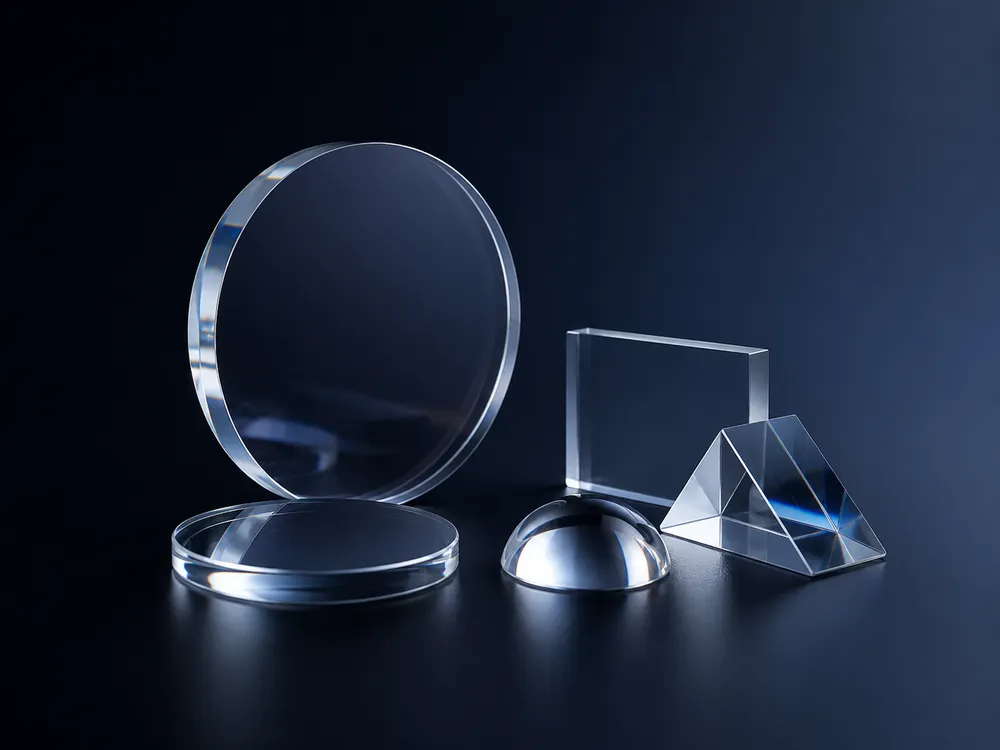
Synthetic sapphire optical material and polished sapphire optical components

Sapphire Optical Material Overview

Sapphire optical material is synthetic single-crystal aluminum oxide (Al2O3) manufactured for optical, mechanical and thermal applications. Controlled crystal growth produces sapphire material with consistent composition and structural properties for precision optical fabrication.

Optical-grade synthetic sapphire differs from gemstone sapphire in its intended function and selection criteria. Gemstones are generally evaluated for color and appearance. Optical sapphire is selected according to transmission, material purity, crystal orientation, internal quality, surface specifications and compatibility with precision manufacturing.

Engineers select sapphire when an optical component must transmit light while resisting scratching, abrasion, elevated temperature or chemical exposure. Sapphire material is commonly used for optical windows, lenses, protective covers, laser applications and compatible infrared systems.

Chenyu Optics manufactures sapphire optical components by converting suitable sapphire crystal material into drawing-defined windows, substrates and custom parts. Material grade, thickness, optical finish and coating are selected according to the wavelength and operating environment.

Technical Parameter Typical Value Engineering Significance
Composition Single-crystal aluminum oxide (Al2O3) High-purity crystalline material suitable for precision optical processing.
Material Type Synthetic Sapphire Produced under controlled growth conditions for technical applications.
Crystal Structure Single Crystal Crystal orientation may be considered during component design and fabrication.
Hardness Mohs 9 Provides excellent scratch and abrasion resistance.
Transmission Approx. 0.17–5.5 μm Covers compatible ultraviolet, visible and infrared wavelengths.
Density Approx. 3.98 g/cm³ Relevant to component weight and mechanical assembly design.
Refractive Index Approx. 1.76 @ 589 nm Important for surface reflection and AR coating design.
Typical Components Windows, lenses, substrates and protective optics Used where optical transmission and environmental durability are required together.

Values are general engineering references rather than guaranteed component specifications. Actual performance depends on sapphire grade, orientation, wavelength, thickness, surface finish and coating.

Key Properties of Sapphire Material

Sapphire is selected when optical transmission must be combined with mechanical, thermal and environmental durability.

High Hardness

Sapphire has a Mohs hardness of 9, making it considerably harder than conventional optical glass and resistant to abrasive wear.

Excellent Scratch Resistance

High scratch resistance helps preserve surface quality when a window is exposed to particles, handling or repeated cleaning.

High-Temperature Stability

Sapphire maintains useful structural properties at elevated temperatures when component geometry and mounting are properly designed.

Chemical Resistance

Resistance to many chemicals and contaminants supports use in industrial, analytical and process-control environments.

Broad Optical Transmission

Optical-grade sapphire transmits from approximately 0.17 to 5.5 μm, depending on grade, thickness and surface treatment.

Property System Benefit Design Consideration
Mohs 9 Hardness Long service life in abrasive environments Hardness increases machining and polishing complexity.
Scratch Resistance Helps maintain optical surface performance Edges and mounting surfaces still require appropriate protection.
Thermal Stability Supports elevated-temperature observation and sensing Thermal gradients, coatings and mounts must be evaluated.
Chemical Resistance Supports exposure to demanding process environments Compatibility should be confirmed for the actual chemical and temperature.
Broad Transmission Supports UV, visible and compatible infrared systems Longer-wave IR applications may require another material.

How to Select Sapphire Optical Material

Engineers should select sapphire by evaluating spectral, mechanical, environmental and manufacturing requirements together.

Choose Sapphire When

High scratch resistance is required
The optical surface will be exposed to abrasive particles, mechanical contact or repeated cleaning.
Protective optical windows are needed
A transparent barrier must protect a sensor, detector, camera or laser assembly.
High-temperature environments exist
The component must retain structural function in an elevated-temperature system.
Mechanical durability is important
The application requires resistance to wear, pressure or demanding environmental conditions.

Consider Alternatives When

Lower cost is the priority
Fused silica or another optical glass may be more economical when extreme hardness is unnecessary.
Large aperture size is required
Material availability, blank size, weight and processing cost may favor fused silica or another substrate.
Long-wave infrared transmission is required
ZnSe or germanium may provide more suitable MWIR or LWIR transmission.
A specialized UV-to-IR range is required
CaF2 may be considered when low dispersion and broader UV-to-mid-IR transmission are important.
Selection Step Question Information Required
1. Wavelength Does sapphire transmit the complete operating band? Minimum wavelength, maximum wavelength and transmission target
2. Environment Is sapphire-level durability necessary? Temperature, chemicals, abrasion, particles and cleaning process
3. Mechanical Load What must the window withstand? Pressure, impact, aperture, thickness and mounting method
4. Optical Quality How precisely must the component control the beam? Surface quality, flatness, parallelism and transmitted wavefront
5. Coating Is reduced surface reflection required? Wavelength, bandwidth, angle of incidence and operating environment

Sapphire Compared with Other Optical Materials

Preliminary comparison for engineers selecting materials by optical range, environmental performance and application.

Material Main Advantage Typical Transmission Range Application Suitability
Sapphire Mohs 9 hardness and high environmental durability Approx. 0.17–5.5 μm Protective windows, flame detectors, laser systems and harsh-environment optics
Fused Silica Low thermal expansion and strong UV performance Approx. 0.18–2.5 μm UV optics, laser windows, spectroscopy and larger precision apertures
Calcium Fluoride (CaF2) Low dispersion and broad UV-to-mid-IR transmission Approx. 0.18–8 μm Spectroscopy, UV optics and compatible infrared imaging systems
Zinc Selenide (ZnSe) Broad infrared transmission and low absorption at 10.6 μm Approx. 0.5–16 μm CO2 laser optics, infrared windows and thermal imaging systems
Germanium Strong MWIR and LWIR transmission Approx. 2–14 μm Thermal imaging lenses, FLIR systems and long-wave infrared windows

Transmission ranges are approximate and vary by grade, thickness and coating. Sapphire is generally preferred for hardness and durability; alternative materials may be better for lower cost, larger apertures or specialized infrared wavelengths.

Sapphire Optical Applications

Sapphire material is used for optical windows, lenses and compatible infrared systems requiring a durable optical interface.

OW

Optical Windows

Sapphire windows protect cameras, detectors and sensors from abrasion, particles and demanding environments while transmitting the required wavelength.

LS

Laser Systems

Precision sapphire components support compatible laser wavelengths where hardness, surface durability and thermal stability are required.

IS

Imaging Systems

Sapphire protective windows maintain a stable optical path for cameras and imaging sensors operating in abrasive or contaminated environments.

IR

Infrared Applications

Sapphire can protect compatible infrared sensors and detectors when the complete operating band falls within its useful transmission range.

SE

Sensors

Sapphire covers protect optical and process sensors that require resistance to scratching, heat, chemicals or repeated cleaning.

Application Primary Sapphire Function Important Specification
Protective Window Environmental barrier with optical transmission Thickness, surface quality, flatness and mechanical load
Laser System Beam transmission and component protection Wavelength, surface quality, coating and damage requirements
Imaging System Protective cover for camera or detector Transmitted wavefront, parallelism and coating
Infrared Sensor Durable sensor interface Complete spectral band, thickness and transmission target
Process Sensor Resistance to heat, chemicals and contamination Environment, mounting, sealing and surface durability

Custom Sapphire Manufacturing Capability

Chenyu Optics manufactures custom sapphire optical windows and sapphire optical components according to drawings, wavelengths and operating requirements.

Precision Machining

Sapphire blanks are cut and machined into round, square, rectangular or custom geometries with drawing-defined dimensions and edge features.

Optical Polishing

Controlled grinding, lapping and polishing establish thickness, surface finish, flatness and parallelism.

Custom Dimensions

Diameter, length, width, thickness, clear aperture and edge configuration are evaluated according to the component drawing.

Surface Quality Control

Polished surfaces are inspected against specified surface quality, flatness, parallelism and clear-aperture requirements.

AR Coating Options

AR and BBAR coatings can be evaluated for the required wavelength, angle of incidence, transmission and environmental conditions.

Component Parameter Available Configuration Specification Basis
Geometry Round, square, rectangular or custom Component function and assembly interface
Dimensions Custom to drawing Material availability and manufacturability review
Surface Quality Precision optical finish Imaging, sensing, laser and transmission requirements
Flatness Custom optical specification Wavelength, aperture and wavefront requirement
Parallelism Controlled to drawing Beam deviation and alignment requirements
Coating AR or BBAR options Wavelength, bandwidth, angle and environment

Sapphire Optical Windows

Protective and transmitting windows for sensing, imaging, laser and high-temperature applications.

EXPLORE SAPPHIRE WINDOWS

Optical Lenses

Precision lens components for compatible laser, imaging and optical sensing systems.

EXPLORE OPTICAL LENSES

Custom Optical Components

Drawing-defined sapphire substrates, protective optics and custom components for OEM assemblies.

EXPLORE CUSTOM COMPONENTS

Sapphire Optical Material Engineering FAQ

What is sapphire optical material?

Sapphire optical material is synthetic single-crystal aluminum oxide (Al2O3) used to manufacture optical windows, lenses, substrates and protective components.

What wavelength range does sapphire transmit?

Optical-grade sapphire typically provides useful transmission from approximately 0.17 to 5.5 μm. Actual transmission depends on grade, crystal orientation, thickness, surface finish and coating.

Why is sapphire harder than glass?

Sapphire has a strong single-crystal aluminum oxide structure and a Mohs hardness of 9. Common optical glasses are softer and provide less resistance to scratching and abrasive wear.

Why are sapphire windows used in optical systems?

Sapphire windows transmit compatible UV, visible and infrared wavelengths while protecting sensors, cameras and laser assemblies from scratching, heat, particles and chemical exposure.

Can sapphire be used for infrared applications?

Yes. Sapphire can be used for compatible near-infrared and selected mid-infrared systems within its approximate 0.17–5.5 μm range. ZnSe or germanium may be more suitable at longer infrared wavelengths.

Does sapphire require an AR coating?

An AR coating is recommended when reduced reflection or higher transmission is required. The coating design should match the wavelength, angle of incidence, bandwidth and operating environment.

What alternatives to sapphire should engineers consider?

Fused silica may suit UV, low-expansion or larger-aperture requirements; CaF2 offers broad UV-to-mid-IR transmission; ZnSe and germanium provide longer-wave infrared coverage.

Can Chenyu Optics manufacture custom sapphire components?

Yes. Chenyu Optics manufactures custom sapphire optical windows and components with drawing-defined dimensions, surface quality, flatness, parallelism and AR coating requirements.

Need a Custom Sapphire Optical Solution?

Chenyu Optics manufactures sapphire optical windows and custom sapphire components based on drawings, wavelength requirements, operating conditions and coating specifications.

Scroll to Top