
Product Overview
Multispectral zinc sulfide (ZnS) is an advanced infrared optical material designed for applications requiring transmission in both visible and infrared wavelength ranges. Through additional hot isostatic pressing (HIP) processing, the internal scatter of standard CVD ZnS is significantly reduced, resulting in improved visible transparency and enhanced multispectral performance.
Compared with standard infrared-grade ZnS, multispectral ZnS provides lower optical scatter and better transmission from visible wavelengths through MWIR and LWIR regions. This makes it suitable for multi-sensor optical systems, infrared imaging platforms, and applications requiring both visible observation and thermal imaging.
Multispectral ZnS optical windows are widely used in infrared imaging systems, airborne optical systems, thermal imaging equipment, and advanced multispectral optical assemblies exposed to harsh operating environments.
Chenyu Optics provides custom multispectral ZnS optical windows according to customer drawings and technical specifications, including custom dimensions, precision polishing, AR coating, DLC coating, and prototype manufacturing support.
Key Features
✓ Visible to LWIR transmission
✓ Improved visible transparency compared with standard ZnS
✓ Reduced optical scatter
✓ Suitable for multispectral optical systems
✓ Good environmental durability
✓ Custom AR and DLC coating available
✓ Precision optical polishing support
Typical Specifications
| Parameter | Specification |
|---|---|
| Material | Multispectral Zinc Sulfide (MS ZnS) |
| Processing Method | HIP processed CVD ZnS |
| Spectral Range | 0.4 – 12 μm |
| Visible Transmission | Improved compared with standard ZnS |
| Infrared Performance | Excellent MWIR and LWIR transmission |
| Optical Scatter | Low scatter |
| Surface Quality | 60/40, 40/20 available |
| Surface Flatness | λ/2 to λ/10 |
| Coating Options | AR / DLC coating available |
| Available Shapes | Round, square, custom shapes |
| Applications | EO/IR systems, thermal imaging, multispectral optics |
Optical Transmission Characteristics
Multispectral ZnS is designed for optical systems that require both visible observation and infrared transmission. Compared with standard CVD ZnS, it provides improved visible transparency and lower scatter while maintaining useful transmission in MWIR and LWIR wavelength ranges.
For applications using shared apertures, multispectral ZnS can help combine visible imaging and infrared sensing into one optical path. Actual transmission performance depends on material thickness, surface quality, coating design, and system wavelength requirements.
Optical Transmission Characteristics
Multispectral ZnS provides useful transmission from visible wavelengths through MWIR and LWIR regions, making it suitable for multispectral optical systems and infrared imaging applications.
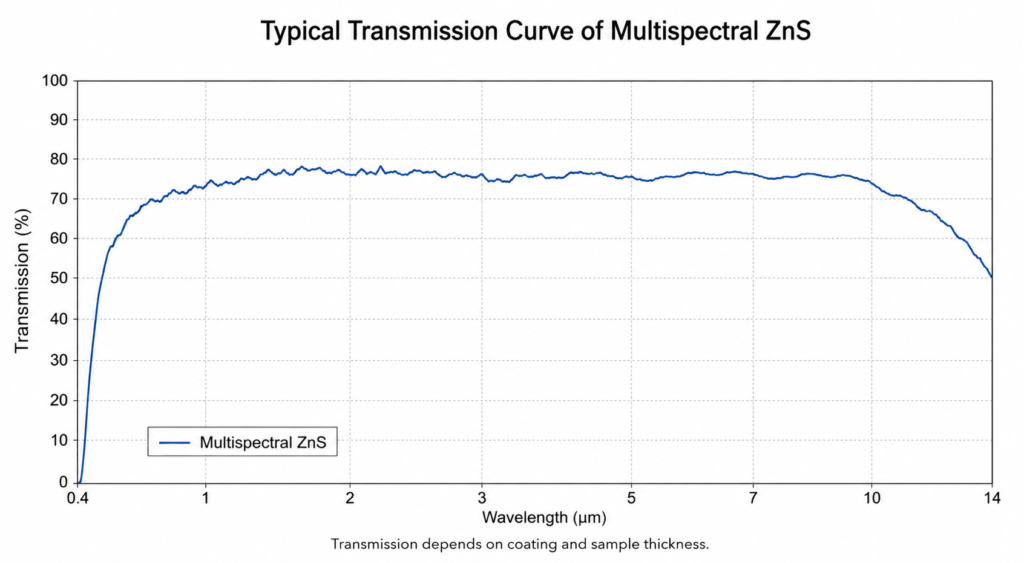
Multispectral ZnS is designed for optical systems requiring transmission from visible wavelengths through MWIR and LWIR regions. Compared with standard infrared-grade ZnS, multispectral ZnS provides improved visible transparency and reduced optical scatter.
This material is widely used in multispectral optical systems, thermal imaging platforms, and infrared applications requiring both visible observation and infrared sensing performance.
Actual transmission performance depends on coating design, material thickness, surface quality, and operating wavelength range.
Multispectral ZnS is designed for optical systems requiring transmission from visible wavelengths through MWIR and LWIR regions. Compared with standard infrared-grade ZnS, multispectral ZnS provides improved visible transparency and reduced optical scatter.
This material is widely used in multispectral optical systems, thermal imaging platforms, and infrared applications requiring both visible observation and infrared sensing performance.
Actual transmission performance depends on coating design, material thickness, surface quality, and operating wavelength range.
Applications
- EO/IR multispectral imaging systems
- Thermal imaging and infrared sensing platforms
- Airborne and maritime infrared optical systems
- Infrared surveillance and target acquisition equipment
- Visible-to-LWIR shared aperture optical systems
- Harsh-environment infrared optical windows
Manufacturing Capabilities
| Capability | Available Range |
|---|---|
| Diameter | 5–300 mm |
| Thickness | 0.5–50 mm |
| Surface Quality | 60/40 to 20/10 |
| Surface Flatness | Up to λ/10 |
| Coating | AR / DLC available |
| Custom Shapes | Round, square, custom |
Custom Manufacturing Options
✓ Custom dimensions and thickness
✓ Precision optical polishing
✓ AR and DLC coating support
✓ Prototype and small-batch production
✓ Drawing-based custom manufacturing
✓ Custom edge and chamfer processing
Materials Comparison
Compared with standard CVD ZnS, multispectral ZnS offers better visible clarity and lower scatter, making it more suitable for multi-sensor optical systems. Standard CVD ZnS is usually more cost-effective for thermal-only LWIR applications.
Compared with ZnSe, ZnS generally provides better mechanical durability and environmental resistance, which is useful for protective optical windows and harsh-environment infrared systems.
FAQ
What is multispectral ZnS used for?
Multispectral ZnS is used for visible-to-infrared optical systems, thermal imaging, multispectral sensors, and optical windows requiring both visible clarity and infrared transmission.
What is the difference between standard CVD ZnS and multispectral ZnS?
Standard CVD ZnS is mainly used for infrared applications, while multispectral ZnS undergoes additional processing to reduce scatter and improve visible transmission.
Can multispectral ZnS be used for LWIR applications?
Yes. Multispectral ZnS can support LWIR applications while also providing improved visible transparency compared with standard CVD ZnS.
Can AR coating be applied to multispectral ZnS windows?
Yes. AR coatings can be designed according to customer wavelength requirements, including visible, MWIR, and LWIR bands.
Can DLC coating be applied?
DLC coating may be available for applications requiring improved surface durability and environmental resistance, depending on the required wavelength range.
Do you support custom sizes?
Yes. Custom diameter, thickness, polishing, coating, edge processing, and drawing-based manufacturing are available.
What is the refractive index of multispectral ZnS?
The refractive index of multispectral ZnS is approximately 2.2 in the infrared wavelength range, depending on wavelength and coating design.
Can DLC coating be applied to multispectral ZnS?
Yes. DLC coating may be available for applications requiring improved environmental durability and surface protection.
What surface quality can be achieved?
Typical surface quality ranges from 60/40 to 20/10 depending on customer specifications and application requirements.