
Introduction
Recently, more infrared optics customers have been evaluating alternatives to germanium materials for LWIR thermal imaging systems.
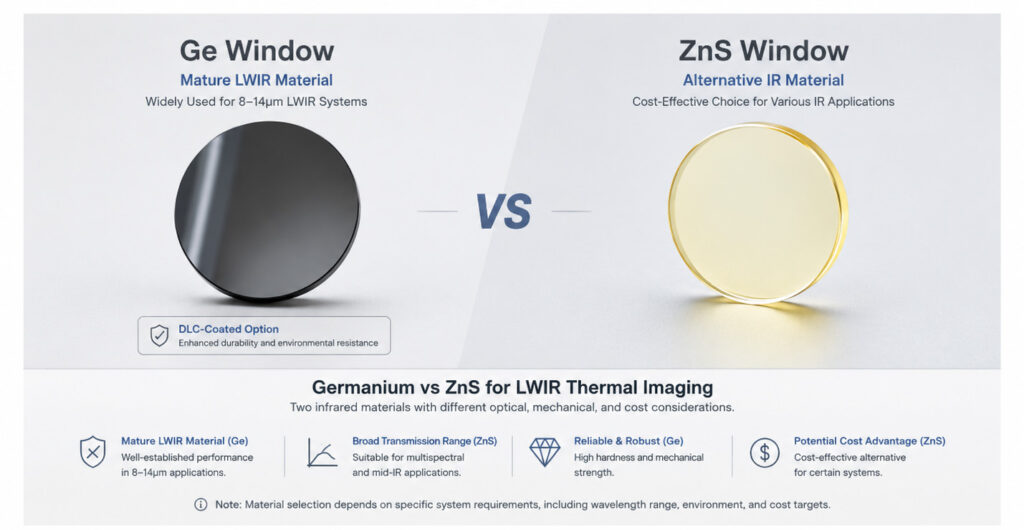
Germanium is still one of the most widely used infrared optical materials for 8–14μm applications. However, due to rising material costs, longer lead times, and export-related supply concerns in recent years, many buyers have started considering alternative materials such as ZnS, silicon, and chalcogenide glass.
Different infrared systems have different requirements for transmission, durability, hardness, and cost. Therefore, selecting the right infrared material has become increasingly important for thermal imaging applications.
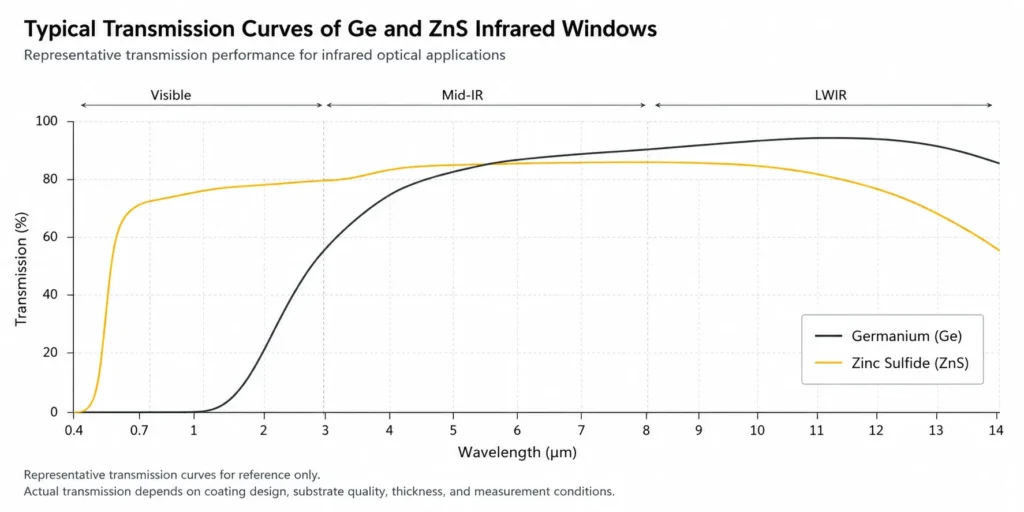
The curve above shows the typical transmission behavior of Ge and ZnS materials across visible, mid-infrared, and LWIR wavelength ranges.
Ge is mainly used for LWIR applications, while ZnS offers broader multispectral transmission and may be considered as an alternative material depending on the system design.
Why Germanium Is Still Widely Used
Germanium remains a popular material for LWIR thermal imaging optics because of its excellent transmission in the 8–14μm wavelength range and its mature optical design ecosystem.
Many thermal imaging systems have been designed around germanium optics for years, making it a familiar and reliable option for infrared engineers and optical designers.
Why Customers Are Considering ZnS
In recent years, more customers have started evaluating ZnS as an alternative infrared material.
Compared with germanium, ZnS can offer lower material cost and broader transmission performance for some infrared applications. Some customers also prefer ZnS because it supports multispectral applications more easily.
However, ZnS is generally softer than germanium, which means surface durability and coating protection become more important.
DLC Coating for Better Durability
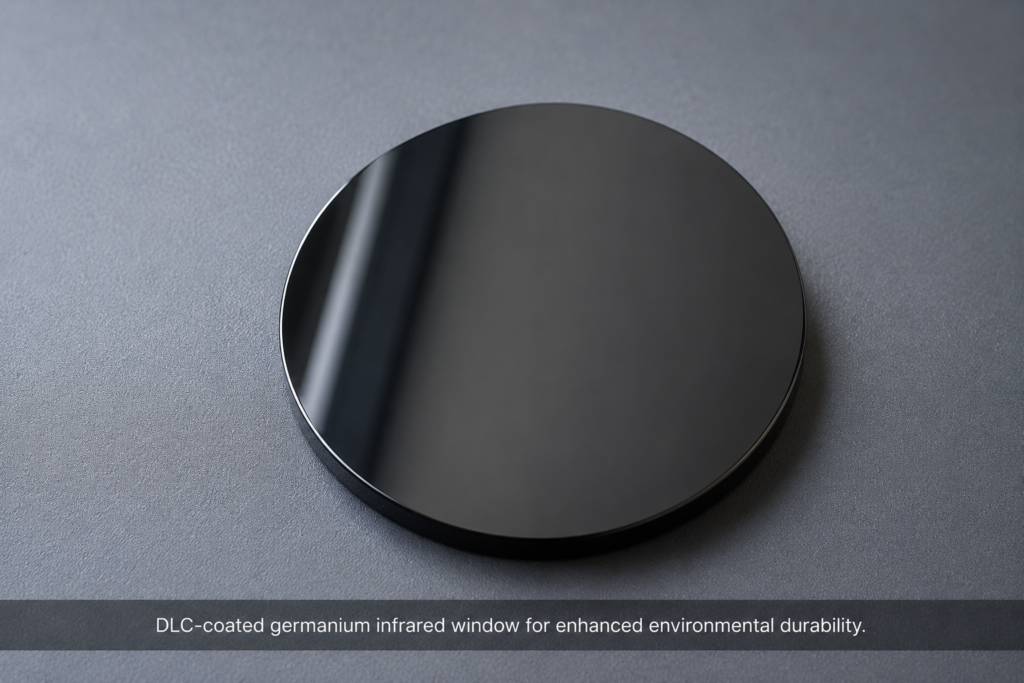
For outdoor or harsh-environment infrared applications, DLC coating is commonly considered to improve durability and scratch resistance.
Some infrared windows use double-side AR coating, while others use one side AR coating and one side DLC coating to achieve better environmental resistance.
DLC coatings are especially useful for ZnS infrared windows because ZnS surfaces are relatively softer compared with some other infrared materials.
Other Alternatives Such as Chalcogenide Glass
Besides ZnS and silicon, some infrared optics companies are also evaluating chalcogenide glass materials for future infrared systems.
These materials are attracting attention because of their lower cost potential and suitability for molded infrared optics in some applications.
Final Thoughts
At present, germanium is still widely used in many LWIR thermal imaging systems. However, alternative infrared materials such as ZnS, silicon, and chalcogenide glass are becoming increasingly important in the infrared optics industry.
Material selection depends on optical performance requirements, environmental conditions, coating design, durability expectations, and overall system cost.